
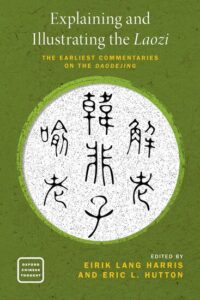
 Although the ancient Chinese text Laozi–also known as the Daodejing–is highly popular worldwide, few Anglophone readers are familiar with the history of how the Chinese themselves have interpreted it. This volume aims to introduce students and general readers to the two earliest surviving commentaries on the Laozi, through translations that are approachable for non-specialists and can be read on their own. These two commentaries, the “Jie Lao” (Explaining the Laozi) and “Yu Lao” (Illustrating the Laozi), appear as two chapters in the book Han Feizi, traditionally dated to the 3rd century BCE. They are interesting not only for showing how at least one very early reader understood the Laozi, but also for what they may reveal about the state of the Laozi itself at that time, before it achieved the form of the text that is so famous nowadays. The book also includes original essays that explore the commentaries’ relation to the rest of the Han Feizi, compare and contrast them with other Laozi commentaries, and analyze their place in the larger history of Chinese commentarial writing. The table of contents is below the fold.
Author Archives: Justin Tiwald
Episode 38 of “This Is the Way”: Xunzi on Human Nature and Human Artifice
Xunzi is famous for the claim that “human nature is bad.” But what does he mean by this, and if goodness does not come naturally to us, where does it come from?
In this episode, we discuss Xunzi’s distinction between nature (xing 性) and deliberate effort (wei 偽), his disagreement with Mencius, and his view that moral goodness must be “learned” and “worked at.” We also ask how sharp the distinction between the natural and the artificial really is, and consider Xunzi’s comparison of moral cultivation to crafts like pottery and woodworking. If we are shaped through deliberate effort, are we both the material being shaped and the ones doing the shaping? Continue reading →
Episode 37 of “This Is the Way”: Confucius as a Ritual Prodigy
In this episode, we are joined by Mark Csikszentmihalyi, Professor of East Asian Languages and Cultures and Eliaser Chair of International Studies at the University of California, Berkeley, and a leading scholar of early Chinese thought. Our conversation draws on his new book, Confucius: A New Tradition (Reaktion Books, 2026), and its striking portrayal of Confucius as a “ritual prodigy.” Through several passages from Book 10 of the Analects, we explore what ritual expertise involves, whether moral and practical wisdom can be innate, and how seemingly minor details of dress and conduct express or instantiate important social and ethical values. We also discuss Confucius’s participation in an exorcism ritual, changing interpretations of ghosts and spirits, and the famous story of Confucius’s reaction to the burning of his horse stables. Along the way, we consider how successive biographies and commentaries have continually reconstructed Confucius to address new philosophical and historical concerns. Continue reading →
Episode 36 of “This Is the Way”: Zhuangzi’s Happy Fish Debate
In this episode, we take up one of the most puzzling and fascinating passages in the Zhuangzi: the “happy fish debate” between Zhuangzi and Huizi. Can Zhuangzi really know that the fish are happy if he is not a fish? Along the way, we explore skepticism, language, animal minds, and the ordinary but surprisingly sophisticated ways we recognize joy in other living things. Continue reading →
Episode 35 of “This Is the Way”: Confucius on Moral Examples
Confucian philosophers often suggest that having good and bad examples plays a critical role in moral education and motivation. How do good examples figure into our ethical education, and how do bad examples help us discover vices or shortcomings in our selves? In this episode, we discuss this wide-ranging issue in connection with the Analects of Confucius, beginning with Confucius’s famous remark that he can find a teacher in just about any social setting (even when out walking with at least two other people chosen at random). Continue reading →
Episode 34 of “This Is the Way”: Deference and Autonomy in Confucian Ethics
Many of us value autonomy in decision-making: we want to make our own choices and think for ourselves. But we also know that in many areas of life, it is well advised to have greater faith in people who know more than we do, in experts such as doctors, scientists, plumbers, chess coaches, teachers, and maybe even philosophers.
In this episode of This Is the Way, we explore moral autonomy and moral deference in Confucian philosophy, focusing on Xunzi’s powerful defense of trusting tradition, ritual, and moral experts. We also explore some powerful objections to Xunzi by later Confucians who worried that too much deference to external sources might make real moral understanding — and thus real moral virtue — impossible. Continue reading →
Episode 33 of “This Is the Way”: Carrots, Sticks, and Rituals
What’s the best way to fight corruption: harsh laws and fear of punishment, or rituals and moral transformation? In this episode we discuss a deep disagreement that takes its inspiration from the political philosophies of the Confucian philosopher Xunzi and the Legalist philosopher Han Feizi. We are also happily joined by Professor Daniel Bell of the University of Hong Kong, one of the world’s leading experts in Chinese political thought. Bell reimagines the views of Xunzi and Han Feizi in his book Why Ancient Chinese Political Thought Matters: Four Dialogues on Chinese Past, Present, and Future. There he stages he stages the debate as a dialogue between a modern-day Professor Xun and his student Han Fei, set against the backdrop of the recent anti-corruption campaign in the People’s Republic of China. The conversation ranges from the psychology of rewards and punishments to meritocracy, institutional design, the question of whether good governance can ever be decoupled from good character, and whether Confucians might be the true realists after all. Continue reading →
Episode 32 of “This Is the Way”: Music Has in It neither Grief nor Joy
When you hear sad music and feel some sadness in response, is that because the music has successfully carried the sadness of the musician to you as the listener? Or is it better to say that the sadness is in you, released by the music but not “carried” by it? In this show (our second with a live audience), we discuss the music theory of the third-century philosopher Ji Kang 嵆康 (223–262 CE), who argued against the “carrier” view of music and for a more complicated and pluralistic account of the emotional contents of music. We also discuss Ji Kang’s interpretation of a famously evocative and mysterious passage in the Zhuangzi, regarding the “piping of Heaven.” To guide us in discussing these issues, we lean heavily on our guest, Meilin Chinn of Santa Clara University, a leading expert on the philosophy of music in China. Continue reading →
Episode 31 of “This Is the Way”: The Great Music Debate — Mohists vs. Classical Confucians
Is music an extravagance in a world of scarcity or a necessary expression of our humanity? We explore Mozi’s consequentialist condemnation of elaborate musical performances and Xunzi’s argument that music, proper guided, plays a critical role in taming unruly emotions and building social bonds. Beneath the disagreement lies a profound clash over basic human goods, how emotion should be shaped, and whether the arts are dispensable or essential to human flourishing. Continue reading →
Live audience recording of “This Is the Way” in Santa Clara: February 12, 2026
 Richard Kim and Justin Tiwald will be recording another podcast episode with a live audience on the evening of February 12, 2026, on the campus of Santa Clara University (SCU) in California, USA. Their guest will be SCU’s Meilin Chinn, and the topic will be the philosophy of music in the thought of Ji Kang 嵇康 (a.k.a. Xi Kang, 224-263 CE).
Here are the event details: Continue reading →
