
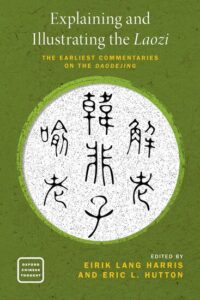
 Although the ancient Chinese text Laozi–also known as the Daodejing–is highly popular worldwide, few Anglophone readers are familiar with the history of how the Chinese themselves have interpreted it. This volume aims to introduce students and general readers to the two earliest surviving commentaries on the Laozi, through translations that are approachable for non-specialists and can be read on their own. These two commentaries, the “Jie Lao” (Explaining the Laozi) and “Yu Lao” (Illustrating the Laozi), appear as two chapters in the book Han Feizi, traditionally dated to the 3rd century BCE. They are interesting not only for showing how at least one very early reader understood the Laozi, but also for what they may reveal about the state of the Laozi itself at that time, before it achieved the form of the text that is so famous nowadays. The book also includes original essays that explore the commentaries’ relation to the rest of the Han Feizi, compare and contrast them with other Laozi commentaries, and analyze their place in the larger history of Chinese commentarial writing. The table of contents is below the fold.
Category Archives: Daodejing
Documentary on Laozi
The documentary, Wisdom of China: Laozi, is now available on YouTube. This documentary discusses the historical evidence regarding Laozi and the meaning of the Daodejing, but also looks at the immense influence of Laozi’s ideas on topics as diverse as green energy, modern physics, politics, the martial arts, music, and the counter-culture movement of the 1960s and 1970s. The diverse figures discussed include Confucius, Abraham Lincoln, Bruce Lee, Ursula K. Le Guinn, The Beatles, and Nobel Laureate in physics Niels Bohr. Among the scholars interviewed are Feng Cao (Chinese People’s University), Xia Chen (Chinese Academy of Social Sciences), Guying Cheng (Peking University), Alexus McLeod (Indiana University), Michael Puett (Harvard University), Misha Tadd (Nankai University), and Lihua Yang (Peking University).
Episode 25 of “This Is the Way”: Daoist Utopia
In this episode, we delve into Chapter 80 of the Daodejing, one of the most vivid portraits of Daoist social ideals. We unpack its vision of a “simple agrarian utopia,” where people live in small communities, ignore labor-saving tools, and resist the endless chase for more. Along the way, we discuss political minimalism, technological restraint, contentment in daily life, and radical localism, asking what it would mean to be satisfied even while knowing other or “better” possibilities exist. We reflect on our own consumerist culture, and probe whether Daoist utopia is naive, radical, or unexpectedly wise for our time. Continue reading →
Workshop: Philosophy of the Daodejing in Chinese Scholarship
Editorial Planning Workshop: Philosophy of the Daodejing in Chinese Scholarship
Workshop Organisations: Department of Philosophy, Tsinghua University, and Tsinghua Academy of Chinese Learning
Workshop Organisers: Ai Yuan (Tsinghua University), Daniel Sarafinas (East China Normal University), Daniel Sarafinas (East China Normal University) and Xiao Ouyang (Beijing University)
Date: 29th May, 2025
Time: 10:00am to 5:00 pm
Location: Room 227, Humanities Building, Tsinghua University
About the Workshop:
Episode 11 of “This Is the Way”: Nonaction in the Daodejing
The concept of wuwei 無為/无为, often translated as nonaction or effortless action, is central to classical Chinese philosophy. But what exactly is the idea and what are its practical implications? What puzzles does it raise regarding the nature of human actions, purpose, and intention? We examine these questions by focusing on some central passages from the Daodejing.
Continue reading →
New Book: The Daodejing Commentary of Cheng Xuanying
This is now the third translation in the Oxford Chinese Thought book series, which is devoted to providing high-quality translations of important philosophical and religious texts, for scholars and for classroom use. A short description follows below the fold.
Call for Papers for Midwest Conference on Chinese Thought (Virtual)
16th Annual Midwest Conference on Chinese Thought
Wright State University
30 April-1 May 2021
The Midwest Conference on Chinese Thought was created to foster dialogue and interaction between scholars and students working on Chinese thought across different disciplines and through a variety of approaches. Submissions are invited for papers on any aspect of Chinese thought as well as papers dealing with comparative issues that engage Chinese perspectives.
This year’s conference will be held virtually on Friday, April 30 and Saturday, May 1 and hosted by Wright State University. Our keynote speaker will be Robin R. Wang, Professor of Philosophy at Loyola Marymount University.
Professor Wang will present “Dao of Rou 柔 (Suppleness): Proprioceptive Knowledge and Its Epistemological Value in Early Daoism”:
Through Chinese intellectual history, early Daoism, a Dao-based and inspired teaching and practice, has been considered the philosophy of rou 柔 (suppleness, pliant, yielding, softness), which the Daodejing couples with water, the infant, and the feminine. A popular Chinese binary expression of culture, gen 根 (root/foundation) and hun 魂 (soul/spirit), takes Dao as the root of Daoist teaching and rou as a spirit of Lao-Zhuang. However, rou has often been understood only as de (德) moral virtue or shu (术) strategy, something more practical than conceptual. This talk will respond to this theoretical gap and argue for rou as a form of proprioceptive awareness or bodily knowledge that shapes a cognitive style and an epistemological stance to guide our rational effort, illumination, and well-being. More importantly, this rou style of knowing embodies the epistemic value, such as intellectual humility, openness, receptivity and resilience, for a cognitive success.
Similar to previous conferences, we anticipate selecting 12-16 papers for presentation. For consideration submit a 1-page abstract to Judson Murray at judson.murray@wright.edu by January 31, 2021 for blind review. For more information, visit the conference website here.
Barnwell on Classical Daoism’s Amoral Ethos
Scott Barnwell has recently added a new chapter to his series of essays on classical Daoism, called Classical Daoism’s Amoral Ethos. On the site he explains that this is the first in a three-part series exploring early Daoist ethics.
Priest on DDJ and MMK at CUHK
Graham Priest will be speaking at CUHK on June 5 and 14; details here.
BNU Summer Philosophy program on Daoism
An announcement from Thomas Michael:
Beijing Normal University is again offering its Summer Philosophy program; this year, it is on the theme of Daoism. The program runs from July 10 to July 25, 2017, and the deadline for submitting application materials is April 23rd, 2017. Please see here for the brochure, here for the Facebook link and application, and read on for more information.
