
For a state to be well governed, it seems like it needs both good institutional rules and also good people to run things. But is one of these factors more fundamental or important than the other? Confucian political thought is widely associated with the view that what’s most critical for good governance is to have people of good character in charge — people who possess sound judgment and genuinely care about those they govern. This longstanding feature of Confucian politics is traceable to a highly influential essay attributed to the Confucian philosopher Xunzi (3rd century BCE), who argued that “people” and not “institutional rules” are the proper sources of good order. In this episode, we explore Xunzi’s defence of virtue in politics, his multiple disagreements with the more institutionalist political thinkers known as Legalists, and the significance of his views for later times. Continue reading →
Category Archives: Legalism
New Book: Explaining and Illustrating the Laozi (the Han Feizi Commentary)
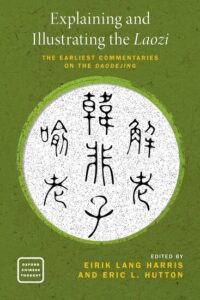 Although the ancient Chinese text Laozi–also known as the Daodejing–is highly popular worldwide, few Anglophone readers are familiar with the history of how the Chinese themselves have interpreted it. This volume aims to introduce students and general readers to the two earliest surviving commentaries on the Laozi, through translations that are approachable for non-specialists and can be read on their own. These two commentaries, the “Jie Lao” (Explaining the Laozi) and “Yu Lao” (Illustrating the Laozi), appear as two chapters in the book Han Feizi, traditionally dated to the 3rd century BCE. They are interesting not only for showing how at least one very early reader understood the Laozi, but also for what they may reveal about the state of the Laozi itself at that time, before it achieved the form of the text that is so famous nowadays. The book also includes original essays that explore the commentaries’ relation to the rest of the Han Feizi, compare and contrast them with other Laozi commentaries, and analyze their place in the larger history of Chinese commentarial writing. The table of contents is below the fold.
Episode 33 of “This Is the Way”: Carrots, Sticks, and Rituals
What’s the best way to fight corruption: harsh laws and fear of punishment, or rituals and moral transformation? In this episode we discuss a deep disagreement that takes its inspiration from the political philosophies of the Confucian philosopher Xunzi and the Legalist philosopher Han Feizi. We are also happily joined by Professor Daniel Bell of the University of Hong Kong, one of the world’s leading experts in Chinese political thought. Bell reimagines the views of Xunzi and Han Feizi in his book Why Ancient Chinese Political Thought Matters: Four Dialogues on Chinese Past, Present, and Future. There he stages he stages the debate as a dialogue between a modern-day Professor Xun and his student Han Fei, set against the backdrop of the recent anti-corruption campaign in the People’s Republic of China. The conversation ranges from the psychology of rewards and punishments to meritocracy, institutional design, the question of whether good governance can ever be decoupled from good character, and whether Confucians might be the true realists after all. Continue reading →
Episode 29 of “This Is the Way”: Shen Dao on Law
Early in Chinese history, a number of political thinkers developed sophisticated arguments for relying on consistent application of laws rather than the personal discretion of political authorities to govern the state. In this episode, we explore the arguments of one of the early pioneers of this way of thinking, Shen Dao 慎到 (c. 350-275 BCE). We are joined by a leading expert on Shen Dao and Chinese Legalism, Eirik Lang Harris. Continue reading →
New Book: Berger, Introducing Chinese Philosophy
Douglas L. Berger, Introducing Chinese Philosophy: From the Warring States to the 21st Century has been recently published through Routledge. The book presents an introductory survey of the major themes, thinkers and texts, philosophical genres and profound insights of the Chinese philosophical tradition. Its coverage ranges from the foundational history of Chinese thought in the 6th–5th centuries BCE up to the present day.
To access the book for further reading, please visit this site.
New book: Jiaohua: Chinese Ideas and Practices of Moral Transformation
Jiaohua: Chinese Ideas and Practices of Moral Transformation, edited by Yingjie Guo, has been published recently by Springer. Please see here for access of the book. Read more for publisher’s summary.
Episode 6 of “This Is the Way”: Partiality and Justice
Episode 6 of This Is the Way is on Tao Jiang’s book. We don’t cover every one of the fascinating issues raised in the 516 pages of Professor Jiang’s volume, but we do cover some of the core topics, including (1) tensions between impartialist justice and partialist humaneness, and (2) Zhuangzi and freedom. A short description follows, with the usual supporting materials. Continue reading →
Three “Collaborative Learning” (四海為學) Seminars in March/April
Reading Sunzi Bingfa
In the history of Chinese thought the Sunzi Bingfa plays many different roles. It has influenced ways of thinking about politics and warfare, but also efficacy in many arenas, and even environmental issues. The Sunzi Bingfa is also written in a way that provides a great introduction to reading classical Chinese, making it a useful text for students to read for many different reasons. In this course we will do a close reading of the Sunzi Bingfa.
Led by: Dimitra Amarantidou, University of Macau, and Paul J. D’Ambrosio, East China Normal University
This course meets from 6:00-8:30pm Beijing time, March 5, 12, 19, 26, April 2, 30, May 7, 14, 21.
Skype link: https://join.skype.com/IvuqyZhnUKjC
Concrete Humanism: Major Confucian Texts and Thinkers
CEACOP seminar: Pines on Book of Lord Shang
Yuri Pines, a renowned historian of ancient China, will give a talk on the Book of Lord Shang, one of the quintessential “Legalist” texts from ancient China. The seminar will be held virtually at 4pm (HKT). Please use the link for the event poster, as well as to contact Dr. David Chung for the Zoom information.
Book of Interest: The Book of Lord Shang Edited and Translated by Yuri Pines
Shang, Yang (2019). The Book of Lord Shang: Apologetics of State Power in Early China (Yuri Pines, Trans.). New York: Columbia University Press. ISBN: 9780231179898.
For more information, please see the publisher website.
