Category Archives: Chinese philosophy – 中國哲學 – 中国哲学

Resuming Duties

I’m officially back in Fearless Leader mode. I’d like to thank Dan Robins very much for guest blogging. We’ll have Dan back in the future, I’m sure (not that he’s going away; I’m sure he’ll be very active in commenting). I’ll be starting some posts composed by my Phil. 245 (‘Confucianism’) students in the next few days. Meanwhile, I thought it would be fun to discuss “portable tradition,” a phrase Robert Neville uses to describe “Boston Confucianism.” The idea of Boston Confucianism was used initially tongue-in-cheek by Neville to refer to the New Confucian movement, in which he included Tu Wei-ming and himself, both of whom teach in Boston–one north of the Charles River (at Harvard) and one south (at BU).

The portability of Confucian tradition is based on the idea that there is nothing necessarily parochial, geographically speaking, about Confucianism–one need not be culturally Chinese or Sino-centered for the tradition to have some intellectual hold or appeal. You don’t have to be Greek, likewise, to be a Platonist. At this level of generality, it all sounds fine, if not innocuous. There is, however, the lingering question of portability not so much across geography (narrowly construed), but across time: is Confucianism portable into modernity and post-modernity?

At least one indirect criticism of portable Confucianism was provided by Bryan van Norden in his 2003 review (PEW 53:3) of Neville’s book, Boston Confucianism (Albany, NY: State University of New York Press, 2000). I’m going to cut and paste (an image of) van Norden’s most critical comments, because I think he’s actually on to something, despite seeming only to be snarky (sorry about png quality–I’m too lazy to type all this out):
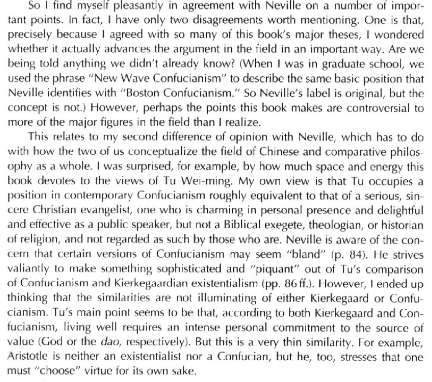
I have to admit, when I read *non-exegetical* pieces by Tu, there is something bland about his discussions–actually, they tend to strike me alternatively as bland or pragmatically undecipherable (What am I supposed to do with the fact of the dependency of human relations on larger patterns of connections to the cosmos as a whole? Study astronomy? Then what?) Is there something striking or captivating about what either Neville or Tu promote in their versions of Confucianism? Admittedly, I haven’t read enough of their works to be an expert; so let me know.

(Did I mention I was fearless?)

Lots and Lots of Dào

There’s a way of reading Dàoist philosophy according to which there is one great dào, and the Dàoist aim is to achieve some kind of relation to that one dào, presumably some kind of union.

As I understand it, this sort of reading implies that once you’ve achieved union with the dào, this will carry you through life no matter what it brings you. And this, I think, sits poorly with much of what we read in Dàoist texts. Verse 1 of the Dàodéjīng in particular is suspicious of the very idea of a single, constant dào; and the Zhuāngzǐ often seems to value a recognition of what is particular to the various situations we face.

So I suggest (I’m largely following Chad Hansen on this) that it would be better to think of dào as differing in different situations, and in ways that are largely unpredictable. Dào is thus not a single thing that one could relate to, or achieve union with, as a whole; no union we could achieve with dào now would carry us through the unpredictably various situations we are liable to face in the future.

(One could put my suggestion by saying that there are different dàos in different situations, but I prefer to follow the classical Chinese, in which “dào” is normally a mass noun.)

This implies that the Dàoist aim cannot be to achieve once and for all a union with the one great dào, it must instead be to maintain an openness to the different dào in different situations—just as, for example, the monkey keeper in Book 2 of the Zhuāngzǐ is open to the dào of his monkeys (in particular, to their preference for having their bigger meal in the morning). This is how I understand the value frequently placed in Dàoist texts on flexibility; I take it to be at the heart of the ideas of míng 明 (illumination) and of the pivot of dào in Zhuāngzǐ 2.

Should this openness itself be conceived of as a dào? This may be an issue over which Dàoists disagreed. The butcher in Zhuāngzǐ 3 loves dào because it takes him beyond skill—that is, beyond any dào he has previously mastered, so he can deal with the situation before him. But the swimmer in Zhuāngzǐ 19 denies that he has his own dào, saying he swims instead according to the dào of the water.

If we take openness to the different dào in different situations to be a dào, then it is a short step to thinking about this as the same as the dào according to which phenomena arise in nature. Perhaps it is in this sense that the texts sometimes tell us that dào is prior to heaven and earth.

Xúnzǐ on Desire

Next week I’ll be taking part in a roundtable discussion at the Pacific APA with Kurtis Hagen, Eric Hutton, and Aaron Stalnaker, and we’ll be talking about what Xúnzǐ had to say about desire. I thought I’d post here some of the thoughts I’ll be presenting there.

The question I want to raise (and I hope it is a provocative question) is whether Xúnzǐ thought of desire as a kind of motivation.

Here’s the argument that he did not. In “Correct Names” (but not the part of that piān that’s actually about naming) he argues against the view that social order requires eliminating or reducing desires. He claims that how we act depends not on what we desire (yù 欲) but on what we approve of (kě 可). He writes, “Desire does not wait for what we can get, but seeking (qiú 求) follows what we approve of (欲不待可得,而求 者從所可).” His main piece of evidence for this is that we have a deep desire for life, but are still able to choose death when we do not approve of the course of action that would be necessary to preserve our lives.

Now, when Xúnzǐ talks about desire, he focuses on desires for sensory gratification and for social acclaim. He rarely implies that the attitudes we might call moral desires are actually desires; these attitudes would, according to the passage in “Correct Names,” count as approvals rather than as desires.

Part of what’s going on here is that Xúnzǐ treats desires as constants of human nature: they arise spontaneously from xìng 性 regardless of what we do and regardless of how virtuous we are. Thus, moral excellence requires us to transform not our desires but the way we act on those desires (the behaviour that he calls seeking). His conception of desire, then, is rooted in his conception of nature more generally: just as nature provides a constant context to which human societies must respond, our desires provide a constant context that we must respond to when we act. But it is approval, not desire, that determines how we respond.

How does this constitute an argument that desire is not, for Xúnzǐ, a form of motivation? Two things. First, he seems to be saying that it is approval, not desire, that gives us our ends or goals. For example, in choosing death, one does not choose an end that has any basis in desire. Second, he sees no conflict between desire and approval. It is not as if there is a struggle between them that approval consistently wins—so his contrast of desire and approval is not at all like the traditional western contrast of reason and passion, which constitute two competing sources of motivation. His view is just that approval is the sort of attitude with which we adopt an end, and desire is not. And this to me suggests that he is not thinking of desire as a form of motivation.

This isn’t a knock-down argument; the concept of motivation may well be too vague to support a knock-down argument. Still, it impresses me that there’s a genuine question here.

Some Modes of Subjection

I want to take up a suggestion I made in the previous thread (here).

In the second volume of his History of Sexuality, Michel Foucault introduced a way of thinking about ethics that might be helpful in thinking about early Chinese ideas. He set aside questions about the content of the ethical code in question (for us, that would be a dào), and asks instead about the ways in which individuals are expected or invited to become ethical subjects.

Foucault’s analysis picks out as especially important the ethical substance (that in us which must be worked on in order to make us ethical subjects), modes of subjection (ways in which we conceive of ourselves in relation to the ethical code), the ethical work (practices of self-cultivation), and a teleology (the sort of being that one aims to become; the gentleman, the benevolent person, or the sage, perhaps).

My suggestion in the last thread was that appeals to human nature in the Mencius might be best thought of as implying a mode of subjection, and not, for example, an argument in favour of a Mencian dào. The idea is that Mencian ethics invites us to think of the dào as natural for us. (How exactly this gets spelled out differs from passage to passage; one important version is that goodness is in some sense already within us, and we just have to release it, a process that does not require force.) Reading the Mencius this way puts appeals to human nature in the context of an account of the psychology of virtue.

One question I have about modes of subjection in early Chinese thought concerns the extent to which they address individuals as individuals. The Mencius seems to do this. So perhaps does the Analects; a while back Patrick referenced an excellent paper by Herbert Fingarette that is easily read as implying that the Analects offers a mode of subjection that addresses individuals as individuals, in order to bring them into relation to a dào that gives no weight to individuality. (Patrick’s reference is here.)

We find something quite different in the Mòzǐ and, I think, in the Xúnzǐ. The Mohists ask us to see ourselves first and foremost as members of a social order (this is clearest in their arguments in favour of conforming upwards and caring inclusively). Xúnzǐ adds to this, for example he adds the idea that the social order is a response to a constant and non-purposive natural context, but like the Mohists he implies an ethical self-understanding that relates us to the dào as members of a social order, not as individuals.

(I wonder—do we have here the beginnings of an explanation of why scholars whose own assumptions about ethics are individualist tend to prefer the Analects and the Mencius over the Mòzǐ and the Xúnzǐ?)

Does this seem like a useful way to set up questions about early Chinese ethics? What other questions and answers does it suggest? I’m particularly interested in what if anything it might lead us to say about the Zhuāngzǐ. (My first ever paper in Chinese philosophy was an attempt to talk about Zhuāngzǐ in something like these terms.)

Normative Theory in the Mencius

Let’s say a normative theory is a theory intended to set out whatever it is that grounds correct norms.

The Mohists had a normative theory that grounded norms on what they called benefit (lì 利). (Or they had a normative theory that based norms on the will of tiān 天, if you read them that way; but you shouldn’t.) As Chris Fraser said a couple of threads back (in this comment), this may actually have been the world’s first explicit normative theory.

It’s often implied that Mencius also had a normative theory, one that grounded norms in facts about human nature, and that’s the issue I want to raise. My view is that the Mencius never argues from claims about human nature to normative conclusions, so there’s no reason to think that its author or authors would have endorsed such a normative theory.

What we find in what may be the most famous invocations of inner goodness in the Mencius is a concern with ability. The discussion of the child by the well is about how people are capable of rén 仁 (the announced topic is the ability of rulers to be rén, but the passage invites generalisation). The discussion about King Xuān and the ox tries to show that the king has what it takes to be a virtuous king. Both passages take their normative claims for granted; there is no hint of a normative theory in either.

Elsewhere in the Mencius, we do find normative arguments, such as in the extended argument against the followers of Shén Nóng, the God of Agriculture, but there’s rarely if ever any attempt to set out a general basis for these arguments, and none of the arguments appeal to human nature.

The one tricky passage is the argument against the Mohist Yí Zhī about funerals and inclusive care. It’s often read as saying that our natural love for our parents rules out inclusive care and demands lavish funerals. But when this passage objects that Mohists are two-rooted, it means that the Mohists embraced both particularist and universalist attitudes, both love and inclusive care. (The Mohists didn’t write about love, but they did place a great deal of emphasis on, for example, filial piety.) This is best read as a complaint about Mohist psychology, which does not treat universalist attitudes (which the Mencius also advocates) as extensions of particularist ones, a point on which the Mencius follows Yǒuzǐ (hi, Bill); this is not a normative argument. And the passage does not even pretend to make a case against moderation in funerals—the funerals it describes approvingly are far more moderate than anything the Mohists advocated.

As far as I can tell, the closest the Mencius comes to embracing a normative theory is in Book 1, in which benevolent government may get grounded in the well-being of the people and in the figure of the virtuous king; and the only connection to human nature here is in the assumption that the people will respond with approval to a king who ensures their well-being.

Well, that’s how I see it, anyway. Thoughts?

Introducing Chinese Philosophy in Phil 101

I want to take up an issue that Bill raised in the last thread (China’s First Philosophers?, comment #18): integrating Chinese philosophy into introductory courses in philosophy. Have folks taught or taken courses that try to do this? Or tried to imagine such a course? What works and what doesn’t? What challenges are there? Are they any different from the challenges involved in integrating a variety of western texts into a single introductory course?

The one such course I’m most familiar with is a comparative introduction to philosophy that Chad Hansen teaches at the University of Hong Kong. (I was a tutor on the course a few times when I was a grad student.) One thing that helps make this course work is that (as those who know Chad’s scholarship might expect) a significant theme of the course is the ways in which the two traditions differ—so some of the issues that might otherwise make it hard to treat Chinese and western texts side-by-side get dealt with front and center. (Of course you might not consider that an advantage if you think Chad’s all wrong about the ways in which the traditions differ.)

What other approaches might work? Bill’s suggestion was that the Mohists might fit well in a course that also touches on utilitarianism. And I know there are a few regulars here who’ve included Chinese texts in courses on virtue ethics (though mostly at a more advanced level, I think). So there are ways of linking up materials from the different traditions thematically.

I guess my own main worry (and now that I’m putting it in writing it seems like a pretty dumb one) has been that getting at some of the ideas I’d want to cover if I were teaching Chinese texts requires a degree of contextualisation and interpretive work that wouldn’t suit an introductory course that isn’t specifically devoted to Chinese thought. (One reason for thinking this is dumb: maybe this would be a good way to teach skills in close reading. And of course the interpretive issues I’m thinking of don’t arise only with ancient Chinese texts.)

Well, those are my (rather scattered) thoughts. What do you think an introductory course that incorporates both Chinese and western materials might look like? (Or does anyone think this would be a bad idea?)

China's First Philosophers?

I’m interested in the question of whether the Mohists were China’s first philosophers—both in what the question means, and in the answers that it might invite.

There’s a good case to be made that in at least one important sense, they were the first.

It’s widely agreed that the Mohists were the first to engage in sustained philosophical argument, and (this may be more controversial) the first to attempt to articulate the normative foundations of their dào.

There’s also good reason to think that it was the Mohists who first provoked other early Chinese thinkers to provide their dào with philosophical justifications. With few exceptions, non-Mohist texts that include such justifications are clearly responding to a philosophical context, often with named opponents. But no such context is apparent in most of the writings of the early Mohists, particularly in those texts that seem earliest (such as the shàng books on war and inclusive care): these texts either do not mention ideological rivals at all, or identify them quite generally as the rulers or gentlemen of the world—not as other philosophers. The implication: philosophical argumentation was original only with the Mohists.

So if we conceive of philosophy in such a way that it essentially involves philosophical argumentation, then it is likely not only that the Mohists were China’s first philosophers, but also that it was precisely their arguments that provoked other early Chinese thinkers to take up philosophy: the Mohists were not only the first in chronological terms, they also provoked the rest.

Is this conclusion correct? How significant is it? What other ways of conceiving of philosophy would lead to different conclusions? Does the possibility of conceiving of philosophy in other ways mean that it is a mistake to wonder who did it first?

Accuracy in Historical Interpretation

Just to introduce as a post, continuation of the great discussion in the Footnotes to Confucius… string of comments:

It sounds like there’s a consensus so far on something like this:

Accuracy, as an ideal of interpreting the ancient Chinese texts, either has independent value (Boram’s view) or has value precisely in helping to achieve various aims that we might have in looking to them (enhancing or filling in gaps in ethical understanding; providing training in suspicion; softening the incredulity of our stares toward David Lewis; etc.).

What I want to know is, to the extent that an interpretation of ancient Chinese texts helps to achieve exactly those kinds of aims, does it really matter whether the interpretation is accurate, beyond a certain minimal threshold? So, take a Whiteheadian, process philosophy interpretation of the later Mohists–not that I know of any, but it’s probably on the horizon; *so what* if someone can point out ways that the accuracy of the reading might be suspect? So long as taking that reading gets someone what he or she wants out of engagement with the ancient Chinese texts, why the hand-wringing about accuracy? Or, is there some primary duty of philosophers to aim for textual accuracy–a geekier cousin of the lover of truth ideal? Alternatively, is there a prima facie assumption by people offering interpretations that they themselves actually *are* engaged in the accuracy game (not having taken Nietzsche and Zhuangzi, among others, to heart)?

Do the accuracy police have any general legitimacy, independent of *particular* hermeneutic aims that might (or might not) be served by accuracy?

From a slightly different angle: if assessment of accuracy is likely to be an elusive thing in any case with a particular text–for example, the Daodejing (Tao Te Ching)–who cares whether the interpretation is accurate or not? (Leave my German Enlightenment interpretation of it alone, man!)

Guest Blogger

On Sunday, we’ll welcome my first guest blogger, Dan Robins. Dan is a good friend and will post for a week or two; I’ll still be around, commenting and occasionally posting as well.

Some information: Dan is an Assistant Professor of Philosophy at the Richard Stockton College of New Jersey. He recently replaced the retired, distinguished scholar of Chinese philosophy, Joanne Birdwhistell. Chad Hansen was Dan’s thesis advisor at the University of Hong Kong where Dan received his Ph.D. Among other things, Dan is working on a great, much more accurate and sophisticated reading of Mozi (Mo Tzu) and Mohism than the traditional reading. I also know (first hand) that he’s a lover of good Scotch.

(Not only is Dan a friend, but recently we realized that by “school” lineage, he’s my nephew: Chad Hansen’s Ph.D. thesis advisor was also my advisor, Donald Munro, making Chad my elder brother, so… Okay, that’s all too Confucian for anyone’s tastes, so I’ll stop.)