Category Archives: Chinese philosophy – 中國哲學 – 中国哲学

Ritual Revival in China

Not sure how we missed this story (c/o China Daily). I’d be interested in your comments, or if anyone has/had involvement with the event or organization, please chime in with your perspective on the revival project.

************************************************************************

Scholars call for revival of Chinese ritual

(China.org.cn)

Scholars call for revival of Chinese ritual

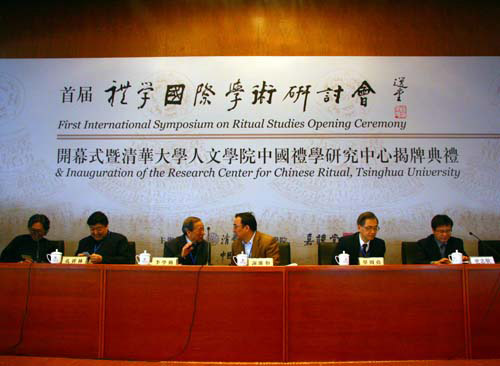
The opening ceremony of the First International Symposium on Ritual Studies at Tsinghua University, Apr. 9, 2012. [Photo/China.org.cn] Continue reading →

Slingerland Wins Dao 2011 Annual Best Essay Award

Dao: A Journal of Comparative Philosophy has an annual best essay award. The award comes with a check of $1,000 and a certificate; the award winning essay will be set for free access; and a special panel will be arranged at APA Eastern Annual Meeting, whether the the check and the certificate will be awarded, together with a critical discussion of the award-winning essay.

At the beginning of each year, a selection committee of three editorial board members of the journal is formed to select three best essays published in the journal in the past year. These three essays are then sent to the whole editorial board for evaluation. The final selection of the best essay is made by a vote of the whole editorial board.

We have just finished this process of selecting the best essay published in our journal in 2011, and Edward Slingerland’s essay, “Metaphor and Meaning in Early China,” published in Dao (2011) 10:1–30, wins the award. The article is for free access at:

http://www.springerlink.com/content/tn037270p11644vj/fulltext.pdf

Here is the official citation:

This is a ground-breaking essay. Slingerland debunks a fairly common assumption that Chinese way of thinking is metaphoric, while the Western way of thinking is logical, an assumption shared by both earlier Orientalists, who claimed the superiority of the Occidental, and more recent “reverse Orientialists,” who claim the superiority of the Oriental. In contrast, using his expertise in contemporary cognitive sciences, Slingerland argues convincingly that metaphor is a universal and fundamental feature of human cognition. What makes the Chinese way of thinking unique is thus not that it is metaphoric but that early Chinese thinkers were more self-aware of the metaphoric nature of language, while modern Western thinkers are more self-deluded about what they are doing. The essay as a whole is thus original in its interdisciplinary, comparative, and philosophical natures. It is the type of work that Dao aims to promote.

Australasian Society for Asian and Comparative Philosophy Conference, July 9-11 2012, Sydney, Australia.

ASACP Conference 2012
University of New South Wales, Sydney, Australia
9-11 July 2012

Conference Theme: Relationships in Asian and Comparative Philosophy

Keynote Speaker: Professor Roger Ames, University of Hawai’i

The conference committee invites submissions of proposals for papers in all areas of Asian and Comparative Philosophy especially on the topic of relationships, although there will also be a focus on the following streams:

Ethics, Personhood and Relationships
Ethics, Environment and Development
Knowledge, Action and Fallibility
Methodology in Comparative Philosophy
Comparative East Asian and South Asian Philosophies

Continue reading →

Book News

I’m very happy to announce news about some of my books!

  • The Chinese translation of Human Rights and Chinese Thought: A Cross-Cultural Inquiry has just been published by China Renmin University Press.
  • The paperback edition of Sagehood: The Contemporary Significance of Neo-Confucian Philosophy has also just appeared. Information on this flyer from OUP will give you a 20% discount, if you are interested.
  • Finally, my latest book, Contemporary Confucian Political Philosophy: Toward Progressive Confucianism is due out next month from Polity Press. UPDATE: this flyer from Polity offers a 20% discount, plus a way to request a free exam copy. (Outside the Americas, use this one instead.)

ISCWP Call for Papers for APA Eastern Division Meeting December 27-30, 2012

The International Society for Comparative Studies of Chinese and
Western Philosophy (ISCWP) plans to sponsor one or two panels at this
year’s Eastern Division Meeting of APA (American Philosophical Association),
which will be held on December 27-30, 2012, in Atlanta, USA.
We hereby invite submissions from the members.

Our Goal: We would like to encourage submissions of individual papers
that are comparative, as well as panels which combine philosophers
working primarily in Chinese traditions with those working primarily
in Western traditions, aimed at promoting more in-depth engagement
between the two groups. We have not stipulated any specific themes for
the panels, but would welcome suggestions. One possible topic is
Theory and Practice of Interpretation in the Chinese Commentary Tradition (jinxue 經學).
One of the paper proposals submitted for the Pacific Division meeting is on
“Context and Correct Meaning in Lunyu Zhengyi 論語正義.”

Continue reading →

Some Thoughts on the Difficulty of Being a Confucian Today

In memoriam Chen Cheng-po…

Yesterday we had a day off in Taiwan and I spent a rainy afternoon visiting the 2-28 Memorial Museum in downtown Taipei. I have been there before, but this time it was quite different, especially since I had the chance to look at some new documents. In particular the biography of one person was deeply moving: the Taiwanese painter Chen Cheng-po 陳澄波 (also known as Chin To-Ha). He was born in 1895 in Chia-Yi, studied arts in Tokyo and went on to become a famous painter in Taiwan and the broader Chinese-speaking world (especially oil paintings). After the liberation of Taiwan from the Japanese occupation, he got involved into politics and was elected into the local parliament at Chia-Yi. After the 2-28 Incident, he tried to negotiate between the Guomindang and the local population. However, he was executed without any particular reason in broad daylight on March 25th of 1947.

Continue reading →

Popular Daoism

Mark Saltveit, professional comedian and author, guest-posted last year on comedy and Daoism. Subsequently, he published his thoughts on that topic with MeFiMag (available for download). Mark is back with some questions that he has about popular Daoism, to get some discussion and opinion from members of our forum. He plans to publish an article about this topic as well (note Mark’s comments below about seeking permission to quote or cite from those who comment in this forum). Please address all comments or questions directly to Mark.

********************************************************

Hello.  I’m working on a feature article (for an intelligent general audience) about criticism of popular Daoist authors (particularly Ursula K. Le Guin and Benjamin Hoff) by certain academics of Eastern religion who are centered around the University of San Diego and the Center for Daoist Studies (http://www.daoistcenter.org/homepage.html).

Some of this criticism seems rather polemical, rooted in an anti-Orientalist critique of the concept of Philosophical Daoism as a Western (and arguably Protestant) gloss. (I’m using the term “Culturalists” as shorthand for this group, and positing Michael Saso as its founder.)  Russell Kirkland calls Le Guin a “fraud” and Louis Komjathy won’t even write “Philosophical Daoism” without applying strikethrough to the words to show his disapproval. Kirkland goes so far as to argue that the Daodejing itself distorts Daoism, “sanitized” by its 3rd Century BCE redactor in a “marketing ploy” designed to strip it of “cultural baggage” and make it more presentable to Northern Chinese courts.  Continue reading →

ISCWP Newsletter Volume 10, Issue 1

Greetings!  Many of you will have recently received the latest ISCWP Newsletter.  For those who are not on the ISCWP membership list, you can find out about the the society’s activities and events by following the link above and looking through recent newsletters, which are all available there.

If any readers are not members of the ISCWP and would like to join, please send me a statement including the following contents: your name, academic affiliation (if applicable), research/interest areas, contact information, and your desire to become a member of the ISCWP.

Hagop Sarkissian
Secretary and Treasurer
ISCWP

Robert Bellah’s New Book "Religion in Human Evolution"

Looking back at the year 2011, I think Robert Bellah’s book Religion in Human Evolution: From the Paleolithic to the Axial Age (Harvard University Press, 2011) is arguably the most important book published last year. I hope the word “religion” in the title would not stop readers of this blog, who are interested in Chinese philosophy, from reading it. The book is really about civilization or culture (wen), which includes both religion and philosophy. One could understand the term “religion” in a very broad sense, which seems to be what Habermas does. In his blurb for Bellah’s book, Habermas says, “In the second part of his book, he succeeds in a unique comparison of the origins of the handful of surviving world-religions, including Greek philosophy.” In fact, since many of our readers believe that early Chinese thought is often both religion and philosophy, they might find this book especially stimulating. Continue reading →