Category Archives: Confucius

Flourishing, the Non-moral Good, & Virtue Ethics

Here’s an issue that I think is relevant to any view about “flourishing” attributed to early Chinese philosophy. If the basic idea of flourishing is some idea about faring well, or “welfare,” we can ask what it takes conceptually to have such an idea. What comes to mind for me is that there has to be some notion of a person’s good, where that good is construed in some way independent of acting correctly–i.e. it has to be a notion of a person’s “non-moral” good. Even as I write that, I’m not quite sure what the reason for that is, but it seems important to me to keep welfare distinct from rightness. I might be totally wrong, but my philosophical instincts whisper otherwise.

The reason this seems important to me vis-a-vis early Chinese philosophy is that it seems like the non-moral good is featured in the Mohist idea of benefit, li 利. But li is not taken as theoretically central or even relevant in the Analects and the Mencius. Maybe it is important in the Xunzi, but I think that is because the Xunzi has a consequentialist view like the Mozi. If any of this is on the right track, then there is not in fact any virtue ethics in early China, in the sense that Van Norden and others think there to be. A lot rides on the idea of flourishing as relying on that of the non-moral good, and hence as being construed independently of rightness, so I wonder what can be said in favor of or against that…

Such a deal…

Thanks to Yuri Pines for the link.

(http://www.chinadaily.com.cn/china/2008-06/05/content_6737093.htm)

Parents call on Confucius for exam good fortune

By Cao Li (China Daily)
Updated: 2008-06-05 08:12

The Temple of Confucius in the center of Shanghai’s old town was unusually full Wednesday morning.

Crowds of people, most of them in their 40s and 50s, burned incense, lit candles and prayed in and around Dacheng Hall where there is a sculpture of Confucius and also where national exams were held during the times of the imperial dynasties.

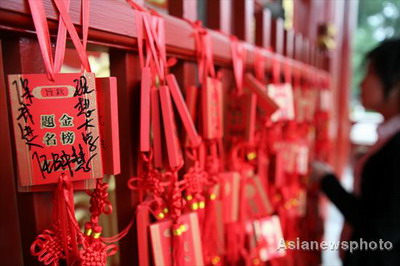
The good luck notes they hung on the trellises and trees outside the hall gave away their reasons for being there. Most read something like, “Dear Confucius, please help my son/daughter in the college entrance exam”.


A visitor hangs a good-luck tablet on a shelf at the Temple of Confucius in Beijing June 3, 2008. [Asianewsphoto]

With the national examinations starting on Saturday, a growing number of parents have turned to Confucius, as a way to ease the pressure.

A cleaner at the temple, surnamed Xu, told China Daily that local people hardly ever visit the temple, but in the past week, hundreds of them had been.

“There are so many visitors coming these days, all the oil and incense burners keep filling up and I have to empty them several times a day,” Xu said.

Visitors pay 12 yuan ($1.75) for a piece of notepaper, incense sticks, two candles and a length of red ribbon.

At the Temple of Confucius in Beijing, visitors have to pay 188 yuan for a wooden tablet on which to write their wishes, although the shelf on which these are then placed is now full, the Beijing Youth Daily reported Wednesday.

One of the visitors at the Shanghai temple Wednesday was 47-year-old Ye Qing. She said she was making a wish for her son who is hoping to study telecommunication engineering at East China Normal University.

“It will work if I am sincere enough,” she said.

About 100,000 Shanghai students will sit the college entrance exam between Saturday and Monday, and their parents are doubtless all hoping for the same good fortune.

Many, like Ye, have booked hotel rooms close to the test venues.

Staff at several hotels in the city’s Minhang district said they have been taking bookings since the beginning of last month, and many are now full, the Xinmin Evening News reported.

Sun Yu, a teacher at the Shanghai Foreign Language School, said parents are prepared to do whatever they can to help their children succeed, including enrolling them in expensive, extracurricular classes.

High school student Vicky Yang said all her classmates spend at least 500 yuan a month on exam-related books and extra lessons.

“Some pay up to 20,000 yuan a semester for classes that promise to help students secure a university place,” she said.

Apart from books and classes, parents also buy their children special tonics to drink, Yang said.

“If you collected up all the empty bottles of tonic my classmates have drunk, you could make a small hill.”

A Series of Footnotes to Confucius, Laozi–or to Me!

Picking up on something very interesting that Justin Tiwald said in the Tu string:

“I don’t think the defenders of Yili learning explicitly embraced the slogan ‘the classics comment on me’ (經注我). Still, there are a number of neo-Confucians who made statements in the neighborhood of this slogan. Lu Xiangshan is known for the shocking assertion that the ‘Six Classics are my footnotes’ (六經皆我註腳).”

We’ve all heard that Whitehead thought western philosophy has been just a long series of footnotes to Plato. It’s easy enough to imagine someone echoing Lu Xiangshan, saying, “Plato’s writings are just a series of footnotes to me.” (Who would that be? I could imagine Russell saying that over a cocktail.)

(Totally unrelated aside: Whitehead also said, and this is my favorite Whitehead quote, “A traveller who has lost his way should not ask ‘Where am I?’ What he really wants to know is, where are the other places?”)

It occurs to me that Lu Xiangshan’s assertion is really just a more strident way of describing “constructive” engagement with Confucianism, where Confucius and others are merely inspirational starting points for some new views, with Confucius providing some quotes and footnotes. Maybe the sort of projects that New Confucians are engaged in would fit this mold; maybe Van Norden’s suggestion for a neo-Mencian virtue ethics; maybe much of the comparative philosophy work that is out there where the author is using the past and trying to make it relevant to the present.

I have to ask, because in most respects, it is what I do for a living (aside from corrupting the youth), is there any independent point or value to investigating history–or more pointedly, Confucius, Laozi, et. al.–as an end in itself? I’m not exactly sure I understand the dictum to “revere the past,” or to “understand the past accurately,” as a worthwhile end in itself (unless, of course, it is on the order of stamp collecting). I used to be qualm-less about that as an endeavor, but I’m starting to have doubts (maybe I’ll have a blog-induced  career crisis). Any thoughts?

Reverence, the Spiritual, and the Sacred in Confucianism

These themes seem to have come up in a few different posts, so I thought we might try to tie together some of the strands. I know it’s asking for a lot, but is there any way to get some clarity on how these concepts operate within the history of Confucianism?

I’m assuming there is some close network of meaning within which each of these can be used to understand each of the others–e.g. “the sacred” is something that calls for reverence; reverence is to be distinguished from a purely socially understood concept of respect because reverence is tied to value of a spiritual sort; and so forth.

[Brief digression: I’m sure many of you know more about Durkheim than I, but it seems like “the sacred” is some sort of indefinable, basic concept on his view; I’ve never found that very helpful (someone correct me, please, if I’m totally misreading Durkheim). I only bring Durkheim up because of Fingarette’s clear use of Durkheim’s template in allowing that “the secular” (as opposed to “the profane”) could be part of the sacred–Fingarette’s book on Confucius is called Confucius: the Secular as Sacred, for those who might not know.]

I think if we look at the instances of jing 敬 in the Analects, Mencius, Liji, and other pre-Buddhist texts, it seems to me like it could easily be translated as “respectfulness” rather than “reverence.” I think the main question, whether it is about translating jing or understanding the junzi’s pursuits as in some sense spiritual, is going to be about what the larger template of analysis is that makes the texts “speak to” spiritual or sacred concerns. I think I can see what that template is for understanding the neo-Confucians in that way: reaction to and partial assimilation of Buddhist concerns that are more clearly driven by soteriological goals. I’m not sure what the template should be for the early Confucians–despite having read Fingarette more than a few times. And I don’t know as much as I should about the New Confucians to understand how they would see themselves addressing issues of reverence, the spiritual, or the sacred.

Well, that’s what I’ll start with. I’m sure I’ll learn a lot from responses to this post.

Confucius: Democracy Advocate?

Picking up on something that Boram Lee very eloquently wrote in the Confucianism and Sexism string:

“… my impression is that at its heart Confucianism is neither autocratic nor authoritarian, as some modern Asian regimes like to claim.

It seems to me that one of the main defining features of Confucianism, at least on its political and economic dimensions, is its commitment to decentralization. Its ideal society is one consisting of small communities, each small community composed of persons governing themselves with ritual. The ideal government is not a centralized bureacracy, but self-government by each over themselves, where no coercion is involved, only voluntary control and participation in social activities, and leadership based on rational and emotional persuasion, not the use of laws and punishments. A centralized bureacracy following paternalistic policies towards uneducated peasants is only a second-best option.”

I think I understand most of the arguments for thinking of Confucianism as compatible with democratic ideals. They are some version of Boram’s point: the Confucian ideal of political community is of each person exercising moral self-scrutiny and self-cultivation; education of others and continuing self-education is an important ideal; persuasion and non-violent moral example are preferred to use of force and harsh legalism; hence, democracy is not far away as an ideal–what else would even seem appropriate for a community of junzi-like citizens but a democracy?

I think that would be great if it were true. And maybe there is some pragmatic value in making democracy seem continuous with a powerful self-conception (i.e. of being “Confucian” in some broad sense) that has traditionally been expressed only in non-democratic ways. But why does this kind of argument seem so strange to me? One thing that comes to mind very quickly is that it makes Confucianism’s ideals sound like those of Kant, or any of the other Enlightenment “autonomists.” The community of junzis sounds something like the “kingdom of ends,” a self-governing lot of moral agents who regard each other with respect for their personhoods.

Could I really complain about that? I’m not sure; but I feel like I should complain–Doesn’t it distort Confucianism? Isn’t it mistaken to think that the junzi ideal really lends itself to self-governance? What’s the connection exactly between self-cultivation and self-governance–doesn’t this rest on some conflation? And why has Confucianism only been used in the service of autocracy so far?

I’m not trying to make trouble here, just trying to scratch this itch.

Lighter Fare II

Thanks, to Yuri Pines from the Warring States Group, for the pointer:

From:

Confucius family tree has two million members

(Xinhua)
Updated: 2008-02-16 22:04

JINAN — He’s been dead for 2,500 years but his family just keeps growing and growing – Confucius, or more properly his descendants, are alive and well and flourishing in China and across the globe, according to the latest version of his family tree which is set to triple the size of his kith and kin.

The job of registering new members to the family tree of revered Chinese thinker and educator Confucius (551-479 BC), was finished by the end of 2007, and the number in the updated tree now stands at more than two million.

The family tree will be published in 2009, according to the Confucius Genealogy Compilation Committee.

“We have received more than 1.3 million new entries and already stopped soliciting new ones,” said Kong Dewei, a Confucius descendant who is directing the updating work.

The 1.3 million are the living members of the Confucius family who have paid the official registration fee of five yuan (70 U.S. cents), but the deceased members will also be included if their descendants can prove a collateral family tree which conforms to the Confucius Genealogy, without any charges, Kong said.

The registration work started in 1998, when Kong Deyong, 77th-generation descendant established the committee in Hong Kong. More than 450 branches were set up around the world to assist the work.

The pedigree has only been revised four times throughout history. The last revision took place in the 1930s and included 600,000 members. The fifth edition of the Confucius family tree will be published to coincide with the 2560th anniversary of the birth of the thinker next year.

Compared with previous versions, the new genealogy will for the first time include overseas and female descendants of the great philosopher.*

Confucius’ family tree is regarded as the world’s longest, recording more than 80 generations of the sage’s family.

[*emphasis added]

A Way without a Mental State

Picking up on Dan Robins’ comment in the previous post:

“On a more substantive point, I tend to accept Chad Hansen’s thesis that early Chinese philosophers (as well presumably as lots of other people) did not work with belief/desire folk psychology because (in effect) they did not think of human thought as propositional. So I wouldn’t agree that belief/desire folk psychology is universal.”

That gives me a chance to post about both Hansen and Fingarette, two of my favorites. On this topic, Hansen gives an interesting and very different defense of Herbert Fingarette’s thesis in “A Way without a Crossroads” (ch. 2 of Confucius: the Secular as Sacred).

Fingarette famously argues there that in the Analects, the language of an “inner life” with respect to choices and responsibilities is conspicuously absent. That isn’t to say that the notions of choice and responsibility are lacking, but that they are, significantly, not spelled out in terms of what we might call inner “mental states” (not Fingarette’s terminology–he refers variously to “inner shape and dynamics” of choice, “looking inward,” “inner life,” and “inner crisis”). Instead of the “choice-responsibility-guilt” complex that implies an inner life, Fingarette argues that for Confucius, the idea of acquiring the Way is of an edification process that provides a correcting and civilizing influence on a person through the rituals, study of poetry, history and so forth. As I understand it, that means that in Fingarette’s view, if there is an idea of moral agency in Confucius, it is not at all concerned with the agent as rational chooser, but the agent as performer, or perhaps “traveler,” of the Way.

In A Daoist Theory of Chinese Thought Hansen takes up something very much like Fingarette’s point. Hansen’s argument for it, though, is grander and more far-reaching. Here, I’m going to try to summarize quickly what his argument is in pp. 75 – 78. Because of the pictographic nature of Chinese written language, Confucius and others of the era thought of language as conventional and public. They did not see the need for a private “language of thought”–or “mentalese”–which Western philosophers have thought necessary for making sense of meaning and translation (they need to suppose each of us has a private language of thought into which any conventional language must be translated in order for us to understand it; this would be a pure language of concepts along with logical apparatus of rationality, or something like that). That provides a plausible explanation, Hansen argues, for why Confucius “offers neither psychological nor other explanations” (77) for the meaning and significance of ritual gestures. And the conventionalism, as opposed to language-of-thought-ism, about language and meaning is why Confucius and those like him would not have been engaged in, because they did not require, the folk-psychology of beliefs and desires to explain the meaning or value of people’s behavior, or the guides (daos) for it.

I realize that might gloss over details a bit from either Fingarette’s or Hansen’s views. But, what’s a blog for anyway, if we don’t do that sort of thing?

I have some worries about whether either of their arguments have anything to do with the folk-psychology of belief and desire, however. First a confession: I’m not really very well trained in philosophy of mind/language issues, so I’ll probably need some rectifying at your hands. I thought belief and desire folk-psychology was something fairly basic and theoretically “thin” that we could attribute to anyone who attributes thoughts and desires to others or to themselves. That’s part of its status as folk-psychology–average Dude doesn’t care about mentalese, language-of-thought, propositional content, or translation; Dude just attributes thoughts and desires to people using language like: “She wants…” “She thinks…” “I guess…” “I’m afraid that…” etc. But that just is the use of belief-desire folk-psychology, isn’t it? If so, isn’t it clear that Confucius and everyone else we’re concerned with engages in it? Attributing a desire and a belief doesn’t have to be so elaborate. Maybe the folk-psychology isn’t in the foreground of explaining the meaning or value of people’s behavior, but that might just have to do with pedagogy. How do you teach people to do right or value the right things? You have to change their beliefs and desires, but how do you do that? You might put at the center some kind of nearly rote behavior which is key to coming to a realization of the value of the activity. Then you wouldn’t say much about changing their beliefs and desires because that just goes without saying.

I could say more, I suppose, but let me see what you think.

The Value(?) of Philosophical Mindset

Just to pick up on–and to pick on a little bit–some comments in the previous thread:

Don’t there seem to be clear rejections of the value of the philosophical mindset in the Daodejing and the Zhuangzi, assuming we can identify the mindset more or less clearly? It also seems like Confucius and Mencius rejected the inherent value of philosophical questioning and argument. Confucius’ love of “learning” (xue 學) is really about ritual, literary, musical, and moral-historical learning. Mencius only seems interested in philosophical thought to the extent that he feels the need to quell interest in Mohism and other movements that he finds calamitous. Maybe with the Neo-Confucians the “investigation of things” implies putting on a philosophical point of view–but even there I’m not so sure it isn’t just more of the type of learning that Confucius loved.

In short, aren’t the Daoist and Confucian traditions actually hostile to the kind of philosophical mindset that challenges and questions, analyzes and clarifies, and so forth? I suppose we could still be interested in Daoism and Confucianism from such a point of view–just like the analytic philosophical interest in the later Wittgenstein–but it all seems a bit perverse, no?

Gentlemen Prefer Bronze

I thought I would post this string of comments that ended up under the “100 ways” post, since it is really a different topic–namely, how to translate “junzi” (often translated “gentleman”). It’s a topic that might be useful/interesting for others to join in on (the “ubermensch” references owe to a quip I made about Nietzsche, to which Chris replied, and which set this whole string of comments in motion):

The Tao has many turns and twists. What about “higher man” [instead of “superman”] for ubermensch? I find “gentleman” distracting for junzi as well. I can only think of someone wearing a suit from the nineteenth century; maybe that *is* the right association?

    Comment by Manyul Im | February 3, 2008 <!– @ 11:53 am –>

    I think “higher man” would run up against the bunch of actual folks in Zarathustra (the folks in part four) who are “higher men” but not “ubermenchen.” I’m actually partial to “overman”, simply because, in a sense, that’s really what it is — the ability to transcend man’s present state. But it is a bit odd as a term, I think.“Gentleman” is problematic, I think, for exactly the reason you say. I think it gives off too much of the impression — one that Confucius himself sees — of thinking that the “gentleman” is a cultured person. Not that they aren’t, but you shouldn’t associated a person of ‘high culture’ with the term, and that’s clearly the impression the translation gives off. Very 19th century, as you note.Not to mention the fact that it’s gender biased, and my women students don’t care much for that (well, me either) and I can’t blame them. Should a translation seek to wash out patriarchical elements that are, clearly, present in the historical and cultural context of the work? It’s a tough question. In part, a “yes” answer might be helped along by the work of those trying to show that Confucianism is not anti-woman as a philosophy (Chenyang Li’s work and others some to mind).I guess the same concern could be raised for Aristotle too.

    Comment by Chris | February 3, 2008 <!– @ 12:36 pm –>

    I just want to say that that’s a pretty cool way to stumble across the Bureau of Public Secrets. Well, that and, does anybody know of a translation of “junzi” that gets the social status about right, doesn’t imply culturedness, and that neither directly implies nor makes ridiculous the Confucian moralisation of that term? “Gentlemen” maybe fails on all three counts, but I haven’t been able to come up with anything better.

      Comment by Dan Robins | February 3, 2008 <!– @ 3:01 pm –>

      Let’s see; I think actually–and I meant to imply that above–that in some of the Analects passages, the association with culturedness and meticulous manners *is* the right association to have. I’m of two minds here; I think that’s because the concept is itself trading on two emphases. I agree with the part of Robert Eno’s assessment in *The Confucian Creation of Heaven*, that there must have been something slightly ridiculous about the ritual mavens who embodied significant aspects of what Confucius probably thought of as junzi-qualities (think of Analects Book 10). On the other hand, the concept seems ripe throughout the Analects for transcending that to something like “the morally noble.” That translation might capture the ambiguity just right, but it sounds clumsy, not to mention the problematic insertion of “moral” into the picture. Maybe just “a noble person,” or a “noble man” if we want to preserve the highly likely sexism of the period?Back to the Ubermensch for a second: I have seen some people use “the superior person” or “the superior man” for junzi. But that sounds more like the Ubermensch to me.

        Comment by Manyul Im | February 3, 2008 <!– @ 4:58 pm –>

        On the junzi, on the three counts Dan mentions, and to avoid the worry of sexism that Chris raises, I second Manyul’s “noble person”. Irene Bloom, for instance, prefers to use it for junzi.A very minor flaw is that “noble person” does not flow as trippingly off the tongue as “gentleman” (but then I’m not a native speaker of English, so I can’t be sure on this point). I don’t think the “gentleman” rendition is all that bad either. It has certain associations that junzi doesn’t convey, but when I immerse myself in the text I find that the English rendition picks up the Confucian associations, and blocks out the Western ones.

        Comment by Boram Lee | February 3, 2008 <!– @ 5:20 pm –>

        “Noble” might work on its own, I suppose. Remember: it’s not just the Confucian usage we want to capture, the Mohists also talked about junzi, and they mostly didn’t like them. (One possible disadvantage of “gentlemen” is that it might make the Mohists’ references to the junzi of the world sound ironic, when they probably weren’t; “noble” may be better on this point.)Manyul, wouldn’t culturedness and meticulous manners be specifically Confucian associations of the term? Then we want a translation that allows for that as a reinterpretation, without suggesting the associations too directly, I think.

        Comment by Dan Robins | February 3, 2008 <!– @ 5:41 pm –>

        I completely certainly agree that culture-mindedness is an important part of the Confucian ideal. I meant that you don’t want a term that gives off the impression that one could capture the “ideal” while being cultured without “native substance” as Confucius says. “Gentleman” to me fails in that sense. My issue with “noble” is what it implies in English. For me, it gives off an impression of economic strata, just as much as “gentleman” might (though in the latter case not as strongly). I understand that the etymology of “jen” traces it back to “noble” in the sense that Nietzsche implies “good” meant “noble” in ancient times (where it at least requires being part of a certain social class or strata). As far as I understand it, Confucius “hijacked” the term to give it more of a moral/ethical feel, making it more dependent upon character, and in doing extended the term to anyone, not just people of a certain class.Why not just “exemplary person” as A/R translate it? “Exemplary” to me can capture what “noble” is trying to get at in the sense of culture without sounding strata-specific, and it can also grab onto the moral/ethical elements (also avoids the sexism).

        Comment by Chris | February 3, 2008 <!– @ 6:04 pm –>

        Dan and Chris, I think we want something that straddles that line between the older meaning of junzi, which is probably more strata-specific (”a lordly one” or “one of noble stock”), and the emerging meaning (”one of noble character”), which is more like a strata-independent category. “Noble person” strikes me as having just that quality of ambiguity, though I suppose the further we move away from the late Middle Ages the less strata-specific it will seem.And it’s not just Confucius (i.e. he of the parts of the Analects that are oldest) who clings to the older meaning, I think. A few generations down the line, when Mencius is portrayed saying that the junzi stays away from the kitchen, in 1A7, there still seems to be at least a hint of apologetics on behalf of class: only the lower sort would be around while someone is butchering animals, but junzis have a reason not to be in there anyway (they don’t want to feel compassion for livestock; that presumably would interfere with ritual/ceremonial slaughter and consumption of animals).

        For Dan: I don’t really see why we ever need to attribute non-ironic use to the Mohists; the junzi isn’t admired in the least by them.

        For Chris: I don’t think “exemplary” captures any of the older meaning so to that extent I don’t like it all that much.

        Comment by Manyul Im | February 3, 2008

        Feel free to join in with comments!