Category Archives: Confucianism

Xunzi and Mencius Meld

Some while ago (1999) I tried to argue that Mencius didn’t really believe in proactive moral cultivation because he thought of human nature as already possessing the directional force toward goodness. The only thing a ruler need do is to provide minimally stable political and economic conditions. Then, if people do not interfere with their own development or with the development of others, then everything will turn out fine, with mulberry trees growing in their seasons, the elderly not having to sweat in the fields, children being filial, etc. That puts Mencius more in line with the Daodejing’s political stance than people usually think, though of course he isn’t entirely for the rustic utopia the latter suggests.

Let me suggest here that if that isn’t Mencius’s view, then it is actually very difficult to justify Xunzi’s vehement opposition to Mencius. The view that most of us were taught to believe is that Mencius thinks humans have nascent capacity for goodness that then needs to be cultivated through education and moral training; then at the end of that process they may end up as good subjects, advisors, or the ruler. For convenience, let’s call that the “moral-training” reading of Mencius. The thing that strikes me as problematic here is that if this is indeed Mencius’s view, then there’s really no difference between it and Xunzi’s views of the matter. Or, perhaps I should say instead, either Mencius has a view that is different from Xunzi’s or Xunzi didn’t realize that his view doesn’t really differ from Mencius’s.

Here’s what I have in mind regarding Xunzi on capacities and cultivation. In the “Human Nature is Detestable” (xing e 性惡) chapter, Xunzi argues that anyone could (ke 可) become a sage like the sage-ruler Yu. But not everyone has the possessed ability (neng 能) to be a sage. As it turns out, everyone has the capacities to be ren 仁 and yi 義, benevolent and upright, but not everyone applies himself to the task of accumulating the effort and training to be good. Why is that any different from the view attributed to Mencius by the moral-training reading of him? If it isn’t different, then what is Xunzi’s beef with Mencius since they seem to hold the very same view?

Here’s some of the relevant Xunzi text (I’ve numbered the text so it’s convenient for us to talk about it; and I’ve typed in Watson’s translation):

  1. “塗之人可以為禹。”曷謂也?曰:凡禹之所以為禹者,以其為仁義法正也。然則仁義法正有可知可能之理。然而塗之人也,皆有可以知仁義法正之質,皆有可以能 仁義法正之具,然則其可以為禹 明矣。The man in the street can become a Yu. What does this mean? What made the sage emperor Yu a Yu, I would reply, was the fact that he practiced benevolence and righteousness and abided by the proper rules and standards. If this is so, then benevolence, righteousness, and proper standards must be based upon principles which can be known and practiced. Any man in the street has the essential faculties needed to understand benevolence, righteousness, and proper standards, and the potential ability to put them into practice. Therefore it is clear that he can become a Yu.
  2. 今以仁義法正為固無可知可能之理邪?然則唯禹不知仁義法正,不能仁義法正也。Would you maintain that benevolence, righteousness, and proper standards are not based upon any principles that can be known and practiced? If so, then even a Yu could not have understood or practiced them.
  3. 將使塗之人固無可以知仁義法正之質,而固無可以能仁義法正之具邪?然則 塗之人也,且內不可以知父子之義,外不可以知君臣之正。今不然。Or would you maintain that the man in the street does not have the essential faculties needed to understand them or the potential ability to put them into practice? If so, then you are saying that the man in the street in his family life cannot understand the duties required of a father or a son and in public life cannot comprehend the correct relationship between ruler and subject. But in fact this is not true.
  4. 塗之人者,皆內可以知父子之義,外可以知君臣之正,然則其可以知之質,可以能之具,其在塗 之人明矣。今使塗之人者,以其可以知之質,可以能之具,本夫仁義法正之可知可能之理,可能之具,然則其可以為禹明矣。Any man in the street can understand the duties required of a father or a son and can comprehend the correct relationship between ruler and subject. Therefore, it is obvious that the essential faculties needed to understand such ethical principles and the potential ability to put them into practice must be a part of his make-up. Now if he takes these faculties and abilities and applies them to the principles of benevolence and righteousness, which we have already shown to be knowable and practicable, then it is obvious that he can become a Yu.
  5. 今使塗之人伏術為學,專心一志,思索 孰察,加日縣久,積善而不息,則通於神明,參於天地矣。故聖人者,人之所積而致矣。If the man in the street applies himself to training and study, concentrates his mind and will, and considers and examines things carefully, continuing his efforts over a long period of time and accumulating good acts without stop, then he can achieve a godlike understanding and form a triad with Heaven and earth. The sage is a man who has arrived where he has through the accumulation of good acts.

As always, let me know what you think.
Wuwei (無為) – What does it mean?

Let me restart the conversation Hagop and I started on the Velleman post, but focus on more on wuwei 無為 just by itself. Here’s what Hagop had to say and how I responded:

Hagop:

I’m teaching the Zhuangzi right now in my Chinese philosophy class, and will be discussing Czikszentmihalyi’s concept of flow along with the stories of the skilled exemplars during our meeting today. Velleman mentions others having made the connection before. I, too, was pointed in the direction of Czikszentmihalyi (by David Wong), but can’t recall at the moment who has written of them together.

As for whether ‘flow’ is a good interpretation of wu-wei, I think there is room to quibble. The phrase ‘wu-wei’ appears two or three times in the inner chapters, and none in relation to Cook Ding. There’s a lot more talk about wu-wei in the outer chapters.

What’s more, the inner chapters seem to include many exemplars who literally ‘do nothing’ (as opposed to acting in a skilled-yet-spontaneous fashion). Think of Zhuangzi’s advice to sit in a gourd or lounge under a tree, or the big yak that is the foil for the weasel (aka Hui Zi), or Zi Qi of South Wall sitting still, or the trees Zhuangzi likes to talk about. All these exemplars are literally doing nothing, and not engaged in flow-like skill activity.

In fact, Butcher Ding is alone as a “skilled” exemplar in the inner chapters (am I foregetting anyone?). Other skilled individuals are mocked. Consider this passage (Watson 2003, 37):

“There is such a thing as completion and injury–Mr. Zhao playing the lute is an example. There is such a thing as no completion and no inury–Mr. Zhao not playing the lute is an example.”

This makes me think that the Butcher is not so central to Zhuangzi’s philosophy and, by extension, that flow is not so central to it either.

(If we are talking about the text as a whole, though, there is more support for the interpretation of wu-wei as flow. In fact, since wu-wei occurs far more often in the outer chapters, along with other stories of skilled exemplars, then perhaps wu-wei as something like ‘flow’ is a later development of the Zhuangist school.)

Me:

Hagop, I agree with you about the “flow” interpretation of Zhuangzi, and I think it’s not merely a quibble. What always struck me were the power of the unintuitive examples in the De Chong Fu (”Sign of Virtue Complete” in Watson): People who’ve had their feet, hands, or noses lopped off for offenses against the kingdom, who aren’t skilled in much if anything, and who, like the useless tree, get along in life precisely by being *unskilled*, i.e. useless. Most noteworthy is Ai Tai Tuo who is both ugly and stupid, yet is someone who can be described as complete in talents 才 and power 德. I’ve never been sure that those examples were even compatible with a “flow” reading, particularly when paired with excellence in skill.

*************************

Despite the title of this post, I think it’s clear what wuwei means at a base level: “non-doing.” But the problem is how further to understand it — non-intentional doing? non-purposive doing? non-forced, effortless, doing? some other thing? Each of those understandings of it implies very different things, suggests very different examples and images, and seems to commit people to very different readings of Daoism. My own thought about the Zhuangzi is that there is more emphasis on something like “non-learned action” in both of senses of “learned”–picked up through training and picked up through advanced education or acculturation.

Another point is how much the concept of wuwei is particular to Daoism. There seems to be really one Confucian instance of it–the two-character phrase itself, at any rate–with the “non-doing” meaning, in Analects 15.5:

子曰:“無為而治者,其舜也與?夫何為哉,恭己正南面而已矣。”

The Master said, “May not Shun be instanced as having governed efficiently without exertion? What did he do? He did nothing but gravely and reverently occupy his royal seat.” [Legge]

But is the concept more generally influential in Chinese philosophical temperament? If so, in which sense or senses, and why?

The Good: Good For, Good At (shan 善), and Benefit (li 利)

Let’s see; I’m trying to figure out how to think about the ancient Chinese term shan 善, roughly “good,” in relation to the various senses of “good” that we as philosophers try to distinguish these days. This has a bearing on, among other things, what to make of the pre-Qin positions on human-nature-is-good (ren xing shan ye), bad (e 惡), neither, or both. I vaguely recall reading somewhere that shan means something more like “good at” (“competent”?), but I can’t recall exactly where–Graham? Nivison? Anyway, here are some senses of good that I’m used to hearing philosophers distinguish from among:

  1. “Good for” – this seems to be the primary “non-moral” sense of “good” that is used in discussing goods that can be indexed to individuals, groups, or things. X can be good for Y in the sense that X is of value to some end or interest of Y. We often speak of something good in this sense as a good or as goods. Such goods seem always quantifiable in this way.
  2. “Good at” – this seems to be a sense of “good” that tracks something like the Greek term for “excellence,” arete (αρετη–sorry for leaving out diacriticals; can’t seem to do them right now). X is good in this sense if X is capable or competent at doing or being something. Example: “As a golfer, Woods is really good.”
  3. “Morally or aesthetically good” – this seems to be a sense of “good” that has something to do with worth that “has no price” (to use a Kantian expression). X is good in this sense if it/he/she is praiseworthy for its/his/her own sake, not for its/his/her value to something else or at doing or being some particular thing. Examples: “That painting is good.” “She wasn’t good but she had good intentions.”

I’m pretty sure these are significantly distinct, non-overlapping senses of “good,” although something, or someone, might be good in all three senses. So, let me say or ask a few things.

First, are there more senses of “good” than this that are significantly different from any of them?

Second, it seems to me like we need to figure out which sense or senses of “good” shan overlaps with or else say what other sense it has; otherwise, obviously, we don’t have a handle on what the ren xing debate is about.

Third, it seems to me like li, “benefit,” is closely allied to the first sense, “good for.”

Some initial thoughts that I have: Shan never struck me as meaning “good at” mainly because I haven’t really seen uniformly in the contexts of its use that there is an indication of what something is “shan at.” If so, then it seems like we have to settle on either 1 (good for), 3 (morally/aesthetically good), or some overlap between them. But “good for” suffers from the same contextual problem as “good at”–e.g. it isn’t uniformly clear that there is something a shan thing is “shan for.” Could shan mean something more like morally or aesthetically good? Here is a reason not to go that way too quickly, though we might end up there eventually:

It seems to me like Xunzi, in his discussion of ren xing could be understood as investigating whether it is good at producing order and harmony (which seem themselves on the other had to be li 利, goods in the good for (humans) sense); Xunzi finds that ren xing is not at all good at producing them. However, that moves Xunzi to conclude that ren xing is e 惡, which seems pretty clearly to mean that it is unseemly or ugly. But that suggests either (a) that shan overlaps in meaning between “good at” and “morally/aesthetically good” and Xunzi is equivocating between his criticism of Mencius and his conclusion about ren xing; or (b) Xunzi’s criticism isn’t really about the incompetence of innate disposition to produce order and harmony. I think I prefer (a), but could it really be that shan is so much like the contemporary English term “good” that it has that much similarity in equivocation potential? My instinct here is to be suspicious about that. Any suggestions, comments, critical remarks, interlocutory agreement?

Value of Family in Confucianism

(Posting from Chicago O’Hare, while waiting to see if I can fly standby…Get me home!)

I’ve been wandering through the airport thinking about the supposed Confucian emphasis on the value of community and family – are these really properly, or particularly Confucian values? Three hypotheses for your consideration:

1) The character of the junzi seems pretty important as an individualistic ideal

  • the character of the junzi isn’t further specified according to its embodiment in family roles
  • the junzi’s character is really an expression of an individualistic ideal, even if it becomes applicable to ends of family and community
  • this is not unlike reasonable Western ideals of moral agency—they aren’t meant to have value apart from social ends; moral agency is primarily directed toward reasonability in social interactions

2) The family is a model, emblematic of the sorts of social interactions that are present in community as a whole, but does not have value-primacy of any sort

3) Community, in Confucian conceptions, is not in principle different from broad notions of civil society in the West

Well, these are meandering thoughts of a tired traveler, but I wonder what you think of the initial formulations…

Resuming Duties

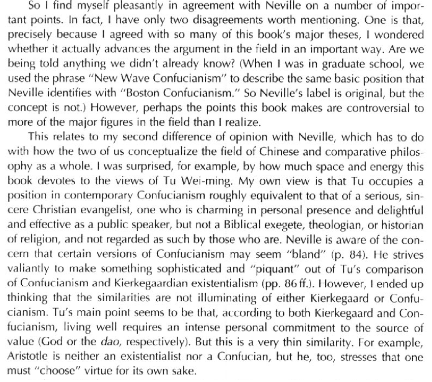
I’m officially back in Fearless Leader mode. I’d like to thank Dan Robins very much for guest blogging. We’ll have Dan back in the future, I’m sure (not that he’s going away; I’m sure he’ll be very active in commenting). I’ll be starting some posts composed by my Phil. 245 (‘Confucianism’) students in the next few days. Meanwhile, I thought it would be fun to discuss “portable tradition,” a phrase Robert Neville uses to describe “Boston Confucianism.” The idea of Boston Confucianism was used initially tongue-in-cheek by Neville to refer to the New Confucian movement, in which he included Tu Wei-ming and himself, both of whom teach in Boston–one north of the Charles River (at Harvard) and one south (at BU).

The portability of Confucian tradition is based on the idea that there is nothing necessarily parochial, geographically speaking, about Confucianism–one need not be culturally Chinese or Sino-centered for the tradition to have some intellectual hold or appeal. You don’t have to be Greek, likewise, to be a Platonist. At this level of generality, it all sounds fine, if not innocuous. There is, however, the lingering question of portability not so much across geography (narrowly construed), but across time: is Confucianism portable into modernity and post-modernity?

At least one indirect criticism of portable Confucianism was provided by Bryan van Norden in his 2003 review (PEW 53:3) of Neville’s book, Boston Confucianism (Albany, NY: State University of New York Press, 2000). I’m going to cut and paste (an image of) van Norden’s most critical comments, because I think he’s actually on to something, despite seeming only to be snarky (sorry about png quality–I’m too lazy to type all this out):

I have to admit, when I read *non-exegetical* pieces by Tu, there is something bland about his discussions–actually, they tend to strike me alternatively as bland or pragmatically undecipherable (What am I supposed to do with the fact of the dependency of human relations on larger patterns of connections to the cosmos as a whole? Study astronomy? Then what?) Is there something striking or captivating about what either Neville or Tu promote in their versions of Confucianism? Admittedly, I haven’t read enough of their works to be an expert; so let me know.

(Did I mention I was fearless?)

Xúnzǐ on Desire

Next week I’ll be taking part in a roundtable discussion at the Pacific APA with Kurtis Hagen, Eric Hutton, and Aaron Stalnaker, and we’ll be talking about what Xúnzǐ had to say about desire. I thought I’d post here some of the thoughts I’ll be presenting there.

The question I want to raise (and I hope it is a provocative question) is whether Xúnzǐ thought of desire as a kind of motivation.

Here’s the argument that he did not. In “Correct Names” (but not the part of that piān that’s actually about naming) he argues against the view that social order requires eliminating or reducing desires. He claims that how we act depends not on what we desire (yù 欲) but on what we approve of (kě 可). He writes, “Desire does not wait for what we can get, but seeking (qiú 求) follows what we approve of (欲不待可得,而求 者從所可).” His main piece of evidence for this is that we have a deep desire for life, but are still able to choose death when we do not approve of the course of action that would be necessary to preserve our lives.

Now, when Xúnzǐ talks about desire, he focuses on desires for sensory gratification and for social acclaim. He rarely implies that the attitudes we might call moral desires are actually desires; these attitudes would, according to the passage in “Correct Names,” count as approvals rather than as desires.

Part of what’s going on here is that Xúnzǐ treats desires as constants of human nature: they arise spontaneously from xìng 性 regardless of what we do and regardless of how virtuous we are. Thus, moral excellence requires us to transform not our desires but the way we act on those desires (the behaviour that he calls seeking). His conception of desire, then, is rooted in his conception of nature more generally: just as nature provides a constant context to which human societies must respond, our desires provide a constant context that we must respond to when we act. But it is approval, not desire, that determines how we respond.

How does this constitute an argument that desire is not, for Xúnzǐ, a form of motivation? Two things. First, he seems to be saying that it is approval, not desire, that gives us our ends or goals. For example, in choosing death, one does not choose an end that has any basis in desire. Second, he sees no conflict between desire and approval. It is not as if there is a struggle between them that approval consistently wins—so his contrast of desire and approval is not at all like the traditional western contrast of reason and passion, which constitute two competing sources of motivation. His view is just that approval is the sort of attitude with which we adopt an end, and desire is not. And this to me suggests that he is not thinking of desire as a form of motivation.

This isn’t a knock-down argument; the concept of motivation may well be too vague to support a knock-down argument. Still, it impresses me that there’s a genuine question here.

A Series of Footnotes to Confucius, Laozi–or to Me!

Picking up on something very interesting that Justin Tiwald said in the Tu string:

“I don’t think the defenders of Yili learning explicitly embraced the slogan ‘the classics comment on me’ (經注我). Still, there are a number of neo-Confucians who made statements in the neighborhood of this slogan. Lu Xiangshan is known for the shocking assertion that the ‘Six Classics are my footnotes’ (六經皆我註腳).”

We’ve all heard that Whitehead thought western philosophy has been just a long series of footnotes to Plato. It’s easy enough to imagine someone echoing Lu Xiangshan, saying, “Plato’s writings are just a series of footnotes to me.” (Who would that be? I could imagine Russell saying that over a cocktail.)

(Totally unrelated aside: Whitehead also said, and this is my favorite Whitehead quote, “A traveller who has lost his way should not ask ‘Where am I?’ What he really wants to know is, where are the other places?”)

It occurs to me that Lu Xiangshan’s assertion is really just a more strident way of describing “constructive” engagement with Confucianism, where Confucius and others are merely inspirational starting points for some new views, with Confucius providing some quotes and footnotes. Maybe the sort of projects that New Confucians are engaged in would fit this mold; maybe Van Norden’s suggestion for a neo-Mencian virtue ethics; maybe much of the comparative philosophy work that is out there where the author is using the past and trying to make it relevant to the present.

I have to ask, because in most respects, it is what I do for a living (aside from corrupting the youth), is there any independent point or value to investigating history–or more pointedly, Confucius, Laozi, et. al.–as an end in itself? I’m not exactly sure I understand the dictum to “revere the past,” or to “understand the past accurately,” as a worthwhile end in itself (unless, of course, it is on the order of stamp collecting). I used to be qualm-less about that as an endeavor, but I’m starting to have doubts (maybe I’ll have a blog-induced  career crisis). Any thoughts?

A Tu (圖) is Worth…

I was thinking about Zhou Dunyi’s Diagram of the Supreme Ultimate (taijitu 太極圖).

Well, about the general idea of such diagrams (tu) really. I’ve been a relative ignoramus about this, but some reading that I’ve been doing recently about whether or not Chinese characters are ideographs got me thinking about diagrams (there are very vehement denials of that thesis by linguists recently, from DeFrancis onward; I think Chad Hansen defends a version of the thesis, though he must have figured out a way to do it without relying on any “language of thought” assumptions). Apparently there was a movement, or “school” of diagrams and numerology. Robin Wang writes in the Internet Encyclopedia of Philosophy:

“From the Han dynasty through the Ming and Qing dynasties (1368-1912 CE), there was a consistent tension between two schools of thought: the school of xiangshu (images and numbers) and the school of yili (meanings and reasoning). At issue between them is how best to interpret the classics, particularly the Yijing. The question often was posed as: ‘Am I interpreting the six classics or are the six classics interpreting me?’

For the school of Xiangshu the way to interpret the classics is to produce a figurative and numerological representation of the universe through xiang (images) and shu (numbers). It held that xiangshu are indispensable structures expressing the Way of heaven, earth and human being. Thus the school of Xiangshu takes the position that ‘I interpret the classics’ by means of the images and numbers. The emphasis is on the appreciation of classics. The school of Yili, on the other hand, focuses on an exploration of the meanings of the classics on the basis of one’s own reconstruction. In other word, the school of Yili treats all classics as supporting evidence for their own ideas and theories. The emphasis is more on idiosyncratic new theories rather than the explanation of the classics. In what follows, our inquiry focuses on the legacy of the Xiangshu school.”

Does anyone know whether what Wang means by the “am I interpreting the classics or are they interpreting me” question is explicit in texts? That would be interesting, I think, for its early hermeneutic sophistication–depending on how early the question is made explicit I suppose.

Anyway, as usual, I have puzzles about diagrams–by now some of you have figured out that “puzzling” is my first approach to anything. One is about how a diagram is helpful. I assume it can display certain relationships through spatial metaphor better than linear discourse could. But how, in general, is a spatial metaphor very helpful for relaying information about non-spatial relationships? Related to that puzzle, I wonder whether sometimes the metaphor itself becomes something that needs explanation and ends up being unhelpful. Take the taijitu, for example. The diagram is, presumably, supposed to be helpful in explaining cosmological relationships. Every time I look at it however (or more to the point, every time a student asks about it), I feel like the diagram is itself a mystery. There’s further irony in the existence of the difficult commentary literature that develops around what the diagram is meant to convey. So, is the diagram helpful in this case or has it only generated an “epi-problem” over and above the cosmological relationships it was meant to clarify?

I wonder if there is something that makes this a general problem or just an issue for particular diagrams, such as the taijitu.

Reverence, the Spiritual, and the Sacred in Confucianism

These themes seem to have come up in a few different posts, so I thought we might try to tie together some of the strands. I know it’s asking for a lot, but is there any way to get some clarity on how these concepts operate within the history of Confucianism?

I’m assuming there is some close network of meaning within which each of these can be used to understand each of the others–e.g. “the sacred” is something that calls for reverence; reverence is to be distinguished from a purely socially understood concept of respect because reverence is tied to value of a spiritual sort; and so forth.

[Brief digression: I’m sure many of you know more about Durkheim than I, but it seems like “the sacred” is some sort of indefinable, basic concept on his view; I’ve never found that very helpful (someone correct me, please, if I’m totally misreading Durkheim). I only bring Durkheim up because of Fingarette’s clear use of Durkheim’s template in allowing that “the secular” (as opposed to “the profane”) could be part of the sacred–Fingarette’s book on Confucius is called Confucius: the Secular as Sacred, for those who might not know.]

I think if we look at the instances of jing 敬 in the Analects, Mencius, Liji, and other pre-Buddhist texts, it seems to me like it could easily be translated as “respectfulness” rather than “reverence.” I think the main question, whether it is about translating jing or understanding the junzi’s pursuits as in some sense spiritual, is going to be about what the larger template of analysis is that makes the texts “speak to” spiritual or sacred concerns. I think I can see what that template is for understanding the neo-Confucians in that way: reaction to and partial assimilation of Buddhist concerns that are more clearly driven by soteriological goals. I’m not sure what the template should be for the early Confucians–despite having read Fingarette more than a few times. And I don’t know as much as I should about the New Confucians to understand how they would see themselves addressing issues of reverence, the spiritual, or the sacred.

Well, that’s what I’ll start with. I’m sure I’ll learn a lot from responses to this post.

Confucius: Democracy Advocate?

Picking up on something that Boram Lee very eloquently wrote in the Confucianism and Sexism string:

“… my impression is that at its heart Confucianism is neither autocratic nor authoritarian, as some modern Asian regimes like to claim.

It seems to me that one of the main defining features of Confucianism, at least on its political and economic dimensions, is its commitment to decentralization. Its ideal society is one consisting of small communities, each small community composed of persons governing themselves with ritual. The ideal government is not a centralized bureacracy, but self-government by each over themselves, where no coercion is involved, only voluntary control and participation in social activities, and leadership based on rational and emotional persuasion, not the use of laws and punishments. A centralized bureacracy following paternalistic policies towards uneducated peasants is only a second-best option.”

I think I understand most of the arguments for thinking of Confucianism as compatible with democratic ideals. They are some version of Boram’s point: the Confucian ideal of political community is of each person exercising moral self-scrutiny and self-cultivation; education of others and continuing self-education is an important ideal; persuasion and non-violent moral example are preferred to use of force and harsh legalism; hence, democracy is not far away as an ideal–what else would even seem appropriate for a community of junzi-like citizens but a democracy?

I think that would be great if it were true. And maybe there is some pragmatic value in making democracy seem continuous with a powerful self-conception (i.e. of being “Confucian” in some broad sense) that has traditionally been expressed only in non-democratic ways. But why does this kind of argument seem so strange to me? One thing that comes to mind very quickly is that it makes Confucianism’s ideals sound like those of Kant, or any of the other Enlightenment “autonomists.” The community of junzis sounds something like the “kingdom of ends,” a self-governing lot of moral agents who regard each other with respect for their personhoods.

Could I really complain about that? I’m not sure; but I feel like I should complain–Doesn’t it distort Confucianism? Isn’t it mistaken to think that the junzi ideal really lends itself to self-governance? What’s the connection exactly between self-cultivation and self-governance–doesn’t this rest on some conflation? And why has Confucianism only been used in the service of autocracy so far?

I’m not trying to make trouble here, just trying to scratch this itch.