Category Archives: Confucianism

Fingarette's Confucius and Historical Contingency

I’m just going to post on Fingarette like I’m serving hors d’oeuvres. So, here goes.

So, according to Fingarette’s Confucius, the value of the individual can’t transcend the particular set of ceremonies in which the individual is embedded. On Fingarette’s reading, Confucius is committed, then, to the value of individuals being tied specifically to the Zhou ritual ceremonies. I don’t think Confucius could say something more Rorty-like–namely, that though the particular tradition is dependent on historical contingency, with a bit of irony and reflection, we can embrace the historically contingent and imbue it with value that we recognize to be contingent, since there isn’t any non-contingent value to be had in any case. In other words, Confucius could not think of the Zhou rituals, in so many words, as being historically contingent; he thinks they are absolutely valuable. That doesn’t mean Fingarette’s Confucius is committed, in so many words, to universal values; it means he doesn’t really think in terms of universal versus historically (or culturally) contingent values. His commitment to the Zhou is naively universalist in its assumption of superiority to the norms and mores of “the barbarians.”

I might have caricatured Rorty, or Fingarette for that matter. Comments welcome, as always.

Fingarette, Confucius, and the Vessel

Continuing Fingarette-palooza, begun on Chris’s, Peony’s, and Sam’s blogs:

Herbert Fingarette, in Confucius–the Secular as Sacred, chapter 5, discusses something about the relationship between ceremony and the individual’s place within it that is far more radical than either of the alternatives that currently presents itself as the “correct” reading of the moral individual within Confucius’s thought (to the extent that we can reasonably reconstruct it). Fingarette argues, or suggests really, that for Confucius the ethical value of the individual can only be a “function” (p. 75) of the value of ritual ceremony. The idea, as Fingarette construes it, is analogous to the value that a ceremonial vessel has in the context of ritual ceremony: the ceremonial vessel’s value is merely a function of the value of the ceremony, which does not depend at all on the utility of the vessel outside of that context, but on its ritual significance within the ritual. So, the analogous value of the individual human being would be a mere function of the value that human ceremony (li 禮) has. And what kind of value does that have? That’s less clear. According to Fingarette:

The shapes of human relationships are not imposed on man, not physically inevitable, not an instinct or reflex. They are rites learned and voluntarily participated in. The rite is self-justifying. The beings, the gestures, the words are not subordinate to rite, nor is rite subordinate to them…. Although the individual must cultivate himself, just as the temple vessel must be carved and chiseled and polished, this self-cultivation is no more central to man’s dignity, in Confucius’s views, than the preparation of the vessel is central. Preparation and training are essential, but it is the ceremony that is central, and all the elements and relationships and actions in it are sacred though each has its special characteristics. (78)

What could this mean? I’ll say this. It does not mean that the cultivation of the virtues in humans is somehow valuable as a function of human good–the Aristotelian picture, broadly construed, of the virtues contributing to human flourishing, which flourishing is based on human nature–or, as Fingarette puts it, “imposed on man” or “physically inevitable.” On Fingarette’s view, that would put Confucius really at odds with a more Mencian view on which, if the rituals had any value whatsoever, it would be because of their role in expressing what was indeed “imposed on man” through his nature (xing 性) by Heaven.

On the other hand, Fingarette’s reading also implies that “role-based” value of humans does not quite get Confucius’s point narrowly enough. A role has to be indexed to some role-context. Most role-based readings of Confucius, I think, read that context as that of the family and, by extension, of the state through a broadening of the family relationship types to include state relationships. But I don’t think Fingarette’s Confucius thinks this way. If Fingarette is right, Confucius isn’t concerned as much with “the family” or “the state” generically construed, but with a particular ceremonialized version of those things. It is the role, very narrowly, that a person can play within the family or state, as ritualized through the Zhou dynastic rituals, that confers upon the individual (as a “vessel” within that ceremony) the kind of value that Confucius champions.

To that extent Fingarette’s reading, I think, actually makes Confucius less relevant for contemporary concerns than he might wish to admit. Or perhaps he likes to think that we can return to the values of Zhou ritual…

Comments welcome, as always.

On de 德 and se 色

I’m going to piggyback on some discussion to which I was party at Peony’s and Sam’s because I wanted to see what might come up further from this blog’s clientale (patrons? target audience?). My apologies to both of the other bloggers for cloning their concerns over here, but I offer them admiration as propitiation.

The issue concerns how to understand Analects 9.18 and 15.13. In both places Confucius is quoted saying: “吾未見好德如好色者也,” widely translated as something like “I have never met one who likes virtue as much as he likes sex.” A slight variation in that is to translate se 色 as “beauty” or “the beauty of women.” I’ve never really liked this way of understanding Confucius’s point. So, here is a proposal for how to understand the sentiment in 9.18 and 15.13. (Some of this is cut and pasted from various comments I made on the other blogs):

I think se 色 really can’t mean something as narrow as sex or lust; its meaning is much broader, expressing a broader more central concern in the Analects. The “sex” translation seems flat out wrong for the following reasons. There really isn’t any independent evidence that sexual license was a temptation Confucius worried over. Nor does it seem that concubinage was an option for anyone other than the emperor or possibly a very powerful warlord (any ancient Chinese concubinage experts should correct or corroborate me on this). This line of translating seems to be a projection of much later genres of moralizing texts onto the Analects. But those issues about sexual desire and practice don’t really determine the issue as much as consideration of a more central concern for Confucius. In Analects 2.8 Confucius uses se in a context that I think is much more helpful in setting our understanding of se in the right direction:

子夏問孝。子曰:“色難。有事弟子服其勞,有酒食先生,曾是以為孝乎?”

“Zixia asked about filial piety. The Master said: ‘[Mere] appearances (se) are the difficulty. With matters to be tended, younger brothers or sons offer their service; with drink and food one partakes in order of birth. Can this really be filial piety?'”

I think this is representative of a concern that Confucius has throughout the Analects with contrasting mere, or rote, behavior that mimics real filial piety (or righteousness, benevolence, ritual, etc) and genuine possession of those characteristics. It’s his concern that the “form” of such activity be filled out with deeper content or correct context. I think that transfers also to distractions that form a category of “surface” pleasure. Appreciation of beauty, in particular, is not a mere surface pleasure for Confucius. So translation of se as ‘love of beauty’ also makes a mistake–the real trouble for Confucius is not appreciating beauty; instead it is enjoying “cheap” delights that merely mimic appreciation of beauty.

The sensibility that Confucius expresses does not concern one arena or type of activity as opposed to a wholly other type–for example, in antiquity, between ritualized life and licentious free-for-all, or something of the sort. I think the sensibility tracks the difference between more closely related activities, namely the “real” or “deep” enjoyment/practice/performance of ritual, filial piety, music, beauty of women, and so forth, and the disingenuous or shallow enjoyment/practice/performance of that same range of things. Confucius’s concerns are focused on a declining empire, but not like the Roman decline as represented in “Caligula.” The decline lies in the loss or threatened loss of coherence, or perhaps integrity, of what he considered to be high culture (in the moral/social/aesthetic mashed-up sense). In effect, it is a type of snobbery but perhaps with less pejorative connotation. It’s like bemoaning the loss of integrity that, say, the ascendence of Kenny G represented for the true jazz aficionado. Kenny G’s performances lack “soul” or something like that, so they are se.

So, if I had to give a translation of the quote from Confucius, it would be something like: “I have never met one who prefers the deeply powerful activity as much as the easy semblance of it.”

As always, comments welcome.

Pre-Qin Love (愛)

[Moving up to front, to restart discussion on this topic — see new comments]

Because it’s now come up twice, in separate places (here and here), I can’t stop thinking about this question: What does ai 愛, broadly translatable as “love,” connote? If I had the time, I would do some actual research into this. But since the antecedent of that conditional is false, I’m going to allow myself just to post the question and my initial thoughts, and see what others think. Let me paste here a version of the comment I made at Tang Dynasty Times, attempting to understand the early Chinese concept through some early Greek ones, and see what kinds of responses I get:

My sense of ai in early Chinese literature is that it is actually more like agape–along with philia–than eros. Lian 戀, along with perhaps se 色, captures the sense of eros much better. Ai seems very much reserved in Classical Chinese for these two senses:

1) kindly attachment and affection (sort of like philia and agape); benevolence, if the direction of hierarchy in the relationship is right

and

2) fondness; or in the verbal sense, to fancy (sort of like hao 好, in the Classical sense)

I can’t call to mind any instances of ai that I’ve come across that connote the type of longing and lustfully urgent desire that eros suggests.

Or maybe that’s too narrow a rendering of eros? Maybe. Still, I think the broad outlines of what I’m saying are right at least.

Afterthought: The meaning of agape isn’t determined by its use in Christianity. So, I don’t think that’s a factor here.

I might sound confident, but I’m happy, as always, to be set straight.

Bootstrapping Problem in Mencius

There’s a very problematic passage–I’ve always thought–in Mencius 6A: 15:

Gongduzi asked: Though equally human, but some are great men (daren 大人) and some are petty men (xiaoren 小人). Why is this?

Mencius replied: Following their greater parts (dati 大體) makes them great men; following their lesser parts (xiaoti 小體) makes them petty men.

Gongduzi asked: But being equally human, how is it that some follow their greater parts and some follow their lesser parts?

Mencius replied: The organs of the ears and eyes do not think and are wrapped up in things (bi yu wu 蔽於物). When there is interaction among things, [those organs] are only led around. The organ of the heart thinks and because it thinks, it can attain (de 得) things [i.e. control and/or transform things]; if something does not think, it cannot attain things. This is what is given to us by Heaven. First, take a stand (li hu qi da zhe 立乎其大者) on the greater; then the lesser is unable to take over. That is all there is to being a great man.

Mencius doesn’t really answer Gongduzi’s question to my satisfaction because it seems clear to me that Gongduzi can just repeat the question in this form: “But being equally human, how is it that some ‘take a stand’ on their greater parts while others do not?”

I call this a bootstrapping problem because it seems to require some kind of “super-agency” in which a person has to take a stand on the better part of herself without being able to rely on that part to guide her in taking that stand. Or so I’ve argued in “Wielding Virtue in the Mengzi” (in Conceptions of Virtue East and West, Kim-chong Chong (ed.), 2006).

Doesn’t this seem like a problem for Mencius? Is there a solution?

Guidance through Principles vs. Concepts/Terms–What's the Difference?

So, continuing some thoughts about language and theory in ethical thought, I’ve been thinking about what significant difference there is supposed to be between ethical guidance through principles as opposed to guidance through some form of “conceptual mastery” or even “skill mastery.”

One way to think of the difference, roughly, between Western and early Chinese ethical thought is to think of the former as emphasizing formulation of principles and guidance through them and the latter as emphasizing either mastery of some sort of “thick” ethical concepts or some set of “ethical skills.” Hence, dominant forms of ethical theorizing in the modern West seem concerned to formulate correct principles of right action so that people can adopt them for deciding how to act, in morally relevant contexts of choice. On the other hand, what seems of concern to early Confucianism seems to be to grasp the meaning and import of certain important terms such as ren 仁 (“humaneness”), li 禮 (“ritual piety”), and so forth; and/or to master certain sorts of “moral perception” skills that involve some kind of correct “connoisseur” responses and judgments–e.g. seeing something as ren or as failing to be li.

There are a few questions about the accuracy of these generalizations that call for some narrowing. Isn’t “Western” really just a gloss for a particular style of theoretical inquiry, largely in the modern era, that models itself on scientific inquiry or on legal reasoning? Shouldn’t something be said about the role of “manuals” of ritual and ceremony, e.g. the Zhouli (The Rituals of the Zhou) and the Liji (The Record of Ritual) for Confucian thinking about ritual piety? They seem to provide discursive action-guidance, and maybe even justification (as a set of rules) for particular ritual actions and attitudes, if not for the institution as a whole (which is something I take Xunzi to have been trying give). Also, the Mohists seem pretty clearly to be formulating an action-guiding principle–viz. to promote benefit.

But those sorts of questions aside, I wonder how different in practice competent application of principles could be from expressions of competence with respect to concept application or skill implementation. What I have in mind is that application of a principle, like application of a concept, actually requires a skill–call it a “connoisseurship of principle application”–that then subsumes the process under similar sorts of success-conditions as any other skill: there has to be something like a “correct perception” of when a principle applies to a situation, just as in the situation where one sees that a concept applies.

Those who know the later Wittgenstein views could maybe see a connection here–I’m not at all an expert on Wittgenstein and it’s been years and years since I read anything on his views, so that would be helpful if someone could speak to the connection or its lack. Those familiar with W.D. Ross should see some connection here, I think, because Ross’s intuitionism requires some kind of noetic perception of one’s true duty from the interactions among considerations of prima facie duties that apply to a situation. That sounds like a skill to me, not unlike skill in legal reasoning (?)–someone who knows about this could also speak to it better than I.

This is all to suggest, tentatively, that there really isn’t much difference when we get down to the business of ethical living between having a “principle-based” view and some more “skill-based” view. Or is there? I’m inclined to reduce principle-application and concept-application to considerations of skill, albeit some kind of mental or “perceptual” skill, but maybe there are problems with that…

Abstract Theorizing and Language – Hall and Ames (and a bit of Hansen)

I’m working on a couple of papers related to language and ethics in early China. One of the issues that keeps coming up are the arguments, from two distinct directions, that the language of early China points to a tendency to avoid abstract thought, including abstract ethical thought. One argument comes from Chad Hansen’s lengthy mass-noun, stuff-ontology, mereology thesis. The other comes from Roger Ames and David Hall’s somewhat quick argument about the relatively “infrequent resort” to counterfactual conditionals in Chinese philosophy.

In this post, I’ll just say a quick thing about Hansen. In terms of “abstract” theorizing, Hansen’s view seems to have two (related) conclusions based on his argument that early Chinese think of the world in terms of intermixed “stuff” rather than individuals and their properties:

  • (H1) universals, or properties, and things are not components of early Chinese thinking; and
  • (H2) the mind (or in this case, the xin 心, “heart-mind”) is not conceived of as engaged in representations of the world (in a “mentalese language of thought”), but rather in acts of discrimination regarding the parts and (mass) wholes among which humans navigate.

In those pretty specific senses, Hansen thinks there is no abstract theorizing in early China. At least that’s my quick summary (read both of Hansen’s books,  Language and Logic in Ancient China and A Daoist Theory of Chinese Thought, to check).

Ames and Hall’s view is less systematic and perhaps based on (someone else’s) bad linguistic research, but there may be arguments for their view that transcend that research. I’ll try to summarize their position, from Thinking Through Confucius, and make a call for some examples that might be interesting to discuss as prima facie counterexamples.

Ames and Hall argue that the Confucian sensibility–and more broadly, all of Classical Chinese thought–is shaped by a lack of “consideration of the differential consequences of alternative possibilities” which “underlies the dominant modes of ethical and scientific thinking” (265). The argument is based in part on Alfred Bloom’s 1981 study, The Linguistic Shaping of Thought: A Study in the Impact of Language and Thinking in China and the West. By way of “cheating,” I’ll paste the opening page of Wu Kuang-ming’s Philosophy East and West (37:1) book review as summary of Bloom’s research and to indicate the direction of argument that Wu takes against Bloom’s thesis:

“In this provocative book, Alfred Bloom claims that the Chinese language does
not have a counterfactual formulation, and therefore Chinese people have
difficulty understanding counterfactual expressions. He said this is because
counterfactuals depend on the ability to turn properties and actions into nouns,
lift them up (abstract them) from actuality, and fit them into a new theoretical
framework of universals. Thus in denying counterfactuals in Chinese language,
Bloom also denies universals in Chinese language. Since language allegedly
shapes thinking, the double denial of counterfactuality and universals amounts
to denying both in Chinese thinking. Since argumentation needs both counter-
factuals and universals, Chinese people are either poor arguers or incapable of
argumentation. This is a serious thesis indeed.

To prove the Chinese lack of counterfactuals, Bloom produced (1) a lack of
counterfactuals in contemporary Chinese writings and conversation, and (2)
poor scores on the tests on counterfactuals taken by Chinese people. To prove
the Chinese lack of theoretical abstraction and “entification,” Bloom produced
(3) poor scores on the tests on abstract thinking taken by Chinese people, and
(4) evidence of the difficulty of translating a single complex English sentence
into a single Chinese sentence. And to clinch the whole matter, Bloom reported
that (5) Chinese people themselves confessed to him that they have difficulty
grasping counterfactuals and universals, saying in effect that Chinese language
has neither.

This review claims that perhaps the situation is more complex than Bloom
would have us believe. Both counterfactuals and universals are needed in think-
ing. What is peculiar about both English and Chinese languages is that they have
their own peculiar ways of expressing these concepts. In other words, counter-
factual thinking must be distinguished from counterfactual formulations in a
specific language; similarly, universals must be distinguished from theoretical
abstract terms, which are a peculiar linguistic form. A lack in the linguistic
formulations of counterfactuals and theoreticals does not necessarily show the
lack of counterfactual thinking and thinking on universals.

The Chinese language has no tense forms, but the Chinese people are one of
the most history-conscious races in the world. The Chinese language has no
gender forms, yet some gender distinction is clearly embedded throughout in
names, adjectives, expressions, and so on, as in English. The fact that Chinese
language lacks linguistic devices for plurality did not prevent the Chinese people
from being good businessmen or engineers….”

In addition to Wu, there have been others critical of Bloom’s thesis (for example, Christoph Harbsmeier in Language and Logic, no. VII:1 in Science and Civilization in China, 116-18).

Ames and Hall admit that though Bloom’s thesis that there is no counterfactual locution in the Chinese language, including Classical Chinese, might be overstated, the “infrequent resort to such locutions in Chinese philosophic argument” (364, note 29) is what matters to their conclusions. So what are the relevant conclusions here? A good and fair summary, I think, lies in this quote:

“If ethics is to be considered always in the light of reflection, deliberation, and conscious judgment among alternatives, then one may certainly assent to the view that such ethical interests are not in any important way represented in classical Chinese philosophy.” (266)

So, two issues:

  • How valid is the reasoning from the relative lack of counterfactual locutions to this conclusion?
  • Regardless of counterfactuals, does the conclusion ring true? Why or why not?

We could start, I suppose, by discussing the nature and role of an apparent counterexemple: Mencius’s use of the “child in the well” example (from 2A:6, text and Legge’s translation–from Donald Sturgeon’s site):

所以謂人皆有不忍人之心者,今人乍見孺子將入於井,皆有怵惕惻隱之心。非所以內交於孺子之父母也,非所以要譽於鄉黨朋友也,非惡其聲而然也。由是觀之,無惻隱之心,非人也;無羞惡之心,非人也;無辭讓之心,非人也;無是非之心,非人也。

“When I say that all men have a mind which cannot bear to see the sufferings of others, my meaning may be illustrated thus: even now-a-days, if men suddenly see a child about to fall into a well, they will without exception experience a feeling of alarm and distress. They will feel so, not as a ground on which they may gain the favour of the child’s parents, nor as a ground on which they may seek the praise of their neighbours and friends, nor from a dislike to the reputation of having been unmoved by such a thing. From this case we may perceive that the feeling of commiseration is essential to man, that the feeling of shame and dislike is essential to man, that the feeling of modesty and complaisance is essential to man, and that the feeling of approving and disapproving is essential to man.”

Does this really count as a counterexample–is it really counterfactual thinking and/or does it engage “reflection, deliberation, and conscious judgment among alternatives”? Are there other, better textual examples to discuss here?

Flourishing, the Non-moral Good, & Virtue Ethics

Here’s an issue that I think is relevant to any view about “flourishing” attributed to early Chinese philosophy. If the basic idea of flourishing is some idea about faring well, or “welfare,” we can ask what it takes conceptually to have such an idea. What comes to mind for me is that there has to be some notion of a person’s good, where that good is construed in some way independent of acting correctly–i.e. it has to be a notion of a person’s “non-moral” good. Even as I write that, I’m not quite sure what the reason for that is, but it seems important to me to keep welfare distinct from rightness. I might be totally wrong, but my philosophical instincts whisper otherwise.

The reason this seems important to me vis-a-vis early Chinese philosophy is that it seems like the non-moral good is featured in the Mohist idea of benefit, li 利. But li is not taken as theoretically central or even relevant in the Analects and the Mencius. Maybe it is important in the Xunzi, but I think that is because the Xunzi has a consequentialist view like the Mozi. If any of this is on the right track, then there is not in fact any virtue ethics in early China, in the sense that Van Norden and others think there to be. A lot rides on the idea of flourishing as relying on that of the non-moral good, and hence as being construed independently of rightness, so I wonder what can be said in favor of or against that…

For New England Area Types

Steve Angle has organized, with Michael Slote, an NEH seminar at Wesleyan University in Middletown, Connecticut on “Confucianism and Virtue Ethics.” It is to run from July 7 to August 15. Steve opens the lecture sessions to anyone who is interested and willing. Here (pasted from email) is the schedule for the lecture sessions, along with what Steve has to say by way of invitation:

“It occurred to me that maybe you could post something on the blog about the speakers who will be coming to Middletown for the summer seminar. It would be neat to have a mini-get-together or two. The details I have now are:

May Sim, Holy Cross — July 10
Bryan Van Norden, Vassar — July 15
Shirong Luo, Simmons — July 17
Eric Hutton, Utah — July 24

All lectures held at the Freeman Center for East Asian Studies, beginning at 3:30. I encourage anyone planning on coming from out of town to let me know.

Thanks!

Steve”

(I know I will be at some of these, since I am relatively close by; it would be nice to meet some of you out there if you are also able to make it! Also, Chris Panza, who writes the blog “A Ku Indeed!” will be a seminar attendee. -Manyul)

Such a deal…

Thanks to Yuri Pines for the link.

(http://www.chinadaily.com.cn/china/2008-06/05/content_6737093.htm)

Parents call on Confucius for exam good fortune

By Cao Li (China Daily)
Updated: 2008-06-05 08:12

The Temple of Confucius in the center of Shanghai’s old town was unusually full Wednesday morning.

Crowds of people, most of them in their 40s and 50s, burned incense, lit candles and prayed in and around Dacheng Hall where there is a sculpture of Confucius and also where national exams were held during the times of the imperial dynasties.

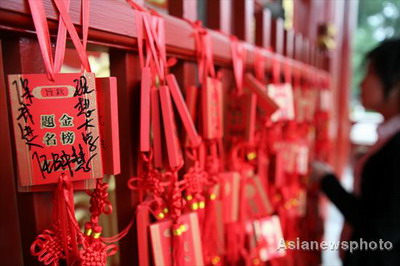
The good luck notes they hung on the trellises and trees outside the hall gave away their reasons for being there. Most read something like, “Dear Confucius, please help my son/daughter in the college entrance exam”.


A visitor hangs a good-luck tablet on a shelf at the Temple of Confucius in Beijing June 3, 2008. [Asianewsphoto]

With the national examinations starting on Saturday, a growing number of parents have turned to Confucius, as a way to ease the pressure.

A cleaner at the temple, surnamed Xu, told China Daily that local people hardly ever visit the temple, but in the past week, hundreds of them had been.

“There are so many visitors coming these days, all the oil and incense burners keep filling up and I have to empty them several times a day,” Xu said.

Visitors pay 12 yuan ($1.75) for a piece of notepaper, incense sticks, two candles and a length of red ribbon.

At the Temple of Confucius in Beijing, visitors have to pay 188 yuan for a wooden tablet on which to write their wishes, although the shelf on which these are then placed is now full, the Beijing Youth Daily reported Wednesday.

One of the visitors at the Shanghai temple Wednesday was 47-year-old Ye Qing. She said she was making a wish for her son who is hoping to study telecommunication engineering at East China Normal University.

“It will work if I am sincere enough,” she said.

About 100,000 Shanghai students will sit the college entrance exam between Saturday and Monday, and their parents are doubtless all hoping for the same good fortune.

Many, like Ye, have booked hotel rooms close to the test venues.

Staff at several hotels in the city’s Minhang district said they have been taking bookings since the beginning of last month, and many are now full, the Xinmin Evening News reported.

Sun Yu, a teacher at the Shanghai Foreign Language School, said parents are prepared to do whatever they can to help their children succeed, including enrolling them in expensive, extracurricular classes.

High school student Vicky Yang said all her classmates spend at least 500 yuan a month on exam-related books and extra lessons.

“Some pay up to 20,000 yuan a semester for classes that promise to help students secure a university place,” she said.

Apart from books and classes, parents also buy their children special tonics to drink, Yang said.

“If you collected up all the empty bottles of tonic my classmates have drunk, you could make a small hill.”