
New post in the series “Family as Topic, Root and Model in the West: An Ephemeral Resource for Comparative Philosophy.” Continue reading →
Tag Archives: Comparative philosophy
Early Christianity
New post in the series “Family as Topic, Root and Model in the West: An Ephemeral Resource for Comparative Philosophy.” Continue reading →
Roman Stoicism
New post in the series “Family as Topic, Root and Model in the West: An Ephemeral Resource for Comparative Philosophy.” Continue reading →
Plato
New post in the series “Family as Topic, Root and Model in the West: An Ephemeral Resource for Comparative Philosophy.” Continue reading →
Athens and the Polis
New post in the series “Family as Topic, Root and Model in the West: An Ephemeral Resource for Comparative Philosophy.” Continue reading →
Family as Topic, Root, and Model in the West
Here is the beginning of a planned series of sketches on family as topic, root, and model (inspiration for other order) in Western philosophy and culture. I expect to post a new installment every two or three weeks. Papers are linked at their titles.
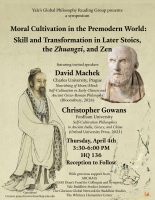
Moral Cultivation in the Premodern World: Craft and Transformation in Later Stoics, the Zhuangzi, and Zen
Yale’s Global Philosophy Reading Group warmly invites you to a symposium entitled Moral Cultivation in the Premodern World: Craft and Transformation in Later Stoics, the Zhuangzi, and Zen. The symposium will take place next Thursday, April 4th in HQ 136, from 3:30 to 6:00 PM, with a reception (food from House of Naan, Prosecco, and sparkling water) to follow. Please see the description, program, and abstracts below for more details. We hope to see you there!
If you know in advance that you’ll attend, please send a quick email to james.brown-kinsella@yale.edu so we can order enough food and drink for the reception.
Problematising harmony, disrupting harmony: perspectives from philosophical traditions
19th-20th May 2022
Philosophy Department, Nanyang Technological University
In-person and via Zoom
The idea of harmony has positive connotations. We consider ourselves fortunate if we live in a harmonious neighbourhood or a harmonious society. Harmonious music is pleasing to the ear, as is harmonious architecture to the eye. People who see eye to eye are harmonious in their beliefs and perhaps in their sentiment. “Harmony” often also suggests a condition manifesting desirable equilibrium, or proportion, or balance (that may also be ethical or aesthetic in nature), across a range of human activities, projects and collaborations.
New book: Mastery, Dependence, and the Ethics of Authority, by Aaron Stalnaker
Oxford University Press has just published my new book on early Confucian social thought, and what contemporary people might learn from it: Mastery, Dependence, and the Ethics of Authority. The publisher’s page is here. At present the cheapest way to purchase it is directly from Oxford, with a discount code for 30% off (AAFLYG6).

This comes with hearty thanks to Steve Angle and Bryan Van Norden, who were belatedly revealed as the press’s referees.
EACP inaugural conference in Vilnius
The inaugural biennial conference of the European Association for Chinese Philosophy will be held in Vilnius in early June. Keynote speakers Carine Defoort and Peng Guoxiang. Deadlines and other information on the EACP web site:
