Author Archives: Manyul Im

University of Bridgeport

The Good: Good For, Good At (shan 善), and Benefit (li 利)

Let’s see; I’m trying to figure out how to think about the ancient Chinese term shan 善, roughly “good,” in relation to the various senses of “good” that we as philosophers try to distinguish these days. This has a bearing on, among other things, what to make of the pre-Qin positions on human-nature-is-good (ren xing shan ye), bad (e 惡), neither, or both. I vaguely recall reading somewhere that shan means something more like “good at” (“competent”?), but I can’t recall exactly where–Graham? Nivison? Anyway, here are some senses of good that I’m used to hearing philosophers distinguish from among:

  1. “Good for” – this seems to be the primary “non-moral” sense of “good” that is used in discussing goods that can be indexed to individuals, groups, or things. X can be good for Y in the sense that X is of value to some end or interest of Y. We often speak of something good in this sense as a good or as goods. Such goods seem always quantifiable in this way.
  2. “Good at” – this seems to be a sense of “good” that tracks something like the Greek term for “excellence,” arete (αρετη–sorry for leaving out diacriticals; can’t seem to do them right now). X is good in this sense if X is capable or competent at doing or being something. Example: “As a golfer, Woods is really good.”
  3. “Morally or aesthetically good” – this seems to be a sense of “good” that has something to do with worth that “has no price” (to use a Kantian expression). X is good in this sense if it/he/she is praiseworthy for its/his/her own sake, not for its/his/her value to something else or at doing or being some particular thing. Examples: “That painting is good.” “She wasn’t good but she had good intentions.”

I’m pretty sure these are significantly distinct, non-overlapping senses of “good,” although something, or someone, might be good in all three senses. So, let me say or ask a few things.

First, are there more senses of “good” than this that are significantly different from any of them?

Second, it seems to me like we need to figure out which sense or senses of “good” shan overlaps with or else say what other sense it has; otherwise, obviously, we don’t have a handle on what the ren xing debate is about.

Third, it seems to me like li, “benefit,” is closely allied to the first sense, “good for.”

Some initial thoughts that I have: Shan never struck me as meaning “good at” mainly because I haven’t really seen uniformly in the contexts of its use that there is an indication of what something is “shan at.” If so, then it seems like we have to settle on either 1 (good for), 3 (morally/aesthetically good), or some overlap between them. But “good for” suffers from the same contextual problem as “good at”–e.g. it isn’t uniformly clear that there is something a shan thing is “shan for.” Could shan mean something more like morally or aesthetically good? Here is a reason not to go that way too quickly, though we might end up there eventually:

It seems to me like Xunzi, in his discussion of ren xing could be understood as investigating whether it is good at producing order and harmony (which seem themselves on the other had to be li 利, goods in the good for (humans) sense); Xunzi finds that ren xing is not at all good at producing them. However, that moves Xunzi to conclude that ren xing is e 惡, which seems pretty clearly to mean that it is unseemly or ugly. But that suggests either (a) that shan overlaps in meaning between “good at” and “morally/aesthetically good” and Xunzi is equivocating between his criticism of Mencius and his conclusion about ren xing; or (b) Xunzi’s criticism isn’t really about the incompetence of innate disposition to produce order and harmony. I think I prefer (a), but could it really be that shan is so much like the contemporary English term “good” that it has that much similarity in equivocation potential? My instinct here is to be suspicious about that. Any suggestions, comments, critical remarks, interlocutory agreement?

Velleman, Frankfurt, and Zhuangzi

I just ran across a fascinating paper by David Velleman, “The Way of the Wanton,” which he lists as a work in progress. It’s available on the Social Science Research Network (SSRN), for download, here. Anyone interested in Zhuangzi should find this very interesting. In the paper, Velleman gives a non-standard reading of Frankfurt’s early work (“Freedom of the Will and the Concept of a Person,” Journal of Philosophy 68, (1971)) on second-order desiring, the idea of the self, “identification” with first-order desire, and Frankfurt’s idea of “wantonness.” It strikes me as an excellent example, not of comparative philosophy, but just plain philosophy that takes something “transportable” (?) in Chinese philosophy seriously.

To give a very brief synopsis of Velleman’s reading: Contrary to Frankfurt’s own conclusions, Velleman argues that a reflexive self–one that has second-order attitudes toward one’s own first order attitudes–doesn’t contribute to identification, but to something phenomenologically opposite, what he calls “dis-identification” (p. 14). Here’s the example Velleman gives:

“Being the subject of a desire usually entails being the subject of various thoughts symptomatic or expressive of the desire. Being thirsty, for example, entails thinking thirsty thoughts: looking around for quantities of liquid, wondering if they are potable, considering ways of reaching them, avidly imagining their taste, and so on. All of these thoughts are framed from the perspective of a potential drinker, but none explicitly represents the occupant of that perspective. They are framed from the point-of-view of a potential drinker who remains out of the picture, at the unrepresented origin of that point-of-view. Of course, the thoughts symptomatic of thirst may include the first-personal thought “I’m thirsty,” but that thought is in the first instance an atomic expression of thirst, like smacking one’s lips or crying ‘Water!’, rather than a compositionally analyzable attribution of thirst to oneself.

The difference between that expression of thirst and the attribution of thirst to oneself defines a continuum of possible thoughts that include awareness of one’s thirst in various degrees of explicitness. Sometimes one looks for a drink without yet knowing that one is thirsty; sometimes one looks for a drink while knowing about one’s thirst but not attending to it at all; sometimes one attends equally to the possible drink and the dryness of one’s throat or the urgency of one’s craving; sometimes one focuses on the thirst to the exclusion of the prospects for slaking it.

Across this continuum, one becomes progressively less engrossed in the activities motivated by thirst. At the former end are the cases in which one ‘loses oneself’ in gazing at the cool drink being served at the next table, or in peeling an orange, or in assaulting the shell of a cocoanut. In the middle of the continuum are the cases in which one undertakes such activities with cool self-possession. At the latter end are cases in which one is distracted by one’s thirst from the very activities that it would motivate. Cases of the first kind can end with the thought ‘Oh, I must be thirsty’: noticing that one’s attention has become engrossed in the pitcher of water carried by a waiter, one belatedly becomes aware of one’s thirst. Cases of the last kind can end with the thought ‘Stop thinking about how thirsty you are and get a drink!’

This last thought is naturally couched in the reflexive second-person, because it occurs when one has put a distance between oneself and one’s thirst—that is, between one’s reflecting self and one’s thirsting self. Attentively reflecting on one’s thirst entails standing back from it, for several reasons. First, the content of one’s reflective thoughts is not especially expressive of the motive on which one is reflecting: ‘I am thirsty’ is not an especially thirsty thought, not necessarily the thought of someone thinking thirstily. Second, attentive reflection is itself an activity—a mental activity—and as such it requires a motive, which of course is not thirst. Reflecting on one’s thirst is therefore a distraction from acting on one’s thirst, and in that respect it is even a distraction from being thirsty. Most importantly, though, consciousness just seems to open a gulf between subject and object, even when its object is the subject himself. Consciousness seems to have the structure of vision, requiring its object to stand across from the viewer—to occupy the position of Gegenstand.” (pp. 14-16)

Velleman thinks his reading of Frankfurt has some good news for Franfurtians (pp. 17-19) but also some bad news. I’ll skip to the bad news because it is relevant to Velleman’s discussion of Daoism in Zhuangzi. Frankfurt’s idea of identification as Velleman sees it, can’t really be an account of “the self”:

“But I have now interpreted higher-order volitions as identifying the agent with his motives, not in the normative sense of authorizing them to act as his proxies, but in the phenomenological sense of putting him ‘in touch’ with them, by bridging the reflective gap. Under my interpretation, Frankfurt’s theory becomes a theory of how to stay engaged or even engrossed in one’s activities, despite the distancing effects of reflexive consciousness. As such, it may no longer pick out a proper part of the psyche that (in Davidson’ words) ‘can execute the decision and take the rap’….

…[I]f Frankfurt’s theory is intended to solve the problem of reflexive awareness, as I suggest, then it may turn out to be a half measure, stopping short of a complete solution. Although we can bridge the reflexive gap and get “in touch” with our motives by means of higher-order volitions, we can eliminate the gap entirely by becoming so engrossed in an activity that we stop reflecting and lose ourselves. There is at least one philosophical tradition that recommends transcending reflexive awareness in this manner. It is the
Daoist tradition, especially as represented in the Zhuangzi. In my interpretation of Frankfurt, his theory of agency becomes a prolegomenon to that work.” (pp. 20-21)

Did you catch that last part? Velleman thinks of Frankfurt’s theory of agency as a kind of prolegomenon to the spontaneity (wuwei) views in the Zhuangzi. I’ll quote some snippets of his discussion of Zhuangzi and let you read the rest:

“The spiritual ideal expressed in the Zhuangzi is one of effortless action, as described by the phrase wu wei. The word wei means ‘action’, and wu wei is its negation — literally ‘non-action’. But ‘non-action’ does not mean doing nothing at all; it means acting without deliberate intention or effort — spontaneous activity….” (p. 21)

“The performance of artisans like Butcher Ding and Woodworker Qing is guided by an inexpressible knack. Wheelwright Pien says: ‘You can’t put it into words, and yet there’s a knack to it somehow. I can’t teach it to my son, and he can’t learn it from me’. The way to exercise such a knack is not to keep one’s eye on an ultimate goal, or to follow the precepts of a method, or even to focus on one’s actions themselves. On the contrary, Woodworker Qing must forget external goals (‘congratulations and rewards, titles or stipends’), forget evaluative judgment (‘blame or praise … skill or clumsiness’), and indeed forget himself: ‘I forget I have four limbs and a form and body’.” (pp. 22-23)

“Zhuangzi’s conception of spontaneous activity has been compared to the ‘flow’ experience described by the psychologist Mihaly Csikszentmihalyi (Flow: The Psychology of Optimal Experience. New York: Harper and Row, 1990). Csikszentmihalyi
conducted research in which subjects were prompted to record their activities, and their feelings about them, at regular intervals during the day. He then identified a category of “optimal experiences” that occur in the course of highly challenging activities in which
the subject exercises appropriate skills.

According to Czikszentmihalyi, ‘flow’ begins as follows:

When all of a person’s relevant skills are needed to cope with the challenges of a situation, that person’s attention is completely absorbed by the activity. There is no excess psychic energy left over to process any information but what the activity offers. All the attention is concentrated on the relevant stimuli. [53]

As in the ‘knack’ stories of the Zhuangzi, evaluative judgment is suspended

In normal life, we keep interrupting what we do with doubts and questions. ‘Why am I doing this? Should I perhaps be doing something else?’ Repeatedly we question the necessity of our actions, and evaluate critically the reasons for carrying them out. But in flow there is no need to reflect, because the action carries us forward as if by magic. [54]

Also as in the ‘knack’ stories, awareness of the self disappears:

[O]ne of the most universal and distinctive features of optimal experience [is that] people become so involved in what they are doing that the activity becomes spontaneous, almost automatic; they stop being aware of themselves as separate from the actions they are performing. [53]

Czikszentmihalyi goes on to explain that this loss of self-consciousness ‘does not involve a loss of self, and certainly not a loss of consciousness, but rather, only a loss of consciousness of the self’ (64).

As we have seen, Frankfurt regards reflexive awareness as the distinctive characteristic of humanity. A spiritual ideal of transcending reflexive awareness would thus be, in Frankfurt’s terms, an ideal of transcending what makes us human. But transcending what
makes us human is just what the Zhuangzi and Czikszentmihalyi recommend.” (pp. 24-25)

What do you think of this, as a reading of Zhuangzi or Frankfurt? Comments open…

Confucius and Aristotle – book review

With much thanks to Patrick for the heads up, here is the link to Notre Dame Philosophical Reviews‘ review of Jiyuan Yu’s The Ethics of Confucius and Aristotle: Mirrors of Virtue, a book that is on our Shamelessly Brief Book Review list.

While I’m thinking of it, here’s something that occurred to me while I was at the APA meetings last week, listening to Stephen Angle and Michael Slote talking about Bryan van Norden’s book, Virtue Ethics and Consequentialism in Early Chinese Philosophy (also reviewed on Notre Dame Philosophical Reviews here). I wondered how things would look if instead of trying to read Confucius, Mencius, Mozi, Xunzi, or other Chinese philosophers as virtue ethicists, Aristotelians, Humeans, Kantians, or consequentialists someone did a close comparative exegesis from the other direction: try to read Aristotle, Hume, Kant, Mill, Hursthouse, Slote, or some other Western philosopher as a Confucian, a ritualist, a Mohist, or Daoist. That’s probably a bit of the crank in me being tired of the philosophical taxonomy game that seems only concerned with assimilating Chinese philosophy into Western ethical theory.

On the other hand, I’m on record (comment #23) saying that “philosophy” is really a Western concept. So, maybe it’s really that I’m tired of the taxonomy game in either direction when it’s not clear what that gets us. So what if Mencius is more like Aristotle than Hume, or vice versa? Why not just try to understand Mencius as Mencian and just leave it at that? Am I just being cranky or missing something of value in the taxonomy enterprise?

By the way, this shouldn’t be construed as being about Jiyuan Yu’s book; I haven’t read it (nor have I formed any opinions about it yet!). Comments about Yu’s book or the review of it are, of course, welcome as well.

Value of Family in Confucianism

(Posting from Chicago O’Hare, while waiting to see if I can fly standby…Get me home!)

I’ve been wandering through the airport thinking about the supposed Confucian emphasis on the value of community and family – are these really properly, or particularly Confucian values? Three hypotheses for your consideration:

1) The character of the junzi seems pretty important as an individualistic ideal

  • the character of the junzi isn’t further specified according to its embodiment in family roles
  • the junzi’s character is really an expression of an individualistic ideal, even if it becomes applicable to ends of family and community
  • this is not unlike reasonable Western ideals of moral agency—they aren’t meant to have value apart from social ends; moral agency is primarily directed toward reasonability in social interactions

2) The family is a model, emblematic of the sorts of social interactions that are present in community as a whole, but does not have value-primacy of any sort

3) Community, in Confucian conceptions, is not in principle different from broad notions of civil society in the West

Well, these are meandering thoughts of a tired traveler, but I wonder what you think of the initial formulations…

Comparative Philosophy Metadiscussion

I’m at the Pacific Division meetings of the American Philosophical Association, in Pasadena CA this year. I just presented a paper last night on rectification of terms (zhengming 正名) and on “term-guidance” in general. Also heard a very interesting argument about Zhang Zai, the neo-Confucian by Jung-yeup Kim; Kim gives a non-monistic reading of Zhang’s views on qi. On the same panel, Wei-min Sun gave an interesting argument addressing Joseph Needham’s puzzle about why science didn’t develop, in particular the “theoretical” sciences, in China–short answer: no system of deductive logic developed in China. I’ll post some stuff about these things next week after I get back home.

Right now I’m off to hear an “author-meets-critics” panel on David Wong’s book Natural Moralities: A Defense of Pluralistic Relativism (Oxford University Press, 2006). Here is a nice, detailed Notre Dame Philosophical Reviews review of it by Christopher Gowans. Enjoy, and feel free to comment on Wong’s project! I’ll try to take some notes during the session.

Resuming Duties

I’m officially back in Fearless Leader mode. I’d like to thank Dan Robins very much for guest blogging. We’ll have Dan back in the future, I’m sure (not that he’s going away; I’m sure he’ll be very active in commenting). I’ll be starting some posts composed by my Phil. 245 (‘Confucianism’) students in the next few days. Meanwhile, I thought it would be fun to discuss “portable tradition,” a phrase Robert Neville uses to describe “Boston Confucianism.” The idea of Boston Confucianism was used initially tongue-in-cheek by Neville to refer to the New Confucian movement, in which he included Tu Wei-ming and himself, both of whom teach in Boston–one north of the Charles River (at Harvard) and one south (at BU).

The portability of Confucian tradition is based on the idea that there is nothing necessarily parochial, geographically speaking, about Confucianism–one need not be culturally Chinese or Sino-centered for the tradition to have some intellectual hold or appeal. You don’t have to be Greek, likewise, to be a Platonist. At this level of generality, it all sounds fine, if not innocuous. There is, however, the lingering question of portability not so much across geography (narrowly construed), but across time: is Confucianism portable into modernity and post-modernity?

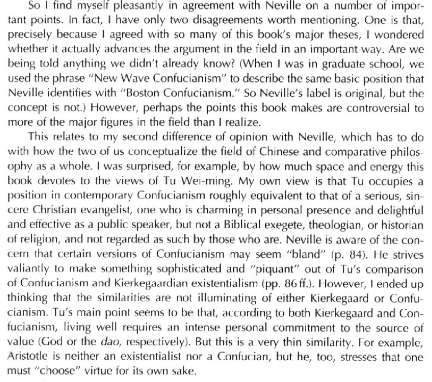
At least one indirect criticism of portable Confucianism was provided by Bryan van Norden in his 2003 review (PEW 53:3) of Neville’s book, Boston Confucianism (Albany, NY: State University of New York Press, 2000). I’m going to cut and paste (an image of) van Norden’s most critical comments, because I think he’s actually on to something, despite seeming only to be snarky (sorry about png quality–I’m too lazy to type all this out):

I have to admit, when I read *non-exegetical* pieces by Tu, there is something bland about his discussions–actually, they tend to strike me alternatively as bland or pragmatically undecipherable (What am I supposed to do with the fact of the dependency of human relations on larger patterns of connections to the cosmos as a whole? Study astronomy? Then what?) Is there something striking or captivating about what either Neville or Tu promote in their versions of Confucianism? Admittedly, I haven’t read enough of their works to be an expert; so let me know.

(Did I mention I was fearless?)

Lots and Lots of Dào

There’s a way of reading Dàoist philosophy according to which there is one great dào, and the Dàoist aim is to achieve some kind of relation to that one dào, presumably some kind of union.

As I understand it, this sort of reading implies that once you’ve achieved union with the dào, this will carry you through life no matter what it brings you. And this, I think, sits poorly with much of what we read in Dàoist texts. Verse 1 of the Dàodéjīng in particular is suspicious of the very idea of a single, constant dào; and the Zhuāngzǐ often seems to value a recognition of what is particular to the various situations we face.

So I suggest (I’m largely following Chad Hansen on this) that it would be better to think of dào as differing in different situations, and in ways that are largely unpredictable. Dào is thus not a single thing that one could relate to, or achieve union with, as a whole; no union we could achieve with dào now would carry us through the unpredictably various situations we are liable to face in the future.

(One could put my suggestion by saying that there are different dàos in different situations, but I prefer to follow the classical Chinese, in which “dào” is normally a mass noun.)

This implies that the Dàoist aim cannot be to achieve once and for all a union with the one great dào, it must instead be to maintain an openness to the different dào in different situations—just as, for example, the monkey keeper in Book 2 of the Zhuāngzǐ is open to the dào of his monkeys (in particular, to their preference for having their bigger meal in the morning). This is how I understand the value frequently placed in Dàoist texts on flexibility; I take it to be at the heart of the ideas of míng 明 (illumination) and of the pivot of dào in Zhuāngzǐ 2.

Should this openness itself be conceived of as a dào? This may be an issue over which Dàoists disagreed. The butcher in Zhuāngzǐ 3 loves dào because it takes him beyond skill—that is, beyond any dào he has previously mastered, so he can deal with the situation before him. But the swimmer in Zhuāngzǐ 19 denies that he has his own dào, saying he swims instead according to the dào of the water.

If we take openness to the different dào in different situations to be a dào, then it is a short step to thinking about this as the same as the dào according to which phenomena arise in nature. Perhaps it is in this sense that the texts sometimes tell us that dào is prior to heaven and earth.

Xúnzǐ on Desire

Next week I’ll be taking part in a roundtable discussion at the Pacific APA with Kurtis Hagen, Eric Hutton, and Aaron Stalnaker, and we’ll be talking about what Xúnzǐ had to say about desire. I thought I’d post here some of the thoughts I’ll be presenting there.

The question I want to raise (and I hope it is a provocative question) is whether Xúnzǐ thought of desire as a kind of motivation.

Here’s the argument that he did not. In “Correct Names” (but not the part of that piān that’s actually about naming) he argues against the view that social order requires eliminating or reducing desires. He claims that how we act depends not on what we desire (yù 欲) but on what we approve of (kě 可). He writes, “Desire does not wait for what we can get, but seeking (qiú 求) follows what we approve of (欲不待可得,而求 者從所可).” His main piece of evidence for this is that we have a deep desire for life, but are still able to choose death when we do not approve of the course of action that would be necessary to preserve our lives.

Now, when Xúnzǐ talks about desire, he focuses on desires for sensory gratification and for social acclaim. He rarely implies that the attitudes we might call moral desires are actually desires; these attitudes would, according to the passage in “Correct Names,” count as approvals rather than as desires.

Part of what’s going on here is that Xúnzǐ treats desires as constants of human nature: they arise spontaneously from xìng 性 regardless of what we do and regardless of how virtuous we are. Thus, moral excellence requires us to transform not our desires but the way we act on those desires (the behaviour that he calls seeking). His conception of desire, then, is rooted in his conception of nature more generally: just as nature provides a constant context to which human societies must respond, our desires provide a constant context that we must respond to when we act. But it is approval, not desire, that determines how we respond.

How does this constitute an argument that desire is not, for Xúnzǐ, a form of motivation? Two things. First, he seems to be saying that it is approval, not desire, that gives us our ends or goals. For example, in choosing death, one does not choose an end that has any basis in desire. Second, he sees no conflict between desire and approval. It is not as if there is a struggle between them that approval consistently wins—so his contrast of desire and approval is not at all like the traditional western contrast of reason and passion, which constitute two competing sources of motivation. His view is just that approval is the sort of attitude with which we adopt an end, and desire is not. And this to me suggests that he is not thinking of desire as a form of motivation.

This isn’t a knock-down argument; the concept of motivation may well be too vague to support a knock-down argument. Still, it impresses me that there’s a genuine question here.

Some Modes of Subjection

I want to take up a suggestion I made in the previous thread (here).

In the second volume of his History of Sexuality, Michel Foucault introduced a way of thinking about ethics that might be helpful in thinking about early Chinese ideas. He set aside questions about the content of the ethical code in question (for us, that would be a dào), and asks instead about the ways in which individuals are expected or invited to become ethical subjects.

Foucault’s analysis picks out as especially important the ethical substance (that in us which must be worked on in order to make us ethical subjects), modes of subjection (ways in which we conceive of ourselves in relation to the ethical code), the ethical work (practices of self-cultivation), and a teleology (the sort of being that one aims to become; the gentleman, the benevolent person, or the sage, perhaps).

My suggestion in the last thread was that appeals to human nature in the Mencius might be best thought of as implying a mode of subjection, and not, for example, an argument in favour of a Mencian dào. The idea is that Mencian ethics invites us to think of the dào as natural for us. (How exactly this gets spelled out differs from passage to passage; one important version is that goodness is in some sense already within us, and we just have to release it, a process that does not require force.) Reading the Mencius this way puts appeals to human nature in the context of an account of the psychology of virtue.

One question I have about modes of subjection in early Chinese thought concerns the extent to which they address individuals as individuals. The Mencius seems to do this. So perhaps does the Analects; a while back Patrick referenced an excellent paper by Herbert Fingarette that is easily read as implying that the Analects offers a mode of subjection that addresses individuals as individuals, in order to bring them into relation to a dào that gives no weight to individuality. (Patrick’s reference is here.)

We find something quite different in the Mòzǐ and, I think, in the Xúnzǐ. The Mohists ask us to see ourselves first and foremost as members of a social order (this is clearest in their arguments in favour of conforming upwards and caring inclusively). Xúnzǐ adds to this, for example he adds the idea that the social order is a response to a constant and non-purposive natural context, but like the Mohists he implies an ethical self-understanding that relates us to the dào as members of a social order, not as individuals.

(I wonder—do we have here the beginnings of an explanation of why scholars whose own assumptions about ethics are individualist tend to prefer the Analects and the Mencius over the Mòzǐ and the Xúnzǐ?)

Does this seem like a useful way to set up questions about early Chinese ethics? What other questions and answers does it suggest? I’m particularly interested in what if anything it might lead us to say about the Zhuāngzǐ. (My first ever paper in Chinese philosophy was an attempt to talk about Zhuāngzǐ in something like these terms.)