Author Archives: Manyul Im

University of Bridgeport

The Lexical Fallacy

I’m working on a review of Bryan Van Norden’s book, Virtue Ethics and Consequentialism in Early Chinese Philosophy. There is a very interesting discussion in his Introduction about what he calls “the lexical fallacy,” a fallacy that he notes was first pointed out to him by Kwong-loi Shun, in conversation.

Van Norden quotes Henry Rosemont (from “Against Relativism” (1988 ) in Larson and Deutsch’s Interpreting Across Boundaries), who actually formulates and uses the lexical principle that Bryan asserts to be fallacious. Let’s call it ‘L’:

(L) “…the only way it can be maintained that a particular concept was held by an author is to find a term expressing that concept in his text. Thus we cannot say so-and-so had a ‘theory of X,’ or that he ‘espoused X principles,’ if there is no X in the lexicon of the language in which the author wrote.” (Rosemont p. 41, footnote 11).

Maybe there is something fallacious about the principle. But Van Norden’s argument for its fallaciousness seems to rely solely on apparent counterexamples. Here they are (all from Van Norden p. 22)–I’ll number them so we can refer to them in discussion:

(C1) “…it seems clear that Anaximander and Anaximenes were doing philosophy, had views about philosophy, and (in some sense) had the concept of philosophy, even though both lived before the Greek term for philosophy, ‘philosophia,’ was coined by the Pythagoreans.”

(C2) “…Aristotle claims that there are ‘unnamed virtues,’ by which he means virtues that he has a concept for but which do not have names in Greek.”

(C3) “…outside of crossword puzzle fans and those in the shoelace industry, almost no English speakers know the word ‘aglet.’ However, I submit that almost all English speakers have the concept of ‘the plastic or metal tip on the end of a shoelace.’

The principle is fallacious, Van Norden further clarifies, because it requires one-to-one lexical correspondence (pp. 22-23): “A slightly different kind of case that illustrates why the lexical fallacy is a fallacy is that of someone who has no one word for a concept because she has several words for one concept.” Bryan asks:

(Q1) “Do we speakers of English not have the concept that corresponds to the contemporary Chinese ‘wo 我’ because we use two different words that translate it in different contexts: ‘I’ and ‘me’?”

(Q2) “Do speakers of contemporary Chinese not have the concept of ‘million’ because they have to use a phrase to express it rather than one lexical item (‘bai wan 百萬,’ literally ‘hundred ten-thousands’)?

I have a few questions that I hope we can discuss here.

First, what do we think of these counterexamples? Are they obvious?

Second, what would be the reason, or argument, that explains why L is fallacious and therefore why C1-C3 are counterexamples to L?

Third, is L something of a “straw man”? Is there some more plausible lexical principle that Rosemont should be after, for his purpose (which I assume is to invite a skeptical attitude toward projects like Bryan’s that take there to be in China theories of virtue or of human rights or whatever despite, let’s suppose, there being no clear “one-to-one” translatable Chinese term). Maybe there is some lexical principle like L that does not require one-to-one lexical correspondence but instead some other lexical correspondence?

Lot’s of questions. Please feel free to comment in any sort of way…

Such a deal…

Thanks to Yuri Pines for the link.

(http://www.chinadaily.com.cn/china/2008-06/05/content_6737093.htm)

Parents call on Confucius for exam good fortune

By Cao Li (China Daily)
Updated: 2008-06-05 08:12

The Temple of Confucius in the center of Shanghai’s old town was unusually full Wednesday morning.

Crowds of people, most of them in their 40s and 50s, burned incense, lit candles and prayed in and around Dacheng Hall where there is a sculpture of Confucius and also where national exams were held during the times of the imperial dynasties.

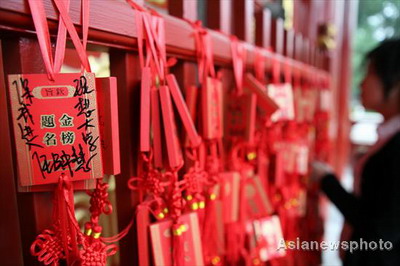
The good luck notes they hung on the trellises and trees outside the hall gave away their reasons for being there. Most read something like, “Dear Confucius, please help my son/daughter in the college entrance exam”.


A visitor hangs a good-luck tablet on a shelf at the Temple of Confucius in Beijing June 3, 2008. [Asianewsphoto]

With the national examinations starting on Saturday, a growing number of parents have turned to Confucius, as a way to ease the pressure.

A cleaner at the temple, surnamed Xu, told China Daily that local people hardly ever visit the temple, but in the past week, hundreds of them had been.

“There are so many visitors coming these days, all the oil and incense burners keep filling up and I have to empty them several times a day,” Xu said.

Visitors pay 12 yuan ($1.75) for a piece of notepaper, incense sticks, two candles and a length of red ribbon.

At the Temple of Confucius in Beijing, visitors have to pay 188 yuan for a wooden tablet on which to write their wishes, although the shelf on which these are then placed is now full, the Beijing Youth Daily reported Wednesday.

One of the visitors at the Shanghai temple Wednesday was 47-year-old Ye Qing. She said she was making a wish for her son who is hoping to study telecommunication engineering at East China Normal University.

“It will work if I am sincere enough,” she said.

About 100,000 Shanghai students will sit the college entrance exam between Saturday and Monday, and their parents are doubtless all hoping for the same good fortune.

Many, like Ye, have booked hotel rooms close to the test venues.

Staff at several hotels in the city’s Minhang district said they have been taking bookings since the beginning of last month, and many are now full, the Xinmin Evening News reported.

Sun Yu, a teacher at the Shanghai Foreign Language School, said parents are prepared to do whatever they can to help their children succeed, including enrolling them in expensive, extracurricular classes.

High school student Vicky Yang said all her classmates spend at least 500 yuan a month on exam-related books and extra lessons.

“Some pay up to 20,000 yuan a semester for classes that promise to help students secure a university place,” she said.

Apart from books and classes, parents also buy their children special tonics to drink, Yang said.

“If you collected up all the empty bottles of tonic my classmates have drunk, you could make a small hill.”

Report from Hong Kong

I’m just about to leave Hong Kong, where for the past two days we’ve been celebrating Chad Hansen and his work–he’s had to retire from HKU because of its mandatory retirement policy. What a great conference, organized by Chris Fraser, Timothy O’Leary, and Dan Robins! And what a great bunch of people there were, especially all his colleagues and students that I met in the HKU Philosophy Department!

(At some point this summer, Chad will be guest-blogging; that should be quite a treat. Keep an eye out for other guest-bloggers this summer as well.)

We’ll start doing more philosophy here in a couple of days after I get back to the States…I promise.

Naturalism & Metaphysics in Early China, part I

I’d like to sneak up on an interpretive issue about early Chinese philosophy from a couple of directions–call them “tentative pincers.” This post will be part I of a two-parter; it will deal with one of the pincers.

The interpretive issue is this: what can we attribute by way of ontology to the early Chinese? (So, as you can see, this is a really minor topic…ha ha.) Chad Hansen has argued at length about this in A Daoist Theory of Chinese Thought (passim). He argues that the whole package of abstract objects (ideas, minds, meanings, etc.) that comes from an Indo-European linguistic base for philosophical speculation, should be left out of a proper understanding of the early Chinese thinkers. The latter have at base a much more pragmatically oriented conception and/or use for language. So, the early Chinese see language primarily as a guidance system. That should color the views we attribute to them–ontological commitments do not venture beyond what is necessary for “getting about” in the world, with the result, for example, that we should understand concern with dao 道 “naturalistically” to be concern with ways of doing, rather than metaphysically to be concerned with some “supernatural,” perhaps abstract, thing to be revered. That’s of course a very cursory summary of Hansen, but we could talk more detail as it comes up. What I wanted to do was to take one step back from Hansen’s approach and discuss a couple of topics that strike me as necessary to clarify prior to Hansen’s argument: naturalism, on the one hand, and “the metaphysical,” on the other. So in this part, we’ll discuss naturalism.

Naturalism

How should we construe “naturalism” in the early Chinese context? I feel like I have some handle on naturalism, but only as a set of commitments of philosophers after the rise of empiricism in its various forms. How do we construe a pre-empiricist philosopher, either in the East or the West, as holding to naturalism? That might seem simple at first: any philosopher who explicitly or implicitly holds to a set of commitments identical to those of naturalism after empiricism is a naturalist. The problem, it seems to me, is that the going understanding of philosophical naturalisms requires someone who is a naturalist to constrain either their method or ontology through some form of reflective equilibrium with empirical science. Here’s why.

There are different ways to characterize views that are regarded philosophically as naturalistic. In recent analyses, at least two large categories of naturalism have been distinguished: methodological and substantive. Alvin Goldman (“A Priori Warrant and Naturalistic Epistemology” Philosophical Perspectives 13) characterizes the two kinds of naturalism, using “metaphysical” in place of “substantive”:

Some forms of naturalism involve metaphysical theses—for example, the thesis that everything in the world either is physical or supervenes on the physical—and some forms of naturalism involve methodological doctrines—for example the doctrine that proper methodology is purely empirical. (p. 2)

Substantive naturalism holds less interest for many contemporary philosophers because of its dogmatic, or potentially question-begging, flavor. Brian Leiter (“Naturalism in Legal Philosophy”, The Stanford Encyclopedia of Philosophy (Fall 2002 Edition), Edward N. Zalta (ed.), URL = <http://plato.stanford.edu/archives/fall2002/entries/lawphil-naturalism/>.) provides a useful expanded discussion of methodological naturalism, which holds more appeal and has a more complicated relationship with the empirical:

Naturalism in philosophy is most often a methodological view to the effect that philosophical theorizing should be continuous with empirical inquiry in the sciences. Such a view need not presuppose a solution to the so-called “demarcation problem”—i.e., the problem of what demarcates genuine science from pseudo-science—as long as there remain clear, paradigmatic cases of successful sciences. Some M-naturalists [i.e. methodological naturalists] want “continuity with” only the hard or physical sciences (Hard M-naturalists); others seek “continuity with” any successful science, natural or social (Soft M-naturalists). Soft M-naturalism is probably the dominant strand in philosophy today.

Assuming then that use of empirical inquiry can be demarcated, so that genuine sciences can be identified, methodological naturalism involves preservation of continuity, or coherence, of one’s own inquiries with a larger class of inquiries. “Continuity with” successful science, however, can be further spelled out by what Leiter refers to as “Results Continuity” and “Methods Continuity.” The former

…requires that the substantive claims of philosophical theories be supported or justified by the results of the sciences…. Moral philosophers like Gibbard and Railton, despite profound substantive disagreements, both think that a satisfactory account of morality’s nature and function must be supported by the results of evolutionary biology, our best going theory for how we got to be the way we are…. A philosophical account of morality that explains its nature and function in ways that would be impossible according to evolutionary theory would not, by naturalistic scruples, be an acceptable philosophical theory.

By contrast, Methods Continuity

…demands only that philosophical theories emulate the “methods” of inquiry of successful sciences. “Methods” should be construed broadly here to encompass not only, say, the experimental method, but also the styles of explanation (e.g., via appeal to causes that determine, ceteris paribus, their effects) employed in the sciences.

Understanding naturalism in these ways, it seems to me like naturalism of any sort has to privilege modern, contemporary science. For example, to be a “naturalist” about ethics, broadly speaking, is to think that the concepts and justifications in ethical theories ought to be constrained by what the available science deems likely to be true of the world, whether it is the kinds of properties and causes that exist generally for various kinds of events and objects, or the psychological explanations that exist for the actions and attitudes of humans and other animals. Alternatively, we could think of naturalism to involve not so much a direct constraint from available science, but at least a hearty commitment to reflective equilibrium that takes seriously into account the picture of the world that the empirical sciences portray.

So, here are some questions I’m mulling: Can empirical science, or empiricism more generally, be attributed to the early Chinese context? On the other hand, does it even seem necessary to connect naturalism to empiricism? Can “naturalism” or “naturalistic” be applied usefully to the early Chinese thinkers without attributing empiricism? Am I being too narrow in construing philosophical naturalism in the ways cited above?

Analogical Reasoning — not just ordinary inference?

Some commentators seem to regard “analogical reasoning” to be a distinct form of reasoning in the early Chinese philosophical context, attributable mostly to the later Mohists and to Mencius. So far as I’ve been able to understand it, the distinctiveness of such reasoning seems suspect; but I’m not 100 percent sure I’ve understood it correctly.

Part of the issue seems to be that we get an account of the method or technique of reasoning in the later Mohist canons, but we get what some people consider the most explicit, or at least self-conscious, use (or misuse) of the method in the Mencius. “Argument” in Mencius, according to most commentators, seems primarily to work on a model of analogy.

There is the statement from 3B9 of the Mencius that Mencius sees himself as engaged in bian 辯, “disputation,” in response to the Mohists. There are technical discussions in the later Mohist writings about the various modes of bian. Among them is the technique called tui 推, “to push” or “to extend.” As A. C. Graham translates the definition of the technique (A. C. Graham, Later Mohist Logic, Ethics and Science, 483), to tui is “…using what is the same in that which he refuses to accept and that which he does accept in order to propose the former” (tui ye zhe yi qi suo bu qu zhi tong yu qi suo qu zhe yu zhi ye 推也者以其所不取之同於其所取者予之也). So, as the later Mohists understand it, in this technique, one “pushes” the opponent’s judgment from a case he already accepts to another case, using something that both cases have in common. Hence this has often been called the method of “analogical inference.”

But now, consider the following reconstruction of so-called “analogical inference,” using the example from Mencius 1A7 that both Graham and Nivison examine as an example of such inference. The example is Xuan’s compassionate response to the ox being taken away to slaughter and the analogous case of his people, the people of Qi, who also seem to require compassionate response. Graham, Nivison, and most others think there’s an inference, then, that Mencius encourages Xuan to make.

Here’s what it seems to me to take, to go from the one case to the other:
1. Xuan ought to feel compassion for O, because O possesses F.
2. Q also possesses F.
3. Therefore, Xuan ought also to feel compassion for Q.

But it seems like we can further analyze 1 as relying on a suppressed premise, one which says something more general about feeling compassion for objects possessing F. If we push the analysis further, the entire inference involved in the case of this “analogical” inference seems most plausibly to be the following:
A. Xuan ought to feel compassion for objects that possess F.
B. O possesses F.
C. Xuan ought to feel compassion for O. (from A, B)
D. Q (also) possesses F.
E. Xuan (also) ought to feel compassion for Q. (from A, D)
A-E seems to spell out more explicitly how the Mohist principle of extending, which is the principle of applying rational pressure to treat similar cases similarly, would actually apply the rational pressure of maintaining consistency among one’s judgments. But then the technique of tui 推 is not so distinct or different from regular, boring inference. This raises two questions for me:

Q1) Have I misunderstood or misconstrued the technique?

Q2) Was I looking for something unreasonable in looking for something distinct or different in a reasoning technique in the first place? In other words, should we think, “Of course it turns out that analogical reasoning is just a familiar form of reasoning!”?

Xunzi and Mencius Meld

Some while ago (1999) I tried to argue that Mencius didn’t really believe in proactive moral cultivation because he thought of human nature as already possessing the directional force toward goodness. The only thing a ruler need do is to provide minimally stable political and economic conditions. Then, if people do not interfere with their own development or with the development of others, then everything will turn out fine, with mulberry trees growing in their seasons, the elderly not having to sweat in the fields, children being filial, etc. That puts Mencius more in line with the Daodejing’s political stance than people usually think, though of course he isn’t entirely for the rustic utopia the latter suggests.

Let me suggest here that if that isn’t Mencius’s view, then it is actually very difficult to justify Xunzi’s vehement opposition to Mencius. The view that most of us were taught to believe is that Mencius thinks humans have nascent capacity for goodness that then needs to be cultivated through education and moral training; then at the end of that process they may end up as good subjects, advisors, or the ruler. For convenience, let’s call that the “moral-training” reading of Mencius. The thing that strikes me as problematic here is that if this is indeed Mencius’s view, then there’s really no difference between it and Xunzi’s views of the matter. Or, perhaps I should say instead, either Mencius has a view that is different from Xunzi’s or Xunzi didn’t realize that his view doesn’t really differ from Mencius’s.

Here’s what I have in mind regarding Xunzi on capacities and cultivation. In the “Human Nature is Detestable” (xing e 性惡) chapter, Xunzi argues that anyone could (ke 可) become a sage like the sage-ruler Yu. But not everyone has the possessed ability (neng 能) to be a sage. As it turns out, everyone has the capacities to be ren 仁 and yi 義, benevolent and upright, but not everyone applies himself to the task of accumulating the effort and training to be good. Why is that any different from the view attributed to Mencius by the moral-training reading of him? If it isn’t different, then what is Xunzi’s beef with Mencius since they seem to hold the very same view?

Here’s some of the relevant Xunzi text (I’ve numbered the text so it’s convenient for us to talk about it; and I’ve typed in Watson’s translation):

  1. “塗之人可以為禹。”曷謂也?曰:凡禹之所以為禹者,以其為仁義法正也。然則仁義法正有可知可能之理。然而塗之人也,皆有可以知仁義法正之質,皆有可以能 仁義法正之具,然則其可以為禹 明矣。The man in the street can become a Yu. What does this mean? What made the sage emperor Yu a Yu, I would reply, was the fact that he practiced benevolence and righteousness and abided by the proper rules and standards. If this is so, then benevolence, righteousness, and proper standards must be based upon principles which can be known and practiced. Any man in the street has the essential faculties needed to understand benevolence, righteousness, and proper standards, and the potential ability to put them into practice. Therefore it is clear that he can become a Yu.
  2. 今以仁義法正為固無可知可能之理邪?然則唯禹不知仁義法正,不能仁義法正也。Would you maintain that benevolence, righteousness, and proper standards are not based upon any principles that can be known and practiced? If so, then even a Yu could not have understood or practiced them.
  3. 將使塗之人固無可以知仁義法正之質,而固無可以能仁義法正之具邪?然則 塗之人也,且內不可以知父子之義,外不可以知君臣之正。今不然。Or would you maintain that the man in the street does not have the essential faculties needed to understand them or the potential ability to put them into practice? If so, then you are saying that the man in the street in his family life cannot understand the duties required of a father or a son and in public life cannot comprehend the correct relationship between ruler and subject. But in fact this is not true.
  4. 塗之人者,皆內可以知父子之義,外可以知君臣之正,然則其可以知之質,可以能之具,其在塗 之人明矣。今使塗之人者,以其可以知之質,可以能之具,本夫仁義法正之可知可能之理,可能之具,然則其可以為禹明矣。Any man in the street can understand the duties required of a father or a son and can comprehend the correct relationship between ruler and subject. Therefore, it is obvious that the essential faculties needed to understand such ethical principles and the potential ability to put them into practice must be a part of his make-up. Now if he takes these faculties and abilities and applies them to the principles of benevolence and righteousness, which we have already shown to be knowable and practicable, then it is obvious that he can become a Yu.
  5. 今使塗之人伏術為學,專心一志,思索 孰察,加日縣久,積善而不息,則通於神明,參於天地矣。故聖人者,人之所積而致矣。If the man in the street applies himself to training and study, concentrates his mind and will, and considers and examines things carefully, continuing his efforts over a long period of time and accumulating good acts without stop, then he can achieve a godlike understanding and form a triad with Heaven and earth. The sage is a man who has arrived where he has through the accumulation of good acts.

As always, let me know what you think.

Wuwei (無為) – What does it mean?

Let me restart the conversation Hagop and I started on the Velleman post, but focus on more on wuwei 無為 just by itself. Here’s what Hagop had to say and how I responded:

Hagop:

I’m teaching the Zhuangzi right now in my Chinese philosophy class, and will be discussing Czikszentmihalyi’s concept of flow along with the stories of the skilled exemplars during our meeting today. Velleman mentions others having made the connection before. I, too, was pointed in the direction of Czikszentmihalyi (by David Wong), but can’t recall at the moment who has written of them together.

As for whether ‘flow’ is a good interpretation of wu-wei, I think there is room to quibble. The phrase ‘wu-wei’ appears two or three times in the inner chapters, and none in relation to Cook Ding. There’s a lot more talk about wu-wei in the outer chapters.

What’s more, the inner chapters seem to include many exemplars who literally ‘do nothing’ (as opposed to acting in a skilled-yet-spontaneous fashion). Think of Zhuangzi’s advice to sit in a gourd or lounge under a tree, or the big yak that is the foil for the weasel (aka Hui Zi), or Zi Qi of South Wall sitting still, or the trees Zhuangzi likes to talk about. All these exemplars are literally doing nothing, and not engaged in flow-like skill activity.

In fact, Butcher Ding is alone as a “skilled” exemplar in the inner chapters (am I foregetting anyone?). Other skilled individuals are mocked. Consider this passage (Watson 2003, 37):

“There is such a thing as completion and injury–Mr. Zhao playing the lute is an example. There is such a thing as no completion and no inury–Mr. Zhao not playing the lute is an example.”

This makes me think that the Butcher is not so central to Zhuangzi’s philosophy and, by extension, that flow is not so central to it either.

(If we are talking about the text as a whole, though, there is more support for the interpretation of wu-wei as flow. In fact, since wu-wei occurs far more often in the outer chapters, along with other stories of skilled exemplars, then perhaps wu-wei as something like ‘flow’ is a later development of the Zhuangist school.)

Me:

Hagop, I agree with you about the “flow” interpretation of Zhuangzi, and I think it’s not merely a quibble. What always struck me were the power of the unintuitive examples in the De Chong Fu (”Sign of Virtue Complete” in Watson): People who’ve had their feet, hands, or noses lopped off for offenses against the kingdom, who aren’t skilled in much if anything, and who, like the useless tree, get along in life precisely by being *unskilled*, i.e. useless. Most noteworthy is Ai Tai Tuo who is both ugly and stupid, yet is someone who can be described as complete in talents 才 and power 德. I’ve never been sure that those examples were even compatible with a “flow” reading, particularly when paired with excellence in skill.

*************************

Despite the title of this post, I think it’s clear what wuwei means at a base level: “non-doing.” But the problem is how further to understand it — non-intentional doing? non-purposive doing? non-forced, effortless, doing? some other thing? Each of those understandings of it implies very different things, suggests very different examples and images, and seems to commit people to very different readings of Daoism. My own thought about the Zhuangzi is that there is more emphasis on something like “non-learned action” in both of senses of “learned”–picked up through training and picked up through advanced education or acculturation.

Another point is how much the concept of wuwei is particular to Daoism. There seems to be really one Confucian instance of it–the two-character phrase itself, at any rate–with the “non-doing” meaning, in Analects 15.5:

子曰:“無為而治者,其舜也與?夫何為哉,恭己正南面而已矣。”

The Master said, “May not Shun be instanced as having governed efficiently without exertion? What did he do? He did nothing but gravely and reverently occupy his royal seat.” [Legge]

But is the concept more generally influential in Chinese philosophical temperament? If so, in which sense or senses, and why?