
Dao: a Journal of Comparative Philosophy 21:1 has been published. There are 11 articles in this issue that was published in March of 2022. See below for the Table of Contents.
Category Archives: Comparative philosophy
Upcoming Neo-Confucianism Seminar on Kang Youwei
The next session of the Columbia University Seminar on Neo-Confucian Studies will convene on Friday April 1st from 10-11:30 am EDT, over Zoom.
The speaker will be Federico Brusadelli of the Università di Napoli L’Orientale, now also a Visiting Fellow at the Polish Institute of Advanced Study. Professor Brusadelli will present his draft “Race, Reproduction, Resources: Kang Youwei’s Datongshu as a 20th-century Global Prophecy.”
If you’d like to receive the paper and join the meeting, please contact Nolan Bensen, Rapporteur for the Seminar on Neo-Confucian Studies.
CFP: Truth and Asian Philosophy
The Asian Journal of Philosophy is pleased to announce a call for papers for a Topical Collection on “Truth and Asian Philosophy.”
The Asian Journal of Philosophy is a brand new journal that aims to publish high-quality articles in any area of analytic philosophy, including what might be called “Asian analytic philosophy,” which is the journal’s way of referring to engagement with Asian philosophical traditions utilizing analytic philosophical methodologies and vocabularies. The journal aspires to be a leading platform for analytic philosophy in Asia. You can find more information about the journal here: https://www.springer.com/journal/44204
For this Topical Collection on “Truth and Asian Philosophy,” we are interested in papers that engage with questions relating to truth and Asian philosophy. Some sample research topics might include but are certainly not limited to:
- How is truth as a concept manifested in Asian philosophical traditions?
- What can cross-cultural inquiries tell us about truth as a philosophical concept?
- What can we learn about truth from studying Asian traditions?
Papers for the Topical Collection will be published in regular issues of the journal rather than in a dedicated special issue, so we have some flexibility in when we are able to process submissions.
Gettysburg Workshop on Chinese and Comparative Philosophy: Openness, Contingency, and Change
The Gettysburg College Philosophy Department & the Norman E. Richardson Memorial Fund present:
Gettysburg Workshop on Chinese and Comparative Philosophy: Openness, Contingency, and Change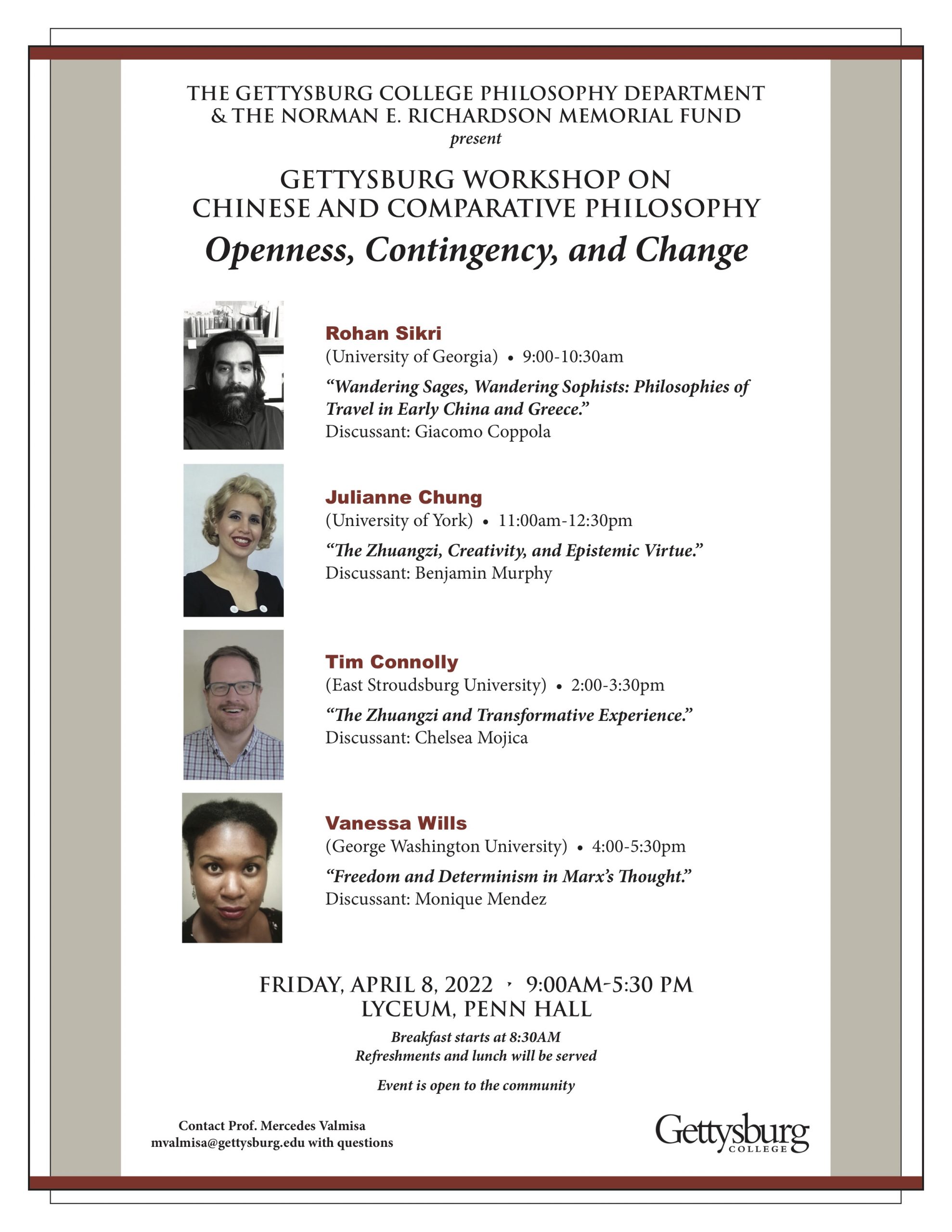
Friday, April 8, 2022, 9AM-5:30 PM, Lyceum, Penn Hall
Breakfast starts at 8:30AM, refreshments and lunch will be served
Event is in person and open to the community; contact Prof. Mercedes Valmisa mvalmisa@gettysburg.edu with questions
- 9-10:30 Rohan Sikri (University of Georgia), “Wandering Sages, Wandering Sophists: Philosophies of Travel in Early China and Greece.” Discussant: Giacomo Coppola
- 11-12:30 Julianne Chung (University of York), “The Zhuangzi, Creativity, and Epistemic Virtue.” Discussant: Benjamin Murphy
- 2-3:30 Tim Connolly (East Stroudsburg University), “The Zhuangzi and Transformative Experience.” Discussant: Chelsea Mojica
- 4-5:30 Vanessa Wills (George Washington University), “Freedom and Determinism in Marx’s Thought.” Discussant: Monique Mendez
Survey for Confucian Robotic Ethics project
JeeLoo Liu writes:
In continuation of my “Confucian Robotic Ethics” project, I have now embarked on a research on incorporating Confucian virtues in designing Ethical AI for Social Robots. But to do so, I need to first understand what people regard as the more important virtues when two sets of virtues (such as loyalty and humaneness; honesty and loyalty; or obedience and righteousness) conflict with each other in various cases of moral dilemmas.
I would like to know what you think about what future autonomous robots should do in situations involving (1) robot assisted suicide (2) whether a robot should lie or not (3) what principle should rescue robots use to decide whom to rescue first (4) should robots obey human order when such orders violate moral principles. These four sets of scenarios have 15 short questions each, and they are philosophically challenging. It takes about 10 minutes for each set, and you have the choice to continue to the next set or exit.
I hope you will find it interesting to answer them. Also, please help spread the word: post it on social media, encourage your students, friends, and family members to do the same.
The survey is completely anonymous and is conducted in three languages: English, Spanish and Chinese (both traditional and simplified). The main site is http://www.fullerton.edu/ethical-ai
Thanks
JeeLoo
______________________
JeeLoo Liu
Professor
Distinguished Faculty of H&SS
Office: H-311G
Department of Philosophy
Cal State University, Fullerton
Fullerton, CA 92834
New Book: Kwon, Confucian Sentimental Representation
Book title: Confucian Sentimental Representation
Kwon conceptualizes a unique mode of political representation in East Asian society, which derives its moral foundation from Confucian virtue politics. Contemporary East Asian societies understand democracy differently than Western societies do. Even citizens in consolidated democracies such as Taiwan and South Korea have different conceptions of an ideal relationship between a political leader and ordinary citizens, as well as a political leader’s accountability and political legitimacy. A political leader’s proper conduct, including his/her everyday languages, behaviors, and expressions when facing citizens’ sorrow, anger, and resentment, plays a crucial role in evaluating whether his/her has political legitimacy in East Asian society. Kwon analyses how this ‘affective accountability’ forms the basis for political representation in these societies and examines how this can be reconciled with liberal democracy.
Kyung Rok Kwon is a postdoctoral fellow of Research Center for Humanities and Social Sciences at Academia Sinica (Taiwan).
ISCWP January 2022 Newsletter
Here is the most recent ISCWP newsletter with news from ISCWP members, a Call for Papers, and information on the China Studies Program Ph.D. Fellowships.
The Newsletter is now also available on the ISCWP website: http://www.iscwp.org
Chinese/Comparative Philosophy Panels at 2022 Central APA
The 2022 Central APA meetings are coming up next month in Chicago; details are here. I have done my best to list panels that are relevant to this blog’s concerns below; please note and additions or corrections in the comments. I’ll be there and hope to see some of you in person!
New Book Series: Philosophy Across Borders
Oxford University Press is seeking submissions of proposals for a new series: Philosophy Across Borders. OUP is committed to publishing high quality philosophical work that draws on broad sourcing to create novel philosophy or novel approaches to recognized problems, methodologies, or approaches. The hope is that books in the series will exhibit conversation between traditions or cultural sources not often engaged together. This might include, e.g., engagement between underrepresented traditions and more widely studied western sources, but it could also include work that engages multiple underrepresented traditions not often engaged together. The goal is not to re-create comparative philosophy, but to provide accessible philosophical work that simply does philosophy in an idiom that is open and global. If you have a proposal for the series, please contact any of the series editors below or the OUP editor, Peter Ohlin.
Series Co-editors: Kristi Dotson, Bronwyn Finnigan, Jonardon Ganeri, Amy Olberding, Evan Thompson
ToC: Dao 20:4
Dao: A Journal of Comparative Philosophy 20:4 has been published. See below for the Table of Contents.
