Category Archives: Comparative philosophy

TOC: Journal of Confucian Philosophy and Culture Vol. 36

The editors are delighted to announce the publication of Volume 36 of the Journal of Confucian Philosophy and Culture (JCPC), with the Special Topic: Texts and Contexts: Women in Korean Confucianism, and featuring Professor Hwa Yeong Wang as guest editor.

JCPC is published biannually (in February and August) and welcomes contributions of both articles and book reviews by qualified authors from around the world. The journal is cross-disciplinary in its outlook and presents work from philosophers, anthropologists, psychologists, sociologists, historians, theologians, political scientists as well as other disciplines. JCPC examines the historical, doctrinal, literary, social, and political developments that have formed contemporary versions of Confucianism for the purpose of interpreting and exploring Confucianism from a modern perspective. The Journal is indexed in AtlaSerials, BAS (Bibliography of Asian Studies), MLA Directory of Periodicals, and KCI (Korea Citation Index). The attached file contains the cover and complete table of contents of Volume 34.

The complete volume is available online at our web site: http://jcpc.skku.edu/.

On-line lecture: Confucianism and the Political Theory of the Business Corporation

Date: 17 September 2021 (Friday)

Time: 16:00 (HKT)

Venue: Online (This talk will be held via Zoom.)

Participants: Chi Kwok, Lingnan University; Sungmoon Kim, City University of Hong Kong

Registration is required. Please email: joogangl@gmail.com

Click here to view flyer.

Abstract: Despite the burgeoning literature in contemporary Confucian political theory, little effort has been devoted to the exploration of the implications of Confucianism to economic justice. Among the few exceptions, Chan (2013) argues that Confucianism would require a sufficientarian, yet inegalitarian, distributions of economic resources; Kim (2019) suggests that Confucianism could offer an account of the political economy of harmony where distributive values of equality, need, and merit “could have their own place”. Although these are important contributions, these works’ focal point is on developing a general outlook and guiding principles of a Confucian moral economy. This paper argues that the modern relevance of a theory of moral economy depends to a significant degree on whether it could offer an attractive normative account to the legally privileged economic agent, business corporation, which enjoys legal rights such as legal personality, limited liability, asset shielding that are unavailable to other market actors. The paper attempts to build a bridge between contemporary Confucian political theory and political theory of the business corporation for two purposes. First, it offers a better ontological account of the business corporation for Confucian political theory to intervene in debates about the business corporation. Second, it also offers alternative moral resources to develop a political theory of the business corporation beyond the usual liberal democratic framework in the literature.

CFP: EACS Young Scholar Award 2022

The Board of the European Association for Chinese Studies is pleased to announce the EACS Young Scholar Award (YSA). The purpose of this award is to encourage research in Chinese studies among young scholars, especially, but not exclusively, scholars studying and working at European institutions.
(See eligibility and submission info below)

Continue reading →

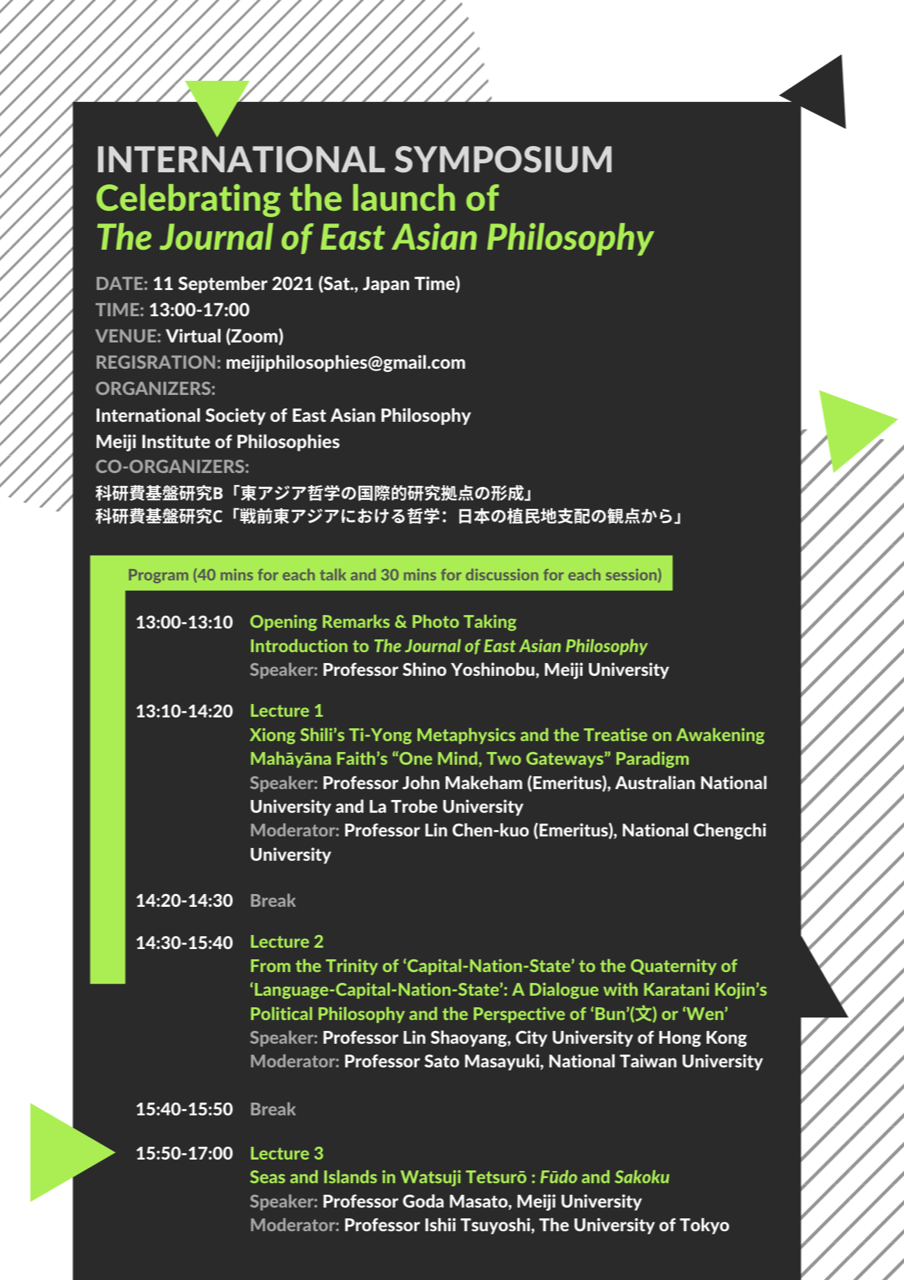
International Symposium: Celebrating the launch of the Journal of East Asian Philosophy

The Meiji Institute of Philosophies(MIPs) and International Society of East Asian Philosophy (ISEAP) are pleased to inform you that they are going to have an international symposium, “Celebrating the launch of The Journal of East Asian Philosophy,” as follows:
Date: 11 September 2021 (Sat., Japan Time)
Time: 13:00-17:00
Venue: Virtual (Zoom)
For registration for participation or any other inquiries, please do not hesitate to contact us at meijiphilosophies@gmail.com.

Please refer to the attached flyer for more details.

JOB: Tenured/Tenure-track Position in Chinese Religions, NYU Shanghai

NYU Shanghai is currently inviting applications for an open-rank position in Chinese religions. We seek candidates who have completed a Ph.D. in Chinese religions, East Asian Studies, or a closely related discipline. We invite applications from candidates working on any of the Chinese religious traditions (Confucianism, Daoism, Buddhism, or popular religious practices in China), with the ability to teach their connections to other parts of Asia.

Continue reading →

Job Opening: Ethics with interest in comparative perspectives at Sophia University

The Faculty of Liberal Arts, Sophia University, invites applications for an open-rank position in philosophy with a specialization in Ethics (Assistant Professor is a five-year tenure-track appointment, while appointments of Associate Professor and Professor are tenured).

We seek candidates who are qualified to teach courses in western philosophical and intellectual traditions, and welcome applicants working from a comparative or multi-cultural perspective. Our faculty is committed to promoting gender balance and we have a strong preference to hire a female candidate.

For more information, please visit: https://www.h-net.org/jobs/job_display.php?id=61655

Ethical Theory and Moral Practice soliciting non-Western submissions

Ethical Theory and Moral Practice encourages submissions on non-western philosophical traditions, especially those that interface contemporary ethics and Asian philosophies. This is part of the editorial team’s ongoing efforts to expand the journal’s repertoire of traditions, ideas and approaches beyond what is typically considered to be mainstream ethics and practical philosophy, and to foster dialogue and engagement across cultures and methodologies. We also invite proposals for book reviews as well as for special issues that engage Asian philosophical traditions. Proposals for special issues are evaluated twice a year through our regular selection process, with deadlines on October 1 and April 1.  

For more information about the journal, please visit https://www.springer.com/journal/10677