
Asian Philosophy 30:3 has been published, with articles on Zhuangzi, Li Zehou, gender in Korean Neo-Confucianism, and more. Details are here.
Angle Reviews Bell and Wang, Just Hierarchy
My review of Daniel Bell and Wang Pei’s book Just Hierarchy: Why Social Hierarchies Matter in China and the Rest of the World (Princeton, 2020) has been published in Ethics; see here. The review ends as follows:
…Perhaps a different approach is in order, one more rooted in China’s dynamic traditions than in the modernism that colors some of Bell and Wang’s thinking. Recalling Zhang Zai’s Western Inscription, we could think about the relationality inherent in the entire, ever-changing cosmos and conceptualize these relations through various degrees of kinship. Care, attention, reciprocity, mutuality, learn- ing, and growth would be the watchwords of such a perspective. There is an important place for just—or maybe more accurately, humane or harmonious—hierarchy in such a vision, and Bell and Wang can be important conversation partners in working out what is and what is not valuable among both traditional and more recent forms of social differentiation. Much of this differentiation (such as sexism and racism) needs strong critique, but at the same time, there is reason to agree with Aaron Stalnaker’s concern that modernity in many societies has been characterized by a “systematic pathologization of dependence” (Mastery, Dependence, and the Ethics of Authority [Oxford: Oxford University Press, 2020], 24). Drawing on Wang and Bell’s book and also on more thoroughgoing efforts to engage with traditional philosophical resources from around the world, it should be possible to identify and defend unequal but healthy forms of social cooperation.
ISCP panels at on-line APA
interview with the New Books Network
At the risk of shameless self-promotion, I’m posting to a link to a recent podcast interview about my new book, The Art of Chinese Philosophy, hosted by the New Books Network. Thanks to Alexus McLeod for some very thoughtful questions!
New Books Network | Paul Goldin, “The Art of Chinese Philosophy:…
David Chai was recently interviewed on the same network:
New Books Network | David Chai, “Zhuangzi and the Becoming of…
End-of-term report on “Living a Good Life”
My colleagues Tushar Iriani, Steven Horst, and I have a post at the Daily Nous site about our experience teaching a new “Philosophy as a Way of Life” course that centrally features students doing structured philosophical exercises associated with each of the four main schools we covered (Confucianism, Aristotelianism, Daoism, and Stoicism). The course website itself is here; each of the “Live Like a ______” weeks are linked from here. Comments or questions either here or at Daily Nous most welcome!
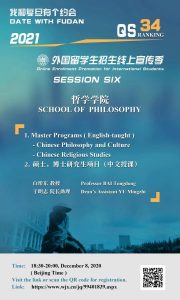
Information session on Fudan’s English-based MA program in Chinese Philosophy
18:30-20:00, Dec. 8 (Tuesday) 2020, Beijing Time. Open to all. See poster below for details.
CFP: Teaching East Asia in the Humanities
Call for Proposals: Teaching East Asia in the Humanities
April 24-25, 2021 (via Zoom)
The past decade has produced a great corpus of literature which defends and reimagines the value of the humanities—its potential to cultivate critical reasoning and cultural literacy necessary for a healthy civil society (Helen Small, 2013), ethically meaningful reading practices (Peter Brooks, 2014), and the character and judgement required to become “more human” (James Hankins, 2017). For teachers of the humanities, maintaining the sort of engaged pedagogy necessary to deliver on these promises means frequent trial and error. This conference is designed to serve as a forum to discuss both our challenges and successes in achieving our goals as humanities teachers in East Asian fields.
We invite proposals that reflect on your own stories of challenging and rewarding moments in your teaching, as well as common pedagogical strategies within your fields. How do we grapple with tensions between global and local perspectives? How do we account for particularities (philosophical concepts, literary forms, and social institutions) in East Asia while avoiding essentialisms, or introduce students to Western theory without perpetuating discursive hegemony? How should we navigate or challenge the boundaries imposed by the premodern/modern divide, or disciplines such as history, literature, philosophy, and religion? What pedagogical hurdles and advantages accompany teaching translated sources? Ultimately, how should we tailor our pedagogy to foster humanistic thinking?
CEACOP Workshop: Modern Confucianism between Philosophy and Sociology
The Center for East Asian and Comparative Philosophy (CEACOP) at the City University of Hong Kong is organising a workshop on 10 Dec in which Prof. Ralph Weber and his team will present their projects on 20th century Confucianism. Please find the event poster here with information about how to register. All are welcome!
Remembering Burchard J. Mansvelt Beck
A message from Paul van Els:
Recently, a widely beloved Leiden University teacher of Classical Chinese, Burchard J. Mansvelt Beck, passed away. He introduced many generations of students to the Mencius, the Analects, and other texts. He also translated into Dutch the Laozi and the Four Canons of the Yellow Emperor, and wrote an introduction to Confucianism. I wrote a (rather lengthy) obituary to honor the memory of this special teacher, which also includes a list of his publications. Please see here.
Editor Position Available with the JOCH
The Journal of Chinese Humanities (JOCH) is expanding operations by adding an editor to our staff. The position is full time and would require the applicant to locate to Jinan, China.
Responsibilities will include processing and reviewing English and Chinese language submissions, communicating with authors, editing articles and translations, organizing article and book reviews, marketing and outreach, planning journal development, and organizing academic activities.
Qualifications are as follows:
• Fluent in English, with the ability to compose written works in academic English
• Proficient in Chinese reading, writing, and speaking
• Background in major field of sinology e.g. philosophy, literature, or history
• At least a Master’s Degree in a field of sinology (PhD preferred)
• Editorial experience a plus
JOCH is an English language, SCOPUS indexed journal for traditional Chinese literature, history, and philosophy.
The position is open until filled. Preference to early applicants. Interested parties should send a CV and statement of interest to Patrick Cody Turk at Patrick@journalofchinesehumanities.com
