Category Archives: Religion

Confucian Fundamentalism?

As a follow-up to my earlier post regarding the controversy that has arisen around the proposed Christian church in Qufu, the following remarks from Prof. Peng Guoxiang of the Tsinghua University Philosophy Department are quite interesting (I quote his remarks with his permission):

…Some self-proclaimed Confucians…are trying to stop [the church] by launching a social movement. This fundamentalist attitude, mingling with nationalism, is embraced not only by the young people, but also by some scholars in Confucian studies. A typical feature of Confucian tradition, religious tolerance and open-mindedness, which we have been proud of and exactly from which that multiple religious participation and multiple religious identity has been developed, is now severely damaged by this extremism. How to redevelop a healthy and profound Confucian vision as one of the great spiritual traditions and make its contributions to humankind in a global context is really a painstaking project.

Also: Continue reading →

Confucians React to Planned Christian Church in Qufu

An open letter, signed by several prominent Chinese scholars and endorsed by numerous Confucian organizations, has been released criticizing the plans to build a large Christian church in Qufu, about 3 km from the Qufu Confucian Temple. The letter begins:

We have recently heard that a large, Gothic-style Christian church, more than 40 meters high and capable of holding more than 3000 people, is under construction in the vicinity of Qufu’s Confucian Temple. We Confucian scholars, organizations, and websites are deeply shocked and worried, and call upon all concerned parties to respect this sacred ground of Chinese culture and halt construction of this Christian church….

I paste the entire letter, including the list of signatories (many of whom have been prominently identified with “Confucian teaching” or “Confucian religion” [rujiao 儒教]), below.  Continue reading →

NEH Summer Seminar on Daoist Literature and History

Terry Kleeman and Steve Bokenkamp will be jointly offering an intensive, 3-week Summer Seminar this coming summer. They write:

This intensive reading seminar, introducing texts from the earliest Celestial Master petitions to manuscripts still in use among Daoist in Taiwan and China, will be held on the campus of the University of Colorado in Boulder from July 18 to August 5, 2011.  We are looking for scholars who want to learn how to read Daoist texts and would like to expand their research and teaching to incorporate Daoist individuals, texts, teachings, and practices. There will also be an opportunity to participate in an anthology of translations from Daoist sources.  The Seminar will be demanding but participants will be free to explore the mountains on weekends.  NEH provides a $2,700 stipend to defer travel and living expenses; we expect housing on campus to run roughly $1150 (shared) or $1800 (single) per person.

For more information, see their website.

Resuming Duties

I’m officially back in Fearless Leader mode. I’d like to thank Dan Robins very much for guest blogging. We’ll have Dan back in the future, I’m sure (not that he’s going away; I’m sure he’ll be very active in commenting). I’ll be starting some posts composed by my Phil. 245 (‘Confucianism’) students in the next few days. Meanwhile, I thought it would be fun to discuss “portable tradition,” a phrase Robert Neville uses to describe “Boston Confucianism.” The idea of Boston Confucianism was used initially tongue-in-cheek by Neville to refer to the New Confucian movement, in which he included Tu Wei-ming and himself, both of whom teach in Boston–one north of the Charles River (at Harvard) and one south (at BU).

The portability of Confucian tradition is based on the idea that there is nothing necessarily parochial, geographically speaking, about Confucianism–one need not be culturally Chinese or Sino-centered for the tradition to have some intellectual hold or appeal. You don’t have to be Greek, likewise, to be a Platonist. At this level of generality, it all sounds fine, if not innocuous. There is, however, the lingering question of portability not so much across geography (narrowly construed), but across time: is Confucianism portable into modernity and post-modernity?

At least one indirect criticism of portable Confucianism was provided by Bryan van Norden in his 2003 review (PEW 53:3) of Neville’s book, Boston Confucianism (Albany, NY: State University of New York Press, 2000). I’m going to cut and paste (an image of) van Norden’s most critical comments, because I think he’s actually on to something, despite seeming only to be snarky (sorry about png quality–I’m too lazy to type all this out):
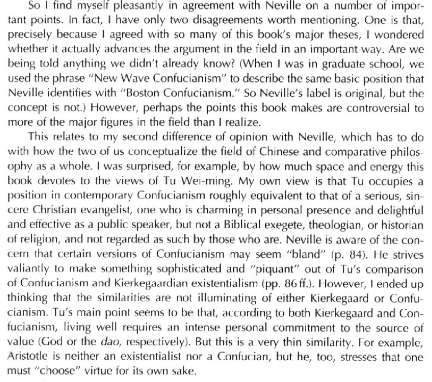
I have to admit, when I read *non-exegetical* pieces by Tu, there is something bland about his discussions–actually, they tend to strike me alternatively as bland or pragmatically undecipherable (What am I supposed to do with the fact of the dependency of human relations on larger patterns of connections to the cosmos as a whole? Study astronomy? Then what?) Is there something striking or captivating about what either Neville or Tu promote in their versions of Confucianism? Admittedly, I haven’t read enough of their works to be an expert; so let me know.

(Did I mention I was fearless?)

Reverence, the Spiritual, and the Sacred in Confucianism

These themes seem to have come up in a few different posts, so I thought we might try to tie together some of the strands. I know it’s asking for a lot, but is there any way to get some clarity on how these concepts operate within the history of Confucianism?

I’m assuming there is some close network of meaning within which each of these can be used to understand each of the others–e.g. “the sacred” is something that calls for reverence; reverence is to be distinguished from a purely socially understood concept of respect because reverence is tied to value of a spiritual sort; and so forth.

[Brief digression: I’m sure many of you know more about Durkheim than I, but it seems like “the sacred” is some sort of indefinable, basic concept on his view; I’ve never found that very helpful (someone correct me, please, if I’m totally misreading Durkheim). I only bring Durkheim up because of Fingarette’s clear use of Durkheim’s template in allowing that “the secular” (as opposed to “the profane”) could be part of the sacred–Fingarette’s book on Confucius is called Confucius: the Secular as Sacred, for those who might not know.]

I think if we look at the instances of jing 敬 in the Analects, Mencius, Liji, and other pre-Buddhist texts, it seems to me like it could easily be translated as “respectfulness” rather than “reverence.” I think the main question, whether it is about translating jing or understanding the junzi’s pursuits as in some sense spiritual, is going to be about what the larger template of analysis is that makes the texts “speak to” spiritual or sacred concerns. I think I can see what that template is for understanding the neo-Confucians in that way: reaction to and partial assimilation of Buddhist concerns that are more clearly driven by soteriological goals. I’m not sure what the template should be for the early Confucians–despite having read Fingarette more than a few times. And I don’t know as much as I should about the New Confucians to understand how they would see themselves addressing issues of reverence, the spiritual, or the sacred.

Well, that’s what I’ll start with. I’m sure I’ll learn a lot from responses to this post.