
In this episode, we are joined by Mark Csikszentmihalyi, Professor of East Asian Languages and Cultures and Eliaser Chair of International Studies at the University of California, Berkeley, and a leading scholar of early Chinese thought. Our conversation draws on his new book, Confucius: A New Tradition (Reaktion Books, 2026), and its striking portrayal of Confucius as a “ritual prodigy.” Through several passages from Book 10 of the Analects, we explore what ritual expertise involves, whether moral and practical wisdom can be innate, and how seemingly minor details of dress and conduct express or instantiate important social and ethical values. We also discuss Confucius’s participation in an exorcism ritual, changing interpretations of ghosts and spirits, and the famous story of Confucius’s reaction to the burning of his horse stables. Along the way, we consider how successive biographies and commentaries have continually reconstructed Confucius to address new philosophical and historical concerns.
First passage: Confucius’s style of dress (Analects 10.6)
君子不以紺緅飾。紅紫不以為褻服。當暑,袗絺綌,必表而出之。緇衣羔裘,素衣麑裘,黃衣狐裘。褻裘長。短右袂。必有寢衣,長一身有半。狐貉之厚以居。去喪,無所不佩。非帷裳,必殺之。羔裘玄冠不以弔。吉月,必朝服而朝。
The junzi [“gentleman,” “superior person”] does not hem his upper robes with crimson or maroon. He does not employ red or purple for leisure clothes. In hot weather, he always wears a singlet of fine or coarse hemp as an outer garment. With a black robe he wears a lambskin jacket; with a plain robe he wears a fawnskin jacket; with a yellow robe he wears a foxskin jacket. His leisure jacket is long, but the right sleeve is cut short. He always wears sleepwear that is half again as long as his height. Thick skins, such as fox and badger, are used at home.
Upon putting aside mourning clothes, he places no restrictions on the ornaments he may hang from his sash. Apart from robes for sacrificial ceremony, the layers of his robes are cut to different lengths. He does not wear a lambskin jacket or black cap when making a condolence call. On the first day of the new year, he always goes to court dressed in full court robes. When undergoing purification, he always wears a robe of plain material. In fasting, he always alters his diet and alters from his usual seat when at home.
(Robert Eno’s translation, in The Analects of Confucius, freely available online)
Second passage: Confucius at drinking events and exorcisms (Analects 10.10-10.11)
鄉人飲酒,杖者出,斯出矣。鄉人儺,朝服而立於阼階。
When villagers gathered to drink wine, he left as soon as those bearing walking staffs departed. When villagers mounted the annual exorcism procession, [the Master] stood in court robes at the eastern steps of his residence.
(Robert Eno’s translation, The Analects of Confucius)
Third passage: The barn’s on fire! (Analects 10.12)
廄焚。子退朝,曰:「傷人乎?」不問馬。
When the stables burnt, the Master returned from court asking, “Was anyone hurt?” He did not ask after the horses.
(Robert Eno’s translation, The Analects of Confucius)
Sources and phrases mentioned
- Mark Csikszentmihalyi (our guest)
- Mark Csikszentmihalyi, Confucius: A New Tradition
- People and destinations from Richard’s journey: Yonsei University, Ewha Women’s University, Sogang University, Halla Kim, Shandong Province, Xintai (City) 新泰市, Mount Tai 泰山
- pian 篇 (“book,” “chapter”)
- Youngsun BACK
- Han Dynasty (206 BCE – 220 CE)
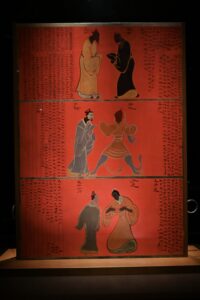
- Haihunhou Tomb 海昏侯墓, the excavated tomb where they discovered a mirror stand with what is now the earliest surviving biography of Confucius (picture of the mirror stand above)
- Mark Csikszentmihalyi, “Confucius” (Mark’s Stanford Encyclopedia of Philosophy article on Confucius)
- Russell T. McCutcheon, The Insider/Outsider Problem in the Study of Religion
- Sima Qian 司馬遷, the Shiji 史記 (Records of the Grand Historian, Records of the Archivist)
- Ezra Pound (1885-1972), American poet who had strong interests in Confucianism
- Baihu tongyi 白虎通義, Han-dynasty text that Mark references, composed circa 79 CE
- Analects 10.9, passage reporting that Confucius wouldn’t sit unless his mat was straight
- Zhu Xi 朱熹 (1130-1200 CE), Neo-Confucian philosopher who wrote a tremendously influential commentary on the Analects
- li 禮, “rites,” “rituals,” “ritual propriety”
- Analects 9.3
- Analects 7.7
- Analects 10.13, depicts Confucius adjusting ritual protocols to accommodate illness
- Analects 3.17, “the sheep and the ceremony”
- Episode 15: Ritual in the Analects (January 1, 2025), on “the sheep and the ceremony” passage (Analects 3.17)
- Chesterton’s Fence
- “Leviticus,” a book in the Judeo-Christian Bible that describes the finer points of some religious protocols
- Kong Anguo 孔安國 (circa 156 – circa 74 BCE), a traditional commentator from the Han dynasty
- Huang Kan 皇侃 (488–545), a later traditional commentator
- The Liji 禮記, the Rites, the Book of Rites
- Analects 11.12
- qiu 丘 (hill, mound, and also the personal name of Confucius [Kong Qiu 孔丘])
- Xunzi, ch. 5 (the Feixiang 非相, “Against Physiognomy” chapter)
- The Spring and Autumn Annals (Chunqiu 春秋)
- Mengzi 7A16, describes Shun as “a quick study” of virtue
- Other sources of the story of Confucius and the burning stables: the Liji 禮記 (the Rites), Kongzi Jiayu 孔子家語 (The Family Sayings of Confucius, recently translated by Brian Bruya and Wenwen Li)
- “Genesis,” a book in the Judeo-Christian Bible
- Aristotle, De Anima (On the Soul)
- “graded love,” “care with distinctions” (ai you chadeng 愛有差等)
- “Confucius as uncrowned king,” refers to a particular account of Confucius as someone who had the qualities of a great ruler but never had the opportunity to rule
- The Liu Family, the Liu House of Han (Han Liu Shi 漢劉氏)
- Dao 道 (Way, the “Dao” in “Daoism” [Daojia 道家])
