
|
APA Newsletter on Asian and Asian-American Philosophers and Philosophies From the Guest Editor “Buddhist Philosophy Today: Theories and Forms,” Rafal Stepien Submission Guidelines and Information Articles “Philosophy, Quo Vadis? Buddhism and the Academic Study of Philosophy,” Brook Ziporyn “What/Who Determines the Value of Buddhist Philosophy in Modern Academia?,” Hans-Rudolf Kantor “Buddhist Philosophy? Arguments from Somewhere,” Rafal Stepien “Doing Buddhist Philosophy,” C. W. Huntington, Jr. “Decolonizing the Buddhist Mind,” Mattia Salvini “Reflecting on Buddhist Philosophy with Pierre Hadot,” Matthew T. Kapstein “Some Suggestions for Future Directions of the Study of Buddhist Philosophy,” Jan Westerhoff “Practicing Buddhist Philosophy as Philosophy,” Pierre-Julien Harter “Emptiness, Multiverses, and the Conception of a Multi-Entry Philosophy,” Gereon Kopf “Buddhist Philosophy and the Neuroscientific Study of Meditation: Critical Reflections,” Birgit Kellner |
Category Archives: Comparative philosophy
New Book: Marshall, ed., Comparative Metaethics
Comparative Metaethics: Neglected Perspectives on the Foundations of Morality, edited by Colin Marshall, has been published by Routledge. Several of the chapters are devoted to classical Chinese philosophy; more information is available at the publisher’s website, here.
New Book: New Life for Old Ideas
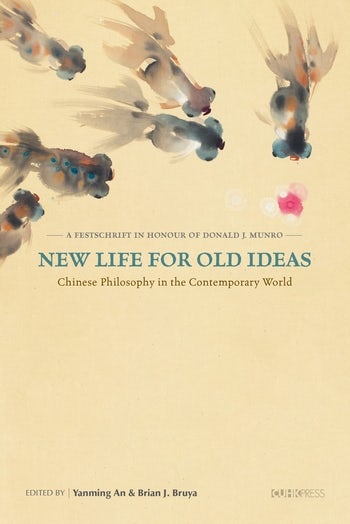
As a student of Don Munro and one of the contributors to the book, I am very happy to announce that CUHK Press has published Yanming An and Brian J. Bruya, eds., New Life for Old Ideas: Chinese Philosophy in the Contemporary World: A Festschrift in Honour of Donald J. Munro.
The publisher’s blurb: “Over five decades, Donald J. Munro has been one of the most important voices in sinological philosophy. Among other accomplishments, his seminal book The Concept of Man in Early China influenced a generation of scholars. His rapprochement with contemporary cognitive and evolutionary science helped bolster the insights of Chinese philosophers, and set the standard for similar explorations today. In this festschrift volume, students of Munro and scholars influenced by him celebrate Munro’s body of work in essays that extend his legacy, exploring their topics as varied as the ethics of Zhuangzi’s autotelicity, the teleology of nature in Zhu Xi, and family love in Confucianism and Christianity. Essays also reflect on Munro’s mentorship and his direct intellectual influence. Through their breadth, analytical excellence, and philosophical insight, the essays in this volume exemplify the spirit of intellectual inquiry that marked Donald Munro’s career as scholar and teacher.”
Suggestions for 2nd Edition of Doing Philosophy Comparatively?
An editor at Bloomsbury contacted me about putting together a 2nd edition of my book Doing Philosophy Comparatively. In the next couple of months we’ll be gathering suggestions about what to add the new edition, which will include about 30% new material, and we’re trying to get as much feedback about the current edition as possible. If you have looked at the book and thought certain topics were missing or that parts of it could be expanded or have other suggestions for improvement, please send me an email at tconnolly@esu.edu. Many thanks!
New article: Jiang & O’Dwyer, “The Universal Ambitions Of China’s Illiberal Confucian Scholars”
T. H. Jiang & Shuan O’Dwyer, “The Universal Ambitions Of China’s Illiberal Confucian Scholars,” has been published in the on-line journal Palladium. It begins:
Amid today’s talk of a coming civilizational clash between China and the West, it is easy to find philosophical experts on China holding forth on the cultural contours of Sino-Western civilizational difference. “China has always been and always will continue to be a communitarian society,” some have insisted; and its Confucian ethos is not a doctrine like America’s liberal individualism, but is instead the “ongoing narrative of a specific community of a people, the center of an ongoing ‘way’ or Dao.”
Such explanations amount to orientalist fantasies. How an industrialized society like modern China, transformed by both Communism and market reforms could still be defined by primordial cultural characteristics is not explained. Moreover, far from being a continuous, deeply organic narrative of the Chinese people, Confucianism is a diverse set of doctrines that have been ideologically contested, marginalized, reinvented and imposed as state dogmas at different times in Chinese history. This point holds for a brand of illiberal, statist Confucianism being promoted today in some of China’s leading universities, a brand whose future is still uncertain, but whose proponents hold out great hopes for its adoption into Chinese Communist Party orthodoxy. Moreover, this reinvented nationalist Confucianism is not without precedent in the modern history of East Asia; over a century ago, Japanese scholars educated in Europe were the pioneers of such a reinvention. This precedent, its cross-cultural inspirations, and its present day historical parallels in contemporary Chinese intellectual life merit examination, in view of the claims made by scholars for the cultural centrality of Confucianism in a morally renewed, globally rising China….
New Book: Johnson, Watsuji on Nature
Title: Watsuji on Nature: Japanese Philosophy in the Wake of Heidegger
Author: David W. Johnson (Associate Professor, Department of Philosophy, Boston College)
Publisher: Northwestern University Press
Publisher URL: http://www.nupress.northwestern.edu/content/watsuji-nature (a brief description of the book can be found here)
The publisher also shared the information that you can order the paperback edition of Watsuji on Nature at a 25% discount at nupress.northwestern.edu using the code NUP19 at checkout.
New PEA Soup Discussion: Dai Zhen on Shu
The second in blog PEA Soup’s series of discussions of cross-cultural normative philosophy has been posted: Tobias Fuchs begins it with a precis and questions related to Justin Tiwald’s 2009 essay “Is Sympathy Naïve? Dai Zhen on the Use of Shu to Track Well-Being.” Join in the discussion here. And don’t feel shy about adding comments related to Dai’s historical opponents or about exegetical issues — everything is fair game!
New edited collection on role ethics

Routledge has published a collection of essays on role ethics edited by Tim Dare and Christine Swanton, which includes two essays on early Confucian ethics. More information is here.
The publisher’s description is as follows:
Although our moral lives would be unrecognisable without them, roles have received little attention from analytic moral philosophers. Roles are central to our lives and to our engagement with one another, and should be analysed in connection with our core notions of ethics such as virtue, reason, and obligation.
This volume aims to redress the neglect of role ethics by confronting the tensions between conceptions of impartial morality and role obligations in the history of analytic philosophy and the Confucian tradition. Different perspectives on the ethical significance of roles can be found by looking to debates within professional and applied ethics, by challenging existing accounts of how roles generate reasons, by questioning the hegemony of ethical reasons, and by exploring the relation between expertise and virtue. The essays tackle several core questions related to these debates:
What are roles and what is their normative import?
To what extent are roles and the ethics of roles central to ethics as opposed to virtue in general, and obligation in general?
Are role obligations characteristically incompatible with ordinary morality in professions such as business, law, and medicine?
How does practical reason function in relation to roles?
Perspectives in Role Ethics is an examination of a largely neglected topic in ethics. It will appeal to a broad range of scholars in normative ethics, virtue ethics, non-Western ethics, and applied ethics interested in the importance of roles in our moral life.
Tiwald to Lecture at Washington College
Justin Tiwald (San Francisco State University) will be giving a public lecture on “Moral Expertise: Confucian Philosophers on Deference and Deliberative Autonomy” during his visit to Washington College on Oct. 16, from 6:30-8:00pm. More information can be found on the flyer here.
New Discussion Series at PEA Soup / First Topic: Kim on Mencius
The terrific ethics blog PEA Soup has initiated a series of discussions on Cross-Cultural Normative Philosophy; details on the series, including planned future installments, are here.
The first discussion, already underway, is of Richard Kim’s “Human Nature and Moral Sprouts: Mencius on the Pollyanna Problem.” Access to the paper and discussion is here.
Thanks to Brad Cokelet for spearheading this initiative!
