Category Archives: Books of Interest

Dao of Football Coaching

Friend of the blog, Mark Saltveit writes:

I’m about to publish a major book called “The Tao of Chip Kelly: Lessons from America’s Most Successful Coach”, about the new coach of the Philadelphia Eagles.  One of the chapters explores how Kelly’s football coaching and management style is, in my opinion, “a near-perfect implementation of Taoist principles,” though I have no reason to believe Coach Kelly has ever heard of Zhuangzi.  To me, he’s Butcher Ding discovering (reinventing?) Tao through attentive immersion in his craft.

The book is written for a popular audience, but if anyone is interested in reading the chapter on Tao (3,300 words) and offering thoughts, please email me mark saltveit at gmail, no spaces. I don’t think I should post it publicly.  For that matter, anyone interested in reading the whole thing is welcome to a near-final PDF (111 pages).

————————
marksaltveit@gmail,.com – (503) 997-1963 – @taoish

“The Tao of Chip Kelly:  Lessons from America’s Most Successful Coach” (Portland: Palindromist Press) will be released June 22, 2013.  More details at www.thetaoofchipkelly.com

Holloway Book and Video

Ken Holloway’s new book, The Quest for Ecstatic Morality in Early China, has been published by Oxford. He writes that:

This book is an analysis of religion in the Guodian manuscript the “Xing zi mingchu” 性自命出. In the Appendix, I provide an annotated translation and Chinese edition of the text. When I was in Beijing shortly after I finished writing the manuscript, I made a short movie of an exhibit of a copy of the “Xing zi mingchu” in the Confucian Temple in Beijing.

The movie should now be available via the Oxford blog: http://blog.oup.com/2013/05/antiquity-perceptions-chinese-culture/; enjoy! And congratulations, Ken.

New Book: Cook, Bamboo Texts of Guodian

164 BambooVol1

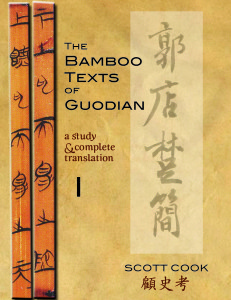
Scott Cook’s extensive, two-volume study and complete translation of the Guodian excavated texts has been published and is available through University of Hawaii Press. For more information, check out these two sites (vol. 1; vol. 2), which are largely identical but have links for purchasing the two volumes at the bottom. Congratulations, Scott!

Here follows the blurb from the website:

The cache of bamboo texts recently unearthed (in 1993) from the village of Guodian, Hubei Province, is without doubt a rare and unique find in the history of Chinese philosophy and literature. As the only archaeologically excavated corpus of philosophical manuscripts to emerge from a Warring States–period tomb, the Guodian texts provide us with a wealth of reliable information for gaining new insights into the textual and intellectual history of pre-imperial China. In this respect, one may reasonably claim that they are the most exciting thing to happen to the study of early China since the third century ad, the last time a pre-imperial textual cache of similar import was unearthed. More than a few scholars have even gone so far as to suggest that their discovery necessitates that the entire history of early Chinese intellectual history will have to be rewritten. The importance of these texts is manifold. First, given the prominence of Confucian works in the corpus, they serve to fill out much of the intellectual historical picture for the doctrines of roughly three generations of Confucian disciples who fell between the times of Confucius 孔子 (551–479 BC) and Mencius孟子 (ca. 390–305 BC). Next, the discovery of three different texts that each parallel portions of the Daodejing 道德經 (aka. Laozi 老子), along with a possibly related cosmogonic work, the “Taiyi sheng shui”太一生水, is helping us better understand the formation and early transmission of the Laozi and the nature of its relationship to early Confucian thought and even popular beliefs. Moreover, the dating of the tomb serves to dispel serious doubts about the early temporal provenance of both the Laozi and many of the chapters from the Li ji 禮記 (Book of Ritual), as well as giving us a number of clues to help us reconstruct the history of the early Chinese canonical “classics” that are cited in some of the texts. And written as they are in the local Chu 楚 script, the manuscripts hold great significance for the study of early Chinese paleography and phonology, giving us tangible examples of “ancient script” forms hitherto seen mainly in early character dictionaries and a limited array of technical manuscripts previously excavated from the region.

Three New Books: Mozi, Yi Jing, and Confucianism in HK

Three new (or at least new to me) books of interest:

If anyone has read any of these, please let us know what you think!

New Book: Anna Sun, Confucianism as a World Religion

Sun_coverExciting news: Anna Sun (Kenyon College)’s book on Confucianism has been published. Congratulations!

Confucianism as a World Religion: Contested Histories and Contemporary Realities

Anna Sun

Princeton University Press | Cloth | 2013 | $35.00 / £24.95 | ISBN: 9780691155579 | 266 pp. | 6 x 9 | 1 line illus. 9 tables

Is Confucianism a religion? If so, why do most Chinese think it isn’t? From ancient Confucian temples, to nineteenth-century archives, to the testimony of people interviewed by the author throughout China over a period of more than a decade, this book traces the birth and growth of the idea of Confucianism as a world religion.

The book begins at Oxford, in the late nineteenth century, when Friedrich Max Müller and James Legge classified Confucianism as a world religion in the new discourse of “world religions” and the emerging discipline of comparative religion. Anna Sun shows how that decisive moment continues to influence the understanding of Confucianism in the contemporary world, not only in the West but also in China, where the politics of Confucianism has become important to the present regime in a time of transition. Contested histories of Confucianism are vital signs of social and political change.Is Confucianism a religion? If so, why do most Chinese think it isn’t? From ancient Confucian temples, to nineteenth-century archives, to the testimony of people interviewed by the author throughout China over a period of more than a decade, this book traces the birth and growth of the idea of Confucianism as a world religion.

Continue reading →

Virtue Ethics and Confucianism Book Inches Toward Publication


VE&C_cover

I am happy to report that the book that Michael Slote and I have been editing, Virtue Ethics and Confucianism, will see the light of day before too many more months pass. Routledge now has a webpage for the book which includes its cover, table of contents, and so on, and it can even be pre-ordered. For those of you who are neither independently wealthy nor buyers for academic libraries (i.e., virtually anyone reading this), please be assured that a more reasonably-priced paperback edition will be forthcoming in a couple more years.


New Book: Yong Huang, Confucius

It has just come to my attention that Yong HUANG’s book Confucius: A Guide for the Perplexed (Bloomsbury 2013) has recently been published [publisher’s site] [Amazon link]. I have only had a chance to take a quick look at it, but it looks to be philosophically sophisticated and yet engaging and accessible. Rather than a systematic overview of Confucius’s teachings, Huang tackles a series of questions that arise “in our everyday life or moral reflection,” and argues that Confucius’s answers are the best — or at least, better than available alternative answers in the Western tradition. Enjoy!

New book: Shizi: China’s First Syncretist

Shizi: China’s First Syncretist

July, 2012
Cloth, 256 pages,
ISBN: 978-0-231-15906-7
$45.00 / £30.95
Columbia University Press

By blending multiple strands of thought into one ideology, Chinese Syncretists of the pre-imperial period created an essential guide to contemporary ideas about self, society, and government. Merging traditions such as Ruism, Mohism, Daoism, Legalism, and Yin-Yang naturalism into their work, Syncretists created an integrated intellectual approach that contrasts with other, more specific philosophies. Presenting the first full English translation of the earliest example of a Syncretist text, this volume introduces Western scholars to both the brilliance of the syncretic method and a critical work of Chinese leadership.

Continue reading →