
Journalist Qian Jianghua writes: “A leading Confucian academic’s defense of polygamy and arranged marriage continues to stoke tensions, months after he made the comments last year in an article titled ‘Only Confucianism can settle modern women.'” More here.
Category Archives: China
New Book: Traces of the Sage
James A. Flath, Traces of the Sage: Monument, Materiality, and the First Temple of Confucius, Honolulu, University of Hawai’i Press, 2016.
Traces of the Sage is a comprehensive account of the history and material culture of the Temple of Confucius (Kong Temple) in Qufu, Shandong.
Application for RCCPC 2-week Visiting Program
The 2-week Visiting Programs organized by the Research Centre for Chinese Philosophy and Culture at the Department of Philosophy of The Chinese University of Hong Kong are now open for application.
Overview:
In order to promote exchanges with scholars from around the world, the Research Centre for Chinese Philosophy and Culture has established several exchange programs to provide financial assistance for visiting scholars to conduct research and participate in academic activities organized by the Centre.
Sungmoon Kim, Public Reason Confucianism now available
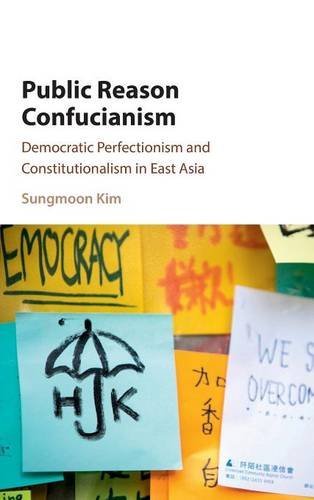 Sungmoon Kim’s new book, Public Reason Confucianism: Democratic Perfectionism and Constitutionalism in East Asia (Cambridge, 2016) has just been published. Congratulations, Sungmoon! Here are links to the CUP website and Amazon. Cambridge has also made available a form that anyone can use to get a 25% discount; click here. Here is the book’s description:
Recent proposals concerning Confucian meritocratic perfectionism have justified Confucian perfectionism in terms of political meritocracy. In contrast, ‘Confucian democratic perfectionism’ is a form of comprehensive Confucian perfectionism that can accommodate a plurality of values in civil society. It is also fully compatible with core values of democracy such as popular sovereignty, political equality, and the right to political participation. Sungmoon Kim presents ‘public reason Confucianism’ as the most attractive option for contemporary East Asian societies that are historically and culturally Confucian. Public reason Confucianism is a particular style of Confucian democratic perfectionism in which comprehensive Confucianism is connected with perfectionism via a distinctive form of public reason. It calls for an active role for the democratic state in promoting a Confucian conception of the good life, at the heart of which are such core Confucian values as filial piety and ritual propriety.
Jenco at Harvard: How Should We Use the Chinese Past?
Leigh Jenco (LSE) will be speaking at Harvard on May 2 at 4:00pm. Her title is “How Should We Use the Chinese Past?: Non-Western Histories of Thought in a Global Age.” More information here.
2017 New England Regional AAS at BC
Boston College is pleased to host the annual meeting of the New England Association for Asian Studies on January 28-29, 2017, under the theme of “Asia: Past, Present, Future.”
NYT on Nicholas Berggruen
A New York Times piece on Nicholas Berggruen; the Berggruen Institute’s Philosophy and Culture Center has emerged as an important new source of funding and programming in our area. (Disclosure: I am on the Academic Board.)
World Congress of Philosophy 2018 in Beijing
Perspectives on Chinese Happiness at the University of Westminster
Perspectives on Chinese Happiness: A two-day event at the University of Westminster
29-30 June 2016
9.30am-5pm
Location: The Pavilion, 115 Cavendish Street, London W1
Free of charge, registration required. Lunch provided on both days.
Open to anyone interested in this topic.
All welcome.
To book a place, please email happy2016@westminster.ac.uk by 7 June 2016
This unique event seeks to establish dialogue with academic and non-academic audiences to discuss and respond to academic research on Chinese happiness.
Continue reading →
El Amine in WaPo on HR and Democracy
Loubna El Amine discusses Confucianism, human rights, and related topics–and even mentions this blog–in her recent Washington Post piece, “Are ‘democracy’ and ‘human rights’ Western colonial exports? No. Here’s why.”
