Category Archives: Comparative philosophy

Rutgers Workshop in Chinese Philosophy: Virtue Epistemology

The 5th RWCP will be held in-person and on-line on Friday, April 22, 2022. In this one-day workshop, six scholars of Chinese philosophy will engage two leading virtue epistemologists, Ernest Sosa and Linda Zagzebski. The workshop program and other details are available here. This year’s workshop is co-sponsored by Rutgers Global-China Office, the Confucius Institute, Religion Department, and Philosophy Department. RSVP is required for attendance, either in-person (limited to the room capacity) or online. Q&A is limited to the in-person audience. Click here to RSVP.


On-line Access to Books on Li Zhi

Rivi Handler-Spitz is happy to announce that both her monograph, Symptoms of an Unruly Age: Li Zhi and Cultures of Early Modernity, and the volume she recently edited with Pauline Lee and Haun Saussy, The Objectionable Li Zhi: Fiction, Criticism, and Dissent in Late-Ming China, are now available as full-text, downloadable books. This is thanks to a grant from the Geiss-Hsu Foundation.

New Book Series: Daoism and the Human Experience

Daoism and the Human Experience is a new series that offers a platform to explore, question, and learn about the ways Daoism has or may contribute to the understanding of the philosophical, religious, literary, aesthetic, medicinal scientific, and ecological aspects of human existence. The series is launching in June 2022 with Daoist Resonances in Heidegger. Read below for more information.

Daoism and the Human Experiences seeks book proposals that will both deepen the understanding of Daoism and the world around us. The editors are still accepting proposals for monographs and edited collections that focus on Daoist thought, irrespective of the historical period, as well as information that explores Daoism within a border context.

Additional information can be found in the attached poster: Daoism and the Human Experience Call for proposals HERE.

Online Panel — Cosmopolitanism: An Invitation for Confucian-Catholic Dialogue

Cosmopolitanism: An Invitation for Confucian-Catholic Dialogue

An event of the China Forum for Civilizational Dialogue, a partnership between Georgetown University and La Civiltà Cattolica

Wednesday, April 13, 2022, 9:00 a.m. – 10:30 a.m. EDT, online; REGISTER HERE.

Continue reading →

Upcoming Neo-Confucianism Seminar on Kang Youwei

The next session of the Columbia University Seminar on Neo-Confucian Studies will convene on Friday April 1st from 10-11:30 am EDT, over Zoom.

The speaker will be Federico Brusadelli of the Università di Napoli L’Orientale, now also a Visiting Fellow at the Polish Institute of Advanced Study. Professor Brusadelli will present his draft “Race, Reproduction, Resources: Kang Youwei’s Datongshu as a 20th-century Global Prophecy.”

If you’d like to receive the paper and join the meeting, please contact Nolan Bensen, Rapporteur for the Seminar on Neo-Confucian Studies.

CFP: Truth and Asian Philosophy

The Asian Journal of Philosophy is pleased to announce a call for papers for a Topical Collection on “Truth and Asian Philosophy.”

The Asian Journal of Philosophy is a brand new journal that aims to publish high-quality articles in any area of analytic philosophy, including what might be called “Asian analytic philosophy,” which is the journal’s way of referring to engagement with Asian philosophical traditions utilizing analytic philosophical methodologies and vocabularies. The journal aspires to be a leading platform for analytic philosophy in Asia. You can find more information about the journal here: https://www.springer.com/journal/44204

For this Topical Collection on “Truth and Asian Philosophy,” we are interested in papers that engage with questions relating to truth and Asian philosophy. Some sample research topics might include but are certainly not limited to:

  • How is truth as a concept manifested in Asian philosophical traditions?
  • What can cross-cultural inquiries tell us about truth as a philosophical concept?
  • What can we learn about truth from studying Asian traditions?

Papers for the Topical Collection will be published in regular issues of the journal rather than in a dedicated special issue, so we have some flexibility in when we are able to process submissions.

Continue reading →

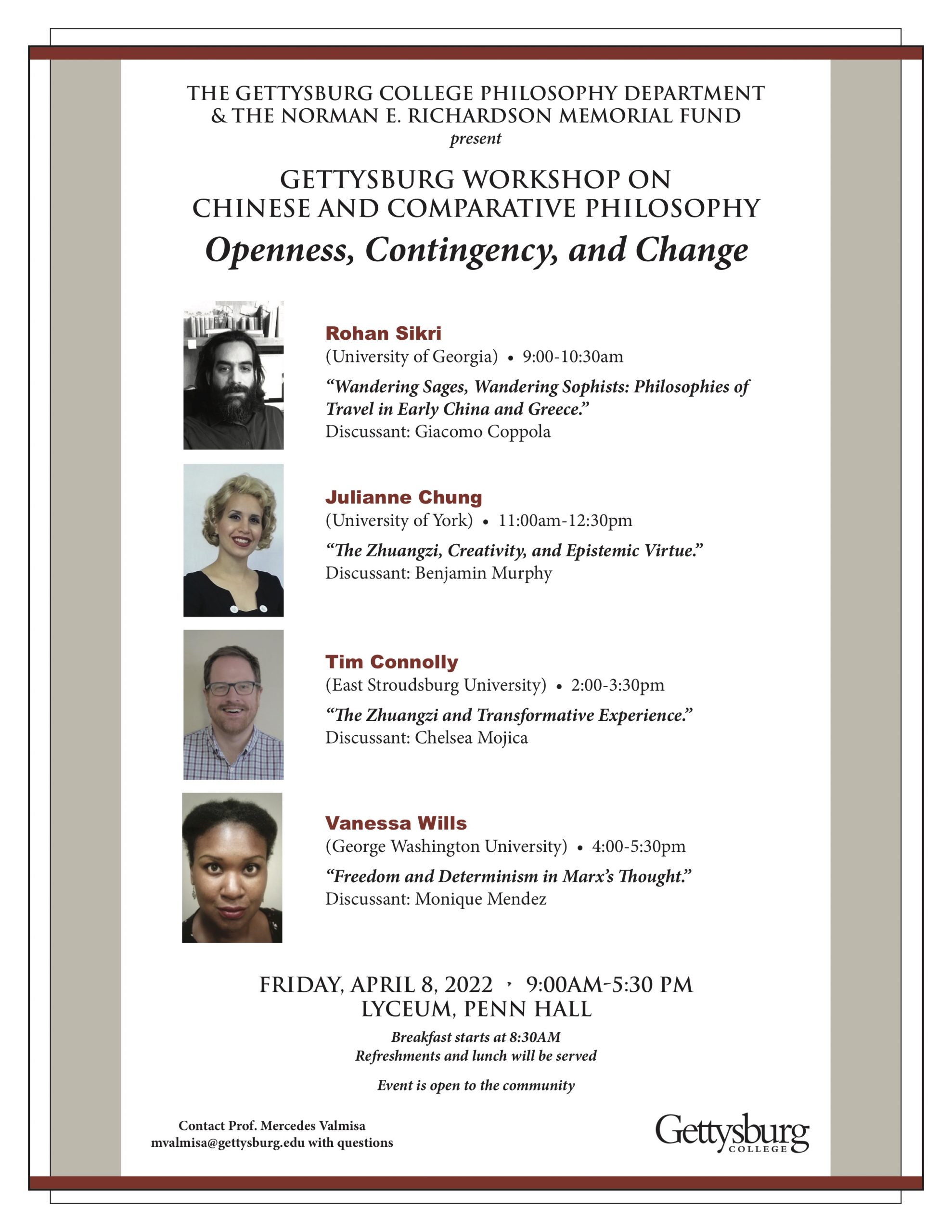
Gettysburg Workshop on Chinese and Comparative Philosophy: Openness, Contingency, and Change

The Gettysburg College Philosophy Department & the Norman E. Richardson Memorial Fund present:

Gettysburg Workshop on Chinese and Comparative Philosophy: Openness, Contingency, and Change

Friday, April 8, 2022, 9AM-5:30 PM, Lyceum, Penn Hall

Breakfast starts at 8:30AM, refreshments and lunch will be served

Event is in person and open to the community; contact Prof. Mercedes Valmisa mvalmisa@gettysburg.edu with questions


  • 9-10:30 Rohan Sikri (University of Georgia), “Wandering Sages, Wandering Sophists: Philosophies of Travel in Early China and Greece.” Discussant: Giacomo Coppola
  • 11-12:30 Julianne Chung (University of York), “The Zhuangzi, Creativity, and Epistemic Virtue.” Discussant: Benjamin Murphy
  • 2-3:30 Tim Connolly (East Stroudsburg University), “The Zhuangzi and Transformative Experience.” Discussant: Chelsea Mojica
  • 4-5:30 Vanessa Wills (George Washington University), “Freedom and Determinism in Marx’s Thought.” Discussant: Monique Mendez


Survey for Confucian Robotic Ethics project

JeeLoo Liu writes:

In continuation of my “Confucian Robotic Ethics” project, I have now embarked on a research on incorporating Confucian virtues in designing Ethical AI for Social Robots. But to do so, I need to first understand what people regard as the more important virtues when two sets of virtues (such as loyalty and humaneness; honesty and loyalty; or obedience and righteousness) conflict with each other in various cases of moral dilemmas.

I would like to know what you think about what future autonomous robots should do in situations involving (1) robot assisted suicide (2) whether a robot should lie or not (3) what principle should rescue robots use to decide whom to rescue first (4) should robots obey human order when such orders violate moral principles. These four sets of scenarios have 15 short questions each, and they are philosophically challenging. It takes about 10 minutes for each set, and you have the choice to continue to the next set or exit.

I hope you will find it interesting to answer them. Also, please help spread the word: post it on social media, encourage your students, friends, and family members to do the same.

The survey is completely anonymous and is conducted in three languages: English, Spanish and Chinese (both traditional and simplified).  The main site is http://www.fullerton.edu/ethical-ai

Thanks
JeeLoo

______________________
JeeLoo Liu
Professor
Distinguished Faculty of H&SS
Office: H-311G
Department of Philosophy
Cal State University, Fullerton
Fullerton, CA 92834

New Book: Kwon, Confucian Sentimental Representation 

Book title: Confucian Sentimental Representation
Kwon conceptualizes a unique mode of political representation in East Asian society, which derives its moral foundation from Confucian virtue politics. Contemporary East Asian societies understand democracy differently than Western societies do. Even citizens in consolidated democracies such as Taiwan and South Korea have different conceptions of an ideal relationship between a political leader and ordinary citizens, as well as a political leader’s accountability and political legitimacy. A political leader’s proper conduct, including his/her everyday languages, behaviors, and expressions when facing citizens’ sorrow, anger, and resentment, plays a crucial role in evaluating whether his/her has political legitimacy in East Asian society. Kwon analyses how this ‘affective accountability’ forms the basis for political representation in these societies and examines how this can be reconciled with liberal democracy.
Kyung Rok Kwon is a postdoctoral fellow of Research Center for Humanities and Social Sciences at Academia Sinica (Taiwan).