Category Archives: Comparative philosophy
Coffee Time Talks on Chinese Thought: Body and Mind in the Analects
Body and Mind in the Analects: Embodied Cognition, Digital Humanities, and the Project of Comparative Philosophy
This talk will explore how engaging with the cognitive sciences and digital humanities undermines claims such as this, and more broadly can help us to do our work as scholars of comparative philosophy.
Host: Professor Edward Slingerland, University of British Columbia
Date: Monday September 27, 2021 10:00-11:30am CST
Zoom link:https://slu.zoom.us/j/98495006071
Questions? Email pauline.lee@slu.edu
See full flyer here.
Sino-Hellenic Environmental Philosophy (online workshop)
SINO-HELLENIC ENVIRONMENTAL PHILOSOPHY
A Comparative Perspective on Environmental Thought in Early China and Graeco-Roman Antiquity
Thursday, 9 – Sunday, 12 December 2021
Online (Zoom)
Organized at the Institute of Philosophy, University of Bern, Switzerland
New Job Listing: Duke-DKU Global Fellows Program
Applications accepted on a rolling basis up to December 15, 2021, by 5pm (EST). Review of applications will begin on November 1st.
The Duke-DKU Global Fellows Program is designed to offer an international experience to post-doctoral scholars or advanced doctoral students whose records demonstrate excellence in teaching and an interest in pursuing an academic career. Duke-DKU Global Fellows teach at Duke Kunshan University (DKU) for the Undergraduate Program.
Most courses at DKU are taught in 7-week terms; a few courses are taught over a semester. Contact hours for all classes are the same; in particular, the number of contact hours for a 7-week course is the same as a 14-week course. Courses might include sections of common courses, distinct elective courses, lab sections or recitations. Assignment of classes will be determined by Fellow specific expertise and by DKU teaching needs.
The Fellowship is contingent upon successful receipt of the appropriate type of Chinese visa. Fellows may teach for a 7-week term up to a full academic year based on DKU teaching needs and the Fellow’s availability and his/her related education and experience required for immigration purposes.
The award carries a $13,000 stipend ($17,000 for fellows who have completed their PhD) for two courses, a $1,500 allowance for costs related to research or course preparation, travel costs to/from China, health insurance, and a housing allowance.
Post-doctoral fellows or advanced doctoral students from all disciplines are invited to apply.
To see the full listing click here.
For more info see below.
TOC: Journal of Confucian Philosophy and Culture Vol. 36
The editors are delighted to announce the publication of Volume 36 of the Journal of Confucian Philosophy and Culture (JCPC), with the Special Topic: Texts and Contexts: Women in Korean Confucianism, and featuring Professor Hwa Yeong Wang as guest editor.
JCPC is published biannually (in February and August) and welcomes contributions of both articles and book reviews by qualified authors from around the world. The journal is cross-disciplinary in its outlook and presents work from philosophers, anthropologists, psychologists, sociologists, historians, theologians, political scientists as well as other disciplines. JCPC examines the historical, doctrinal, literary, social, and political developments that have formed contemporary versions of Confucianism for the purpose of interpreting and exploring Confucianism from a modern perspective. The Journal is indexed in AtlaSerials, BAS (Bibliography of Asian Studies), MLA Directory of Periodicals, and KCI (Korea Citation Index). The attached file contains the cover and complete table of contents of Volume 34.
The complete volume is available online at our web site: http://jcpc.skku.edu/.
On-line lecture: Confucianism and the Political Theory of the Business Corporation
Date: 17 September 2021 (Friday)
Time: 16:00 (HKT)
Venue: Online (This talk will be held via Zoom.)
Participants: Chi Kwok, Lingnan University; Sungmoon Kim, City University of Hong Kong
Registration is required. Please email: joogangl@gmail.com
Click here to view flyer.
Abstract: Despite the burgeoning literature in contemporary Confucian political theory, little effort has been devoted to the exploration of the implications of Confucianism to economic justice. Among the few exceptions, Chan (2013) argues that Confucianism would require a sufficientarian, yet inegalitarian, distributions of economic resources; Kim (2019) suggests that Confucianism could offer an account of the political economy of harmony where distributive values of equality, need, and merit “could have their own place”. Although these are important contributions, these works’ focal point is on developing a general outlook and guiding principles of a Confucian moral economy. This paper argues that the modern relevance of a theory of moral economy depends to a significant degree on whether it could offer an attractive normative account to the legally privileged economic agent, business corporation, which enjoys legal rights such as legal personality, limited liability, asset shielding that are unavailable to other market actors. The paper attempts to build a bridge between contemporary Confucian political theory and political theory of the business corporation for two purposes. First, it offers a better ontological account of the business corporation for Confucian political theory to intervene in debates about the business corporation. Second, it also offers alternative moral resources to develop a political theory of the business corporation beyond the usual liberal democratic framework in the literature.
CFP: EACS Young Scholar Award 2022
ISCWP August 2021 Newsletter
Here is the ISCWP August 2021 Newsletter with updates from its members and a call for researcher collaboration.
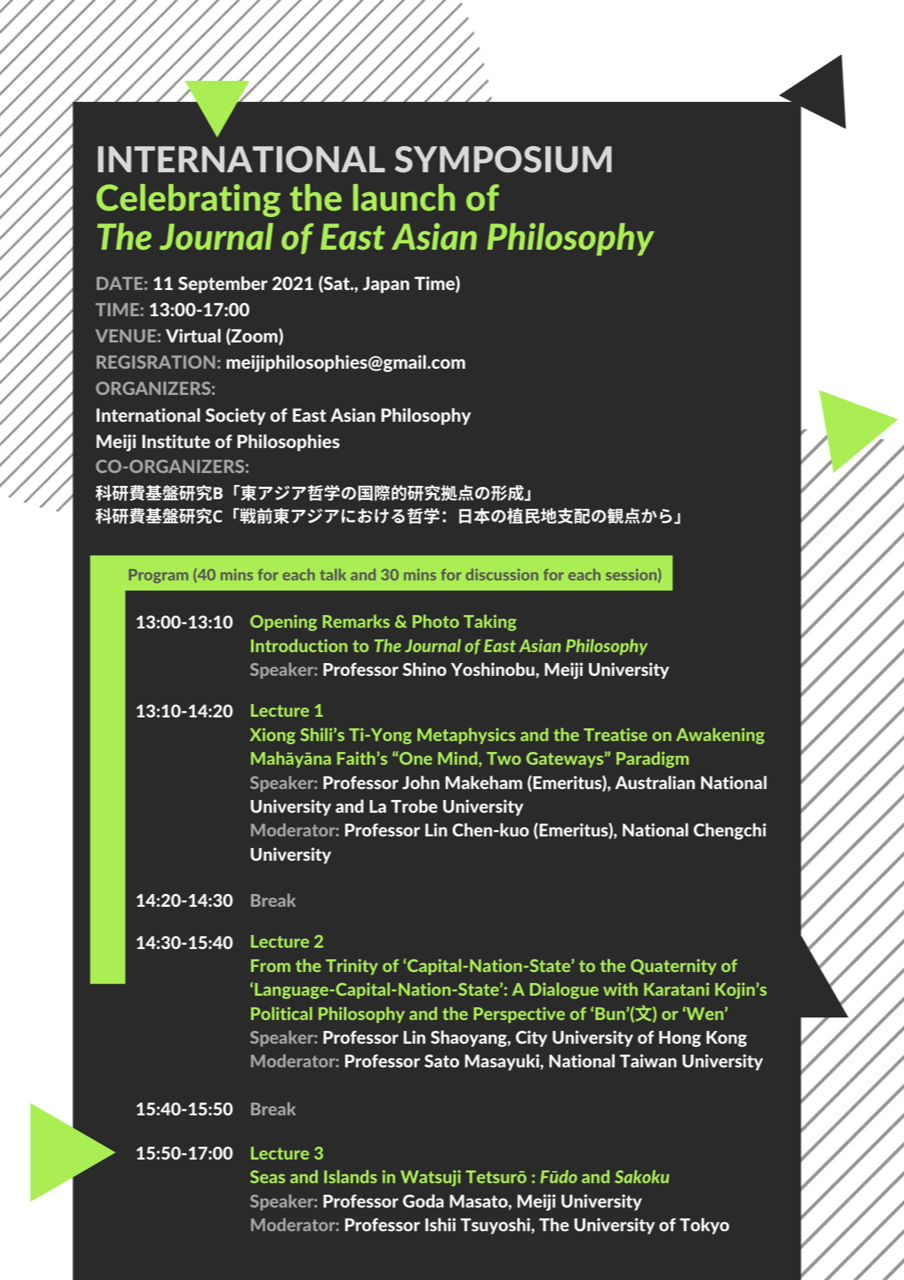
International Symposium: Celebrating the launch of the Journal of East Asian Philosophy
Time: 13:00-17:00
Venue: Virtual (Zoom)
Please refer to the attached flyer for more details.
JOB: Tenured/Tenure-track Position in Chinese Religions, NYU Shanghai
NYU Shanghai is currently inviting applications for an open-rank position in Chinese religions. We seek candidates who have completed a Ph.D. in Chinese religions, East Asian Studies, or a closely related discipline. We invite applications from candidates working on any of the Chinese religious traditions (Confucianism, Daoism, Buddhism, or popular religious practices in China), with the ability to teach their connections to other parts of Asia.