An upcoming conference at the University of Nebraska “The Spirit of Korean Philosophy: Six Debates and their Significance for Asian and Western Philosophy” (OCTOBER 22-24, 2014)
Category Archives: Korea
Neuroimaging Study of Korean vs U.S. Moral Thinking
Stanford scholar shows Koreans and Americans tackle moral dilemmas using different brain regions … offers first look at neural differences between cultural groups solving tricky moral problems.
Someone pointed me to the story, published here (thank you, Annette Bryson!). The study, which is hyperlinked in the story, is available here for free download (last I checked). I have no real comment on it yet, but thought some blog readers who are interested in empirical studies about moral thinking in Confucian societies might find it interesting, assuming, as I do, that Korea has a society that still remains heavily influenced by its history of Confucianism.
Columbia Neo-Confucianism Seminar
The next session of the Columbia University Seminar on Neo-Confucian Studies (Seminar #567) will convene Friday, February 7, 2014 from 3:30 to 5:30pm in the Komoda Room of the Heyman Center for the Humanities at Columbia University. We will have two presenters (copies of the papers are available from the organizers):
- Elizabeth Woo Li. Her paper is titled “‘Rites as Principles’ (li ji li 礼即理): A Fundamental Concept in Confucian Theories of Ethics and Politics.”
- P. J. Ivanhoe. His paper is titled “New Old Foundations for Confucian Ethical Philosophy: Itō Jinsai 伊藤仁斎 (1627-1705), Dai Zhen 戴震 (1722-1776), and Jeong Yakyong 丁若鏞 (1762-1836).”
All are welcome to attend. Please join us immediately after the seminar for dinner at Columbia Cottage restaurant, which is located on the corner of Amsterdam and 111th Streets.
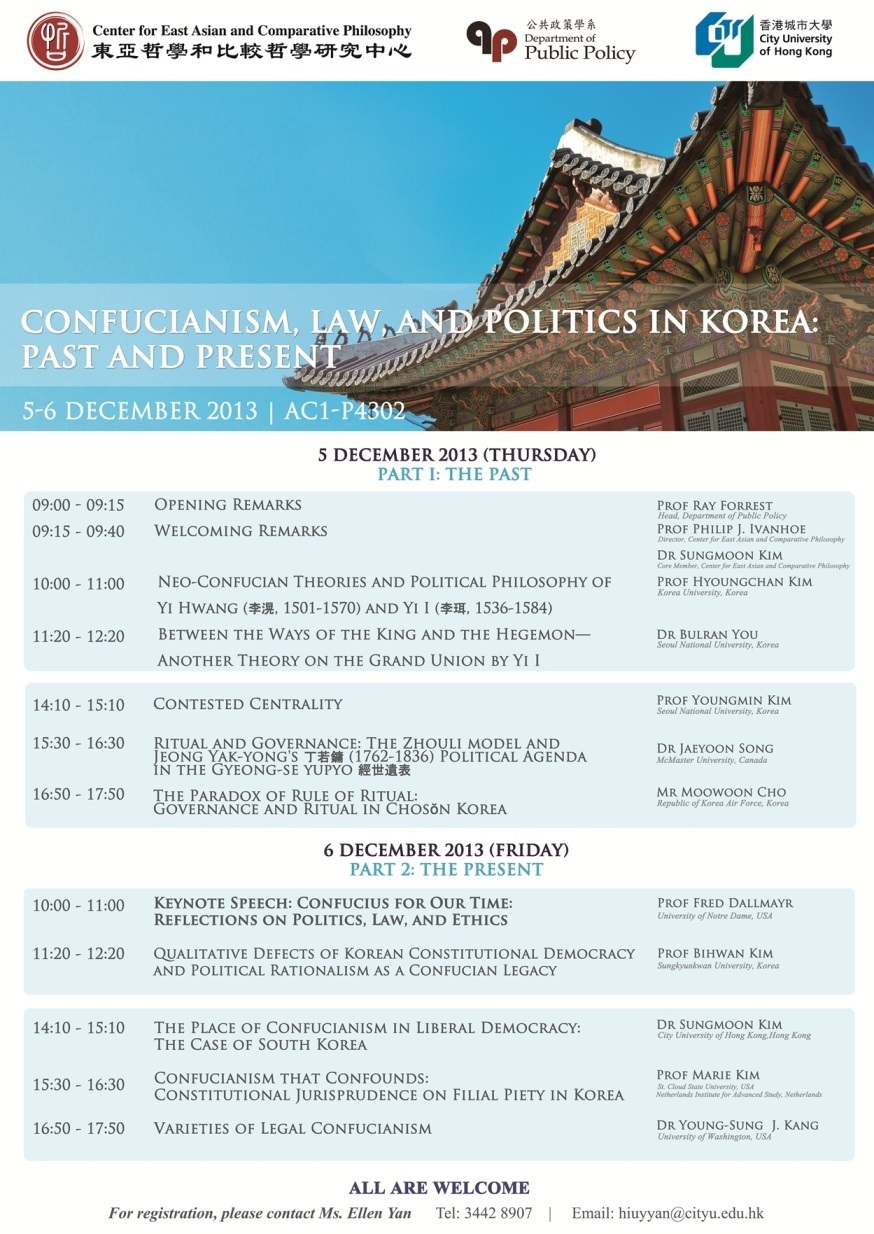
Conference 5-6 December in HK on Confucianism, Law, and Politics in Korea
Eirik Harris reports: We’re hosting a conference on “Confucianism, Law, and Politics in Korea: Past and Present” here at CityU that might interest some of the Warp, Weft and Way readers. The Conference poster with list of speakers and topics is here: http://www6.cityu.edu.hk/ceacop/kpcp/conference_poster.jpg
Job in Confucian Religious Studies
Assistant Professor/Faculty Position in Sogang University, South Korea
The Department of Religious Studies at Sogang University, the Jesuit University in Seoul, South Korea,, invites applications for a full-time, tenure track faculty position in Chinese/Korean religions (centered on Confucianism) at the assistant/associate professor rank, to begin in fall 2013. The Ph.D. must bein hand by time of appointment.
CFP–Constructing and Interpreting the Daotong
Call for papers
Constructing and Interpreting the Daotong (Transmission of the Way) in the Perspective of Chinese and Korean Neo-Confucianism
International conference organised by:
– The Centre of Chinese Studies (CEC, ASIEs, Inalco),
– The Centre of Korean Studies (CECO, ASIEs, Inalco)
– The Institute of Confucian Philosophy and Culture (Sungkyunkwan University, Seoul)
The organising committee is pleased to invite colleagues and Ph.D students interested in Neo-Confucianism to submit abstracts for this international conference regarding the construction and (re-)interpretations of the Daotong. Its objective is to re-examine the process through which Neo-Confucian discourse was legitimated by promoting the notion of Transmission of the Way, both in Chinese and Korean contexts.
Translation of Korean Buddhist Works Online
A team of scholars has published — and made freely available on-line — an extensive set of translations from Korean Buddhism. The homepage is here. The translation are excellent, are accompanied by substantial introductions, and include the classical Chinese original text. Robert Buswell’s Preface to the series follows.
New Books on Women and Confucianism, and on Emotions
Two more recent books, one on women and Confucianism in Choson Korea, the other on emotions in East Asia.
More Information on Korean Philosophy Project
We have already posted an announcement of the substantial grant that PJ Ivanhoe of the City University of Hong Kong, together with several collaborators, received to support work on Korean philosophy in comparative perspective. The team has now prepared a website detailing some of the project’s schedule, collaborators, and planned outcomes (including several terrific-sounding books).
Korean Comparative Philosophy Grant Awarded
A group of scholars including P. J. Ivanhoe has been awarded a major grant from the Korean Studies Promotion Service of the
Academy of Korean Studies to conduct a major research project on Korean Philosophy from Comparative Perspectives. The period of the grant is five years. The aim is to bring the study of Korean philosophy more into the mainstream of world philosophy. There will be workshops, international conferences, post-doc opportunities and sponsoring of senior western philosophers in connection with the project. For more information, see this link. Congratulations to P.J.!