
I will be giving an on-line talk next week on my new book, Growing Moral: A Confucian Guide to Life, hosted by the Center for East Asian and Comparative Philosophy at the City University of Hong Kong. The talk will take place via Zoom at 10 am on Friday, April 8 in HKT, which will be at 10pm on Thursday, April 7 EDT. So if you’re in East Asia, or are a night owl in the US, feel free to join! Details are on the attached poster.
Upcoming Neo-Confucianism Seminar on Kang Youwei
The next session of the Columbia University Seminar on Neo-Confucian Studies will convene on Friday April 1st from 10-11:30 am EDT, over Zoom.
The speaker will be Federico Brusadelli of the Università di Napoli L’Orientale, now also a Visiting Fellow at the Polish Institute of Advanced Study. Professor Brusadelli will present his draft “Race, Reproduction, Resources: Kang Youwei’s Datongshu as a 20th-century Global Prophecy.”
If you’d like to receive the paper and join the meeting, please contact Nolan Bensen, Rapporteur for the Seminar on Neo-Confucian Studies.
CFP: Truth and Asian Philosophy
The Asian Journal of Philosophy is pleased to announce a call for papers for a Topical Collection on “Truth and Asian Philosophy.”
The Asian Journal of Philosophy is a brand new journal that aims to publish high-quality articles in any area of analytic philosophy, including what might be called “Asian analytic philosophy,” which is the journal’s way of referring to engagement with Asian philosophical traditions utilizing analytic philosophical methodologies and vocabularies. The journal aspires to be a leading platform for analytic philosophy in Asia. You can find more information about the journal here: https://www.springer.com/journal/44204
For this Topical Collection on “Truth and Asian Philosophy,” we are interested in papers that engage with questions relating to truth and Asian philosophy. Some sample research topics might include but are certainly not limited to:
- How is truth as a concept manifested in Asian philosophical traditions?
- What can cross-cultural inquiries tell us about truth as a philosophical concept?
- What can we learn about truth from studying Asian traditions?
Papers for the Topical Collection will be published in regular issues of the journal rather than in a dedicated special issue, so we have some flexibility in when we are able to process submissions.
Gettysburg Workshop on Chinese and Comparative Philosophy: Openness, Contingency, and Change
The Gettysburg College Philosophy Department & the Norman E. Richardson Memorial Fund present:
Gettysburg Workshop on Chinese and Comparative Philosophy: Openness, Contingency, and Change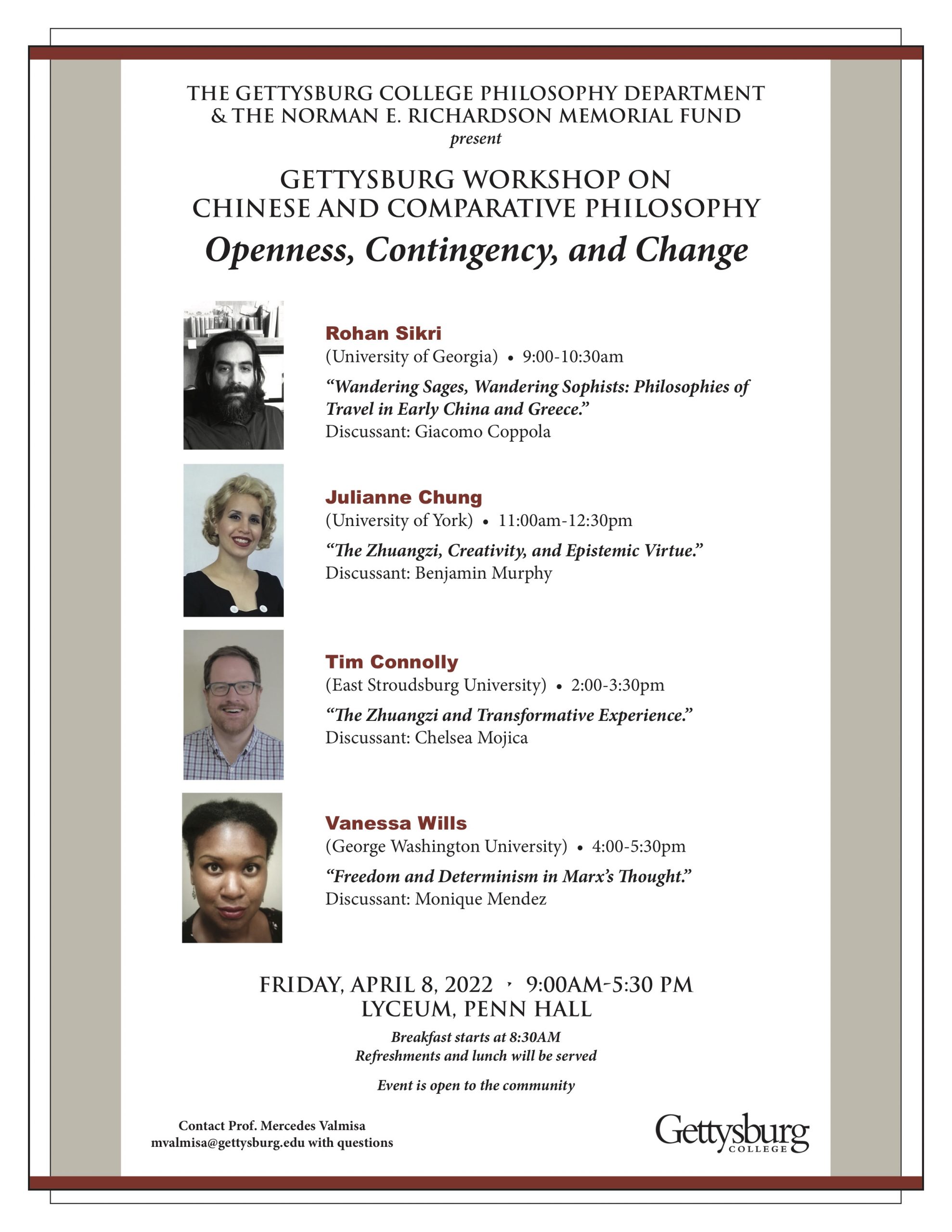
Friday, April 8, 2022, 9AM-5:30 PM, Lyceum, Penn Hall
Breakfast starts at 8:30AM, refreshments and lunch will be served
Event is in person and open to the community; contact Prof. Mercedes Valmisa mvalmisa@gettysburg.edu with questions
- 9-10:30 Rohan Sikri (University of Georgia), “Wandering Sages, Wandering Sophists: Philosophies of Travel in Early China and Greece.” Discussant: Giacomo Coppola
- 11-12:30 Julianne Chung (University of York), “The Zhuangzi, Creativity, and Epistemic Virtue.” Discussant: Benjamin Murphy
- 2-3:30 Tim Connolly (East Stroudsburg University), “The Zhuangzi and Transformative Experience.” Discussant: Chelsea Mojica
- 4-5:30 Vanessa Wills (George Washington University), “Freedom and Determinism in Marx’s Thought.” Discussant: Monique Mendez
Survey for Confucian Robotic Ethics project
JeeLoo Liu writes:
In continuation of my “Confucian Robotic Ethics” project, I have now embarked on a research on incorporating Confucian virtues in designing Ethical AI for Social Robots. But to do so, I need to first understand what people regard as the more important virtues when two sets of virtues (such as loyalty and humaneness; honesty and loyalty; or obedience and righteousness) conflict with each other in various cases of moral dilemmas.
I would like to know what you think about what future autonomous robots should do in situations involving (1) robot assisted suicide (2) whether a robot should lie or not (3) what principle should rescue robots use to decide whom to rescue first (4) should robots obey human order when such orders violate moral principles. These four sets of scenarios have 15 short questions each, and they are philosophically challenging. It takes about 10 minutes for each set, and you have the choice to continue to the next set or exit.
I hope you will find it interesting to answer them. Also, please help spread the word: post it on social media, encourage your students, friends, and family members to do the same.
The survey is completely anonymous and is conducted in three languages: English, Spanish and Chinese (both traditional and simplified). The main site is http://www.fullerton.edu/ethical-ai
Thanks
JeeLoo
______________________
JeeLoo Liu
Professor
Distinguished Faculty of H&SS
Office: H-311G
Department of Philosophy
Cal State University, Fullerton
Fullerton, CA 92834
MARCH 25, 2022: Li Zehou on the ‘Deep Structures of Confucianism’ (Columbia Society for Comparative Philosophy)
THE COLUMBIA SOCIETY FOR COMPARATIVE PHILOSOPHY
Presents: Li Zehou on the ‘Deep Structures of Confucianism’
Lead Presenter: Andrew Lambert (College of Staten Island, CUNY)
Discussants: Robert A. Carleo III (East China Normal University), Emma Buchtel (Hong Kong Education University)
ABSTRACT: Contemporary Chinese intellectual Li Zehou’s cross-cultural methodology blends traditional Confucian thought with thinkers such as Kant and Marx. This seminar addresses the question of culture and its role in Li’s thought. Li has made several claims about how a settled cultural tradition influences the subjects within it. One such claim concerns the existence of ‘deep structures’ of Confucianism, as outlined in this preparatory reading. The idea is that culture, history, and social practice (collectively, a tradition) shape human psychology (including the formation of concepts, emotions, and values) in ways not always apparent to the subject. Within the Chinese tradition, Confucianism constitutes such a deep structure, and its effects cannot be captured by textual studies alone, nor studies of material culture. Rather, the deep structure is articulated in terms of an emergent shared subjectivity. Such traditions can evolve and ultimately dissolve; nevertheless, their effects are deep-rooted. This seminar meeting will aim to identify the parameters of Li’s ambitious theoretical framework and its plausibility, and to explore connections with current work in related fields, such as cultural and empirical psychology.
DATE: March 25, 2022
TIME: 6:30 – 8:00 pm EST
This seminar will take place via Zoom (please scroll down for the full invitation).
Workshop on Tsinghua Logic School
WORKSHOP: Legacy of the Tsinghua Logic School
Time: April 21, 2022
Venue: Hybrid
Organizer: The Joint Research Center for Logic, Tsinghua University
In 1926, recently graduated from Columbia University, Jin Yuelin came back to China and founded the Department of Philosophy at Tsinghua University. With new appointments of Shen Youding and Wang Xianjun in subsequent years, the logic group grew very fast and attracted many young talents. One prominent student of Jin Yuelin was Wang Hao, who later took his PhD degree at Harvard and became a well-known logician worldwide. This pioneering history was recorded in a recent article by Jan Vrhovski: “The Qinghua Logic School: Mathematical Logic at Qinghua University in Peking, 1926–1945”. In 1952, due to the policy of “reorganization of colleges and departments”, Tsinghua’s philosophy department was moved to Peking University. Wang Xianjun stayed there ever since, while Jin Yuelin and Shen Youding soon moved once more, to the Chinese Academy of Social Sciences. In this way the logic tradition spread. In 2000 Tsinghua officially restored its philosophy department with a focus in logic. In the last two decades, Tsinghua has been making lots of progress in logic, with several major appointments. (for more information see the website: www.tsinghualogic.net/JRC). On the occasion of Tsinghua University’s anniversary in April this year, we are organizing a small workshop to discuss the Tsinghua logic tradition, the ideas of the early founding logicians, and plans for our future development.
Lecture: The Emotions of Justice: People’s Voices and their Petitioning Activity in Late Chosŏn Korea
Jisoo Kim will offer an on-line lecture later this week: the title is “The Emotions of Justice: People’s Voices and their Petitioning Activity in Late Chosŏn Korea,” and it will be held at 10am Hong Kong time on Friday, 18 February. For more information and to register, see here.
New Book: O’Dwyer, ed., Handbook of Confucianism in Modern Japan
Handbook of Confucianism in Modern Japan, edited by Shaun O’Dwyer, has been jointly published this month by Japan Documents Imprint and Amsterdam University Press. It features 13 chapters by East Asian and European scholars covering the development of Confucianism in Japan between the mid 19th century and the 21st century.
Tiwald to HKU
My friend and collaborator Justin Tiwald has recently announced that he has accepted a tenured full professorship in the Philosophy Department of the University of Hong Kong, and will begin teaching there full-time in August of this year. Congratulations, Justin!
