
[Scott Barnwell posts Part 3 of his series “Classical Daoism – Is There Really Such a Thing?,” parts 1 and 2 of which also appear here and here at WW&W. We’re using the “Reblog” function for the first time. Feel welcome to initiate discussion here or on his own site. In any case, please direct all comments or questions to Scott. – Manyul]
Author Archives: Manyul Im
Chinese Philosophy Arcs
[Guest contributor, Eric Schwitzgebel, takes a quantitative look at Anglophonic discussions of Chinese philosophy and offers a conjecture. Please address all comments directly to him.]
Different classical Chinese philosophers have drawn different amounts of discussion in the Anglophone world over the past seventy years. I want to look at this phenomenon quantitatively and then suggest a general conjecture about the history of philosophy.
The six target philosophers include two who are well-known in the Western world outside scholarly circles, Confucius and Laozi (aka Lao Tzu), and four who are much less well known, Mencius, Zhuangzi, Xunzi, and Mozi (aka Mengzi, Chuang Tzu, Hsün Tzu, and Mo Tzu). Below is a graph of their “discussion arcs” — that is, the rates, times 1000, at which their names appear in keyword (including abstract and title) searches in Philosopher’s Index, divided by a representative universe of articles. Click the image for a clearer view.

N.Y. Times Blog Post on Western Bias in Philosophy
HERE. Posted by Justin Smith of Concordia University, Montreal. (Hat-tip to Sam Crane, who has his own discussion of the piece going, over on his blog, The Useless Tree.) Much of Smith’s piece is probably “preaching to the choir” for our readers, but it’s good to see these points made in the mainstream. Here is an excerpt:
Western philosophy is always the unmarked category, the standard in relation to which non-Western philosophy provides a useful contrast. Non-Western philosophy is not approached on its own terms, and thus philosophy remains, implicitly and by default, Western. Second, non-Western philosophy, when it does appear in curricula, is treated in a methodologically and philosophically unsound way: it is crudely supposed to be wholly indigenous to the cultures that produce it and to be fundamentally different than Western philosophy in areas like its valuation of reason or its dependence on myth and religion. In this way, non-Western philosophy remains fundamentally “other.” Continue reading →
Adjunct Lecturer needed at Fairfield
This is of interest only to those in the New York/New England area. I’m on an administrative rotation with a reduced teaching load so my department needs someone to teach the Confucianism course this coming Fall. It’s about 20-25 students. A suitably experienced candidate might also be able to pick up a general introduction to philosophy course as well (also 20-25 students). There may also be another course in Spring 2013 — a course called “Asian Philosophies.” And, fyi, I do have another year on the rotation after next year so we’ll likely need someone then as well…
Send any inquiries to my chair; his contact details are below:
Postdoc in Asian Philosophy at Melbourne
Laura Schroeter of the philosophy department at Melbourne (and fellow Univ. of Michigan doctoral program alum!) writes that their one-year postdoc position is still open for applications (deadline is June 17) and they encourage qualified specialists in Asian Philosophy to apply. According to Laura, “The position involves teaching an Asian phil survey course (probably around 40 students) and a small 4th year undergrad seminar (5-15 students), and runs from July 2012-July 2013. It’s funded through some research money of Graham Priest’s, and Graham may want some minor admin help. But basically it’s a low-teaching postdoc position. We’re mainly interested in getting someone who’s good to talk philosophy with.” So, if you’re within something like a 5-year period since you’ve finished your doctoral degree, consider applying to spend a year in Australia with some good philosophers. Below are the particulars for application, as they appeared in the Jobs for Philosophers ad.
Eichmann, Arendt, Milgram and Mencius
A cross-posting of Eric Schwitzgebel’s post on his Splintered Mind blog. Please address all comments directly to Eric; he’ll be checking in here periodically to reply.
********************************************************
Adolf Eichmann, Hannah Arendt, Stanley Milgram, and King Xuan of Qi
Perhaps my favorite Mencius passage is 1A7. At its core is a story of a king’s mercy on an ox.
While the king was sitting up in his hall, an ox was led past below. The king saw it and said, “Where is the ox going?” Hu He replied, “We are about to ritually anoint a bell with its blood.” The king said, “Spare it. I cannot bear its frightened appearance, like an innocent going to the execution ground.” Hu He replied, “So should we dispense with the anointing of the bell?” The king said, “How can that be dispensed with? Exchange it for a sheep.” (Van Norden, trans.)
Mencius asks the king (King Xuan of Qi):
If Your Majesty was pained at its being innocent and going to the execution ground, then was is there to choose between an ox and a sheep?… You saw the ox but had not seen the sheep. Gentlemen cannot bear to see animals die if they have seen them living. If they hear the cries of their suffering, they cannot bear to eat their flesh. Hence, gentlemen keep their distance from the kitchen.
(Note that Mencius does not conclude that gentlemen should become vegetarians. Interesting possibilities for reflection arise regarding butchers, executioners, soldiers, etc., but let’s not dally.) Continue reading →
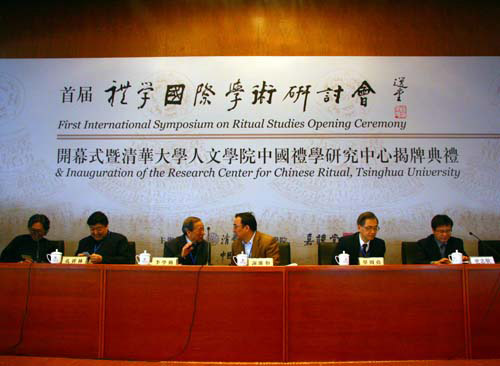
Ritual Revival in China
Not sure how we missed this story (c/o China Daily). I’d be interested in your comments, or if anyone has/had involvement with the event or organization, please chime in with your perspective on the revival project.
************************************************************************
Scholars call for revival of Chinese ritual
(China.org.cn)
The opening ceremony of the First International Symposium on Ritual Studies at Tsinghua University, Apr. 9, 2012. [Photo/China.org.cn] Continue reading →
Huainanzi – shorter edition
Huainanzi update: A couple of years ago — has it really been that long? — WW&W posted an announcement and hosted some discussion that included the authors of the unabridged Huainanzi translation published by Columbia University Press. FYI, I just received in the mail an abridged version of the translation (272 pages instead of 1016), which is now available: The Essential Huainanzi.
Unrelated book note: The WAC (“Writing-across-the-Curriculum”) Clearinghouse at Colorado State University is offering, free of charge, electronic access to Chinese Rhetoric and Writing: An Introduction for Language Teachers by Kirkpatrick and Xu.
Enjoy.
JCP Vol. 38 Supplement Issue TOC
Co-edited by Chung-ying Cheng and blog contributor Justin Tiwald. Great work, Justin!
*********************************************************
Journal of Chinese Philosophy – Special Issue
Confucian Philosophy: Innovations and Transformations
Volume 38, Issue Supplement s1
Pages 1–203
Popular Daoism
Mark Saltveit, professional comedian and author, guest-posted last year on comedy and Daoism. Subsequently, he published his thoughts on that topic with MeFiMag (available for download). Mark is back with some questions that he has about popular Daoism, to get some discussion and opinion from members of our forum. He plans to publish an article about this topic as well (note Mark’s comments below about seeking permission to quote or cite from those who comment in this forum). Please address all comments or questions directly to Mark.
********************************************************
Hello. I’m working on a feature article (for an intelligent general audience) about criticism of popular Daoist authors (particularly Ursula K. Le Guin and Benjamin Hoff) by certain academics of Eastern religion who are centered around the University of San Diego and the Center for Daoist Studies (http://www.daoistcenter.org/homepage.html).
Some of this criticism seems rather polemical, rooted in an anti-Orientalist critique of the concept of Philosophical Daoism as a Western (and arguably Protestant) gloss. (I’m using the term “Culturalists” as shorthand for this group, and positing Michael Saso as its founder.) Russell Kirkland calls Le Guin a “fraud” and Louis Komjathy won’t even write “Philosophical Daoism” without applying strikethrough to the words to show his disapproval. Kirkland goes so far as to argue that the Daodejing itself distorts Daoism, “sanitized” by its 3rd Century BCE redactor in a “marketing ploy” designed to strip it of “cultural baggage” and make it more presentable to Northern Chinese courts. Continue reading →
