Special Issue of the European Journal For Philosophy of Religion: Tradition, Ritual, and Heaven in East Asian Religious Philosophy
Guest Editor: Philip J. Ivanhoe

Special Issue of the European Journal For Philosophy of Religion: Tradition, Ritual, and Heaven in East Asian Religious Philosophy
Guest Editor: Philip J. Ivanhoe
Mat Foust has published a review of Stephen C. Angle and Michael Slote, eds., Virtue Ethics and Confucianism (Routledge, 2013) in the Sungkyun Journal of East Asian Studies. The full text of the review is available on-line here (look for “Book Review 4”). Thanks, Mat!
Dear ISCWP members,
The ISCWP plans to sponsor one or two panels at the 2016 APA Eastern Division meeting (which will take place in January 4-7, 2017 in Baltimore, Maryland, USA).
Please send all submissions Send abstracts and proposals to: xiaoy@kenyon.edu by Sunday May 15, 2016.
Two essays discuss Alexus McLeod’s work on Wong Chong and “truth,” and Alexus replies, in Comparative Philosophy 6:1; these essays are not directed to Alexus’s recently-published book (Theories of Truth in Chinese Philosophy: A Comparative Approach [Rowman & Littlefield International, 2015]), but the dialogue is still valuable.
Hans Van Eyghen reviews Brian Bruya, ed., The Philosophical Challenge from China (MIT, 2015) in Comparative Philosophy 7:1.
2016 Term SJSU Center for Comparative Philosophy Workshop (Conference Series Co-Sponsor: SJSU Philosophy Department Symposium)
How Constructive Engagement of Comparative Philosophy Is Possible: Challenges and Prospect
Conference flyer here.
Eddy Keming Chen, an advanced graduate student in philosophy at Rutgers, served as rapporteur for the recent Rutgers Workshop on Chinese Philosophy, and compiled this very through report on the day’s presentations and discussion. Many thanks, Eddy! (For those who would prefer a nicely formatted PDF version, it is available here.)
Report on The 3rd Rutgers Workshop on Chinese Philosophy (RWCP): CONVERSATIONS WITH WESTERN PHILOSOPHERS (Friday, April 15, 2016)
Eddy Keming Chen , Rutgers Philosophy Department
The 3rd Rutgers Workshop on Chinese Philosophy (RWCP), organized by Tao Jiang (Rutgers), Ruth Chang (Rutgers), and Stephen Angle (Wesleyan), continued the success of the RWCP conferences of the past two years. This year, the workshop included four sessions. Each presenter had been asked to find a Western philosopher to conduct a dialogue on a common theme in Chinese philosophy and Western philosophy. That resulted in four highly suggestive and fruitful conversations: the importance of studying non-Western philosophy, theories of truth, yuan and the “bourgeois predicament,” and the foundations for moral relativism.
The 2-week Visiting Programs organized by the Research Centre for Chinese Philosophy and Culture at the Department of Philosophy of The Chinese University of Hong Kong are now open for application.
Overview:
In order to promote exchanges with scholars from around the world, the Research Centre for Chinese Philosophy and Culture has established several exchange programs to provide financial assistance for visiting scholars to conduct research and participate in academic activities organized by the Centre.
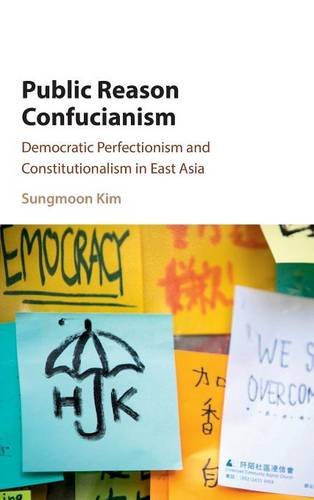 Sungmoon Kim’s new book, Public Reason Confucianism: Democratic Perfectionism and Constitutionalism in East Asia (Cambridge, 2016) has just been published. Congratulations, Sungmoon! Here are links to the CUP website and Amazon. Cambridge has also made available a form that anyone can use to get a 25% discount; click here. Here is the book’s description:
Recent proposals concerning Confucian meritocratic perfectionism have justified Confucian perfectionism in terms of political meritocracy. In contrast, ‘Confucian democratic perfectionism’ is a form of comprehensive Confucian perfectionism that can accommodate a plurality of values in civil society. It is also fully compatible with core values of democracy such as popular sovereignty, political equality, and the right to political participation. Sungmoon Kim presents ‘public reason Confucianism’ as the most attractive option for contemporary East Asian societies that are historically and culturally Confucian. Public reason Confucianism is a particular style of Confucian democratic perfectionism in which comprehensive Confucianism is connected with perfectionism via a distinctive form of public reason. It calls for an active role for the democratic state in promoting a Confucian conception of the good life, at the heart of which are such core Confucian values as filial piety and ritual propriety.
