Category Archives: Confucianism

Ritual Revival in China

Not sure how we missed this story (c/o China Daily). I’d be interested in your comments, or if anyone has/had involvement with the event or organization, please chime in with your perspective on the revival project.

************************************************************************

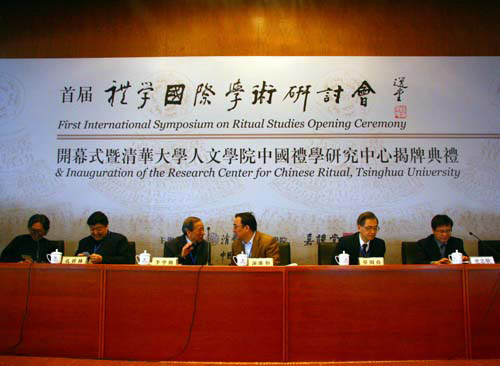
Scholars call for revival of Chinese ritual

(China.org.cn)

Scholars call for revival of Chinese ritual

The opening ceremony of the First International Symposium on Ritual Studies at Tsinghua University, Apr. 9, 2012. [Photo/China.org.cn] Continue reading →

Role Ethics and Criticism

In a previous post, I sketched the two major premises on which Roger Ames and Henry Rosemont rely in their argument that we should attribute “Confucian role ethics” to the Analects and other early Confucian texts. Here, I’d like to consider one potential objection to Confucian role ethics, both as a plausible moral theory in its own right, and as a theory that fits with the texts. The Analects clearly sees the need for critical evaluation of the ways that roles are inhabited by particular people. Does “Confucian role ethics” provide adequate critical purchase for such assessment? Continue reading →

On Confucian Role Ethics

I have recently been at work on an essay called “The Analects and Moral Theory,” one part of which has been examining the idea of “Confucian role ethics,” as recently articulated by Roger Ames and Henry Rosemont. I thought it might be productive to extract some of my analysis here for discussion. In this post I look at the two key premises supporting Confucian role ethics; if folks are interested, in a subsequent post or two I have a couple different objections to the view that may be worth discussion. Continue reading →

CFP: Confucian Traditions Group of AAR

The Confucian Traditions Group will sponsor panels for the 2012 annual meeting of the American Academy of Religion, which will take place in Chicago from November 17-20. This Group invites proposals concerning any aspect of Confucianism from any geographical area. Topics of particular interest this coming year are:

  • Confucianism and tradition — Confucianism as a conservative force or a source of change
  • Confucian ritual interaction with other traditions
  • Confucian self-cultivation
  • Confucianism and the Confucius Institutes
  • “Confucian Fever” — grass-roots Confucianism
  • Unintended consequences of Confucian discourse and institutions

Continue reading →

Nishan Summer Institute

The Center for East-West Relations at Beijing Foreign Studies University sends the following announcement about their Second Annual Confucian Studies Summer Institute. FYI, after you explore a bit, you will find that there is a tuition of $3100 (USD) for the month-long program.

********************************************************

We are pleased to introduce the Second Annual Confucian Studies Summer Institute at the Nishan Birthplace of the Sage Academy in Shandong, China, June 9 to July 7, 2012.

This month-long training program for teachers of Chinese culture (and select graduate students) will be led by professors Roger T. Ames (University of Hawaii), Sor-hoon Tan (National University of Singapore) and Tian Chenshan (Beijing Foreign Studies University), with a special series of lectures by Henry Rosemont, Jr. (Brown University). Our time together will revolve around careful and critical readings of classical texts and contemporary commentaries, seminars, discussion groups, cultural events and activities, and a number of field trips. Continue reading →

Moral Perfection in the Analects (and Beyond?)

As part of some commentary on Paul Goldin’s new book Confucianism, Bill Haines has noted the centrality of the idea of moral perfection in Goldin’s characterization of the basic convictions of the Confucian philosophical orientation. In a subsequent comment, he questions to what degree the ideal of moral perfection was actually held by Confucius. With Bill’s permission, I’m re-posting his comments on this latter subject here, because I think they deserve more attention than they may get buried deep in a comment string. Read on, and please direct your comments to Bill, the author of what follows. Continue reading →

Do Ruists overemphasize filial feeling?

I was at the APA in Washington DC last week, and it was great to get a chance to hear about some very interesting work in Chinese philosophy. A couple of papers got me thinking about the reasoning behind the emphasis on filiality (xiao 孝) in classical Ruism. Whether Ruism gives too much weight to filiality at the expense of other values has been debated recently, and an issue in Dao a year or two ago presented some of this debate. At the conference, I started wondering about a slightly different problem: do Ruists put too much faith in the assumption that someone who is filial will have other moral virtues as well? Is there good reason to think this is generally true? Continue reading →

Review Article on Several Books on Confucius

A recent article in T’oung Pao 97 (pp. 160-201) might be of interest to many readers of the blog. In “Recent Monographs on Confucius and Early Confucianism,” Oliver Weingarten of SOAS considers the following books:

  • Il confucianesimo: i fondamenti e i testi. By Maurizio Scarpari. Turin: Einaudi, 2010. vi + 300 pp.
  • Confucius: A Life of Thought and Politics. By Annping Chin. New Haven: Yale University Press, 2008. xiv + 268 pp.
  • Confucius. By Rémi Mathieu. Sagesses éternelles. Paris: Entrelacs, 2006. 271 pp.
  • Lives of Confucius. By Michael Nylan and Thomas Wilson. New York: Doubleday, 2010. 304 pp.
  • Sang jia gou: wo du Lunyu. By Li Ling. Revised edition. Two volumes. Taiyuan: Shanxi renmin chubanshe, 2007. 2 + 11 + 390 + 120 pp.
  • Qu sheng nai de zhen Kongzi: Lunyu zongheng du. By Li Ling. Beijing: Sanlian shudian, 2008. 13 + 7 + 302 pp.
  • Confucius. Spiritualités vivantes, vol. 198. By Jean Levi. Paris: Albin Michel, 2003. 322 pp.

Continue reading →