Prominent Confucian philosopher and scholar Liu Shuxian died last week in Taiwan at the age of 82.
Here’s a link to the announcement of his passing on the website of the Institute of Chinese Literature and Philosophy at Academia Sinica.

Prominent Confucian philosopher and scholar Liu Shuxian died last week in Taiwan at the age of 82.
Here’s a link to the announcement of his passing on the website of the Institute of Chinese Literature and Philosophy at Academia Sinica.
In a February 2016 blog post, Bin SONG makes a powerful case for switching from “Confucianism” to “Ruism.” This is not a brand-new idea; for instance, David Elstein has consistently used “Ruism,” including in his posts here at Warp, Weft, and Way, and Robert Eno advocated for such a practice in his 1990 book The Confucian Creation of Heaven (see here for relevant quote). Still, Bin Song raises some new arguments. To some degree, the things that Elstein, Eno, and Song are talking about may not be entirely the same: at least in the first instance, I take them to be referring to a modern philosophical movement, an ancient ritual-cum-philosophical movement, and a modern spiritual or religious movement of potential relevance in the contemporary US, respectively. (Admittedly, the application of these categories to Chinese practices can only be approximate; I just mean to gesture toward some possible distinctions.) Be this as it may, it may be that the arguments for using “Confucianism” in any of these contexts are weaker than many of us have assumed. What do you think: should we abandon the word “Confucianism”?
Issue 9 of 当代儒学 (Contemporary Confucianism) has been published, and the table of contents is available here.
Mat Foust has published a review of Stephen C. Angle and Michael Slote, eds., Virtue Ethics and Confucianism (Routledge, 2013) in the Sungkyun Journal of East Asian Studies. The full text of the review is available on-line here (look for “Book Review 4”). Thanks, Mat!
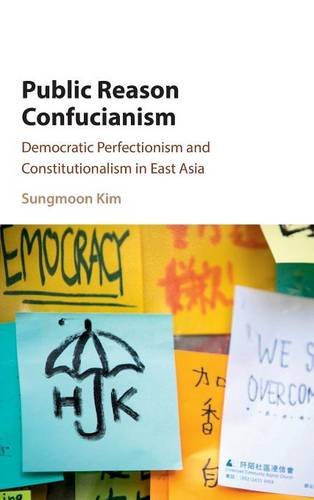 Sungmoon Kim’s new book, Public Reason Confucianism: Democratic Perfectionism and Constitutionalism in East Asia (Cambridge, 2016) has just been published. Congratulations, Sungmoon! Here are links to the CUP website and Amazon. Cambridge has also made available a form that anyone can use to get a 25% discount; click here. Here is the book’s description:
Recent proposals concerning Confucian meritocratic perfectionism have justified Confucian perfectionism in terms of political meritocracy. In contrast, ‘Confucian democratic perfectionism’ is a form of comprehensive Confucian perfectionism that can accommodate a plurality of values in civil society. It is also fully compatible with core values of democracy such as popular sovereignty, political equality, and the right to political participation. Sungmoon Kim presents ‘public reason Confucianism’ as the most attractive option for contemporary East Asian societies that are historically and culturally Confucian. Public reason Confucianism is a particular style of Confucian democratic perfectionism in which comprehensive Confucianism is connected with perfectionism via a distinctive form of public reason. It calls for an active role for the democratic state in promoting a Confucian conception of the good life, at the heart of which are such core Confucian values as filial piety and ritual propriety.
Bin Song, a graduate student at BU, writes:
We Boston Ruists will host a Ruist retreat this summer, July 1-3rd, at Boston University. Attached is the schedule, including all details of the retreat and logistics.
The initiative of this retreat was proposed by some friends in the Facebook group ‘Friends from Afar: a Confucianism group.’ I hope the retreat can be organized as a ‘middle’ sort of Ruism, aiming to propagate Ruist wisdom among ordinary American people but still not losing its scholarly virtuosity.
Anyone interested in learning more about the retreat, or in registering, should contact Bin Song (the information is on the attachment). Comments on this undertaking are of course welcome here.
Bin Song, who holds a PhD in Western philosophy from Nankai University and is currently pursuing a PhD in Religious Studies at Boston University, has begun a series of blog posts in the Huffington Post under the general title, “A Catechism of Confucianism.” As he explains there, “as a Buddhist-Christian Confucian, the primary focus of Bin Song’s spiritual and academic life is to increase the relevance of traditional Confucianism to the contemporary global human society through a on-going dialogue with ordinary people, a variety of philosophical traditions, and non-Confucian world religions.”
This multidisciplinary program, funded by the National Endowment for the Humanities, will offer five weeks of context-rich and critical engagement with Confucian teachings, practices and primary texts (in translation), examining how they have shaped and been shaped by the cultures and societies of China, Korea, Japan and Vietnam. The program will consider how Confucianism addressed both personal and social needs in ways that were inseparable from the dynamics of intellectual exchange, artistic production, social organization and politics.
I am very ha ppy to pass on the news that the Chinese translation of my book Contemporary Confucian Political Philosophy: Toward Progressive Confucianism (Polity, 2013) has been published by Jiangxi People’s Press, as 《当代儒家政治哲学:进步儒学发凡》. More information, including the Preface to the Chinese Edition, can be found here. In case anyone is interested in an English-language version of this new Preface, I will post it below.
