
With graduate school applications due in the next few months, I’d like to put a plug in for our MA and PhD programs here at Indiana University. In particular we are looking for students interested in early Confucian thought (roughly the 6th century BCE through the 3rd century CE). Continue reading →
Category Archives: Chinese philosophy – 中國哲學 – 中国哲学
Position: Chinese and East Asian Thought, University of Sydney
Position: Chinese and East Asian Thought, Assistant Professor,
University of Sydney
 Continue reading →
New Asian Philosophy ToC
The latest issue of Asian Philosophy has been published.
The Chronicle: “Chinese Philosophy Lifts Off in America”
A very nice article about Chinese philosophy in the U.S.!
ACLS Opportunities
I trust that anyone looking for fellowship support already knows about the standard ACLS Fellowships, applications for which are due next week, along with the extremely nice Ryskamp Fellowships. It’s worth keeping in mind the following opportunities as well:
- “Comparative Perspectives” grants are designed to support anything from brainstorming sessions to formal conferences, and have an explicit emphasis on projects that “compare aspects of Chinese history and culture with those of other nations and civilizations, explore the interaction of these nations and civilizations, or engage in cross-cultural research….” Deadline is Nov. 19.
- Then there is the Luce/ACLS Fellowships in China Studies, which offer three different kinds of support, including predissertation grants, postdoctoral fellowships, and reading workshop grants.
All of these can potentially be supported by the Munro Fund, which as previously reported here is designed to support “research projects on Chinese philosophical traditions and ethical systems that exhibit high quality in sinology and in critical analysis, as well as relevance to human problems.”
Early China ToC
Early China 35-36 (2012-2013) is now in print. This very special mega-volume is dedicated to Li Xueqin and guest-edited by Xing Wen. It includes interviews with Li Xueqin by Sarah Allan and Wang Tao; articles by David Keightley, Constance Cook, Xing Wen, Shu CHEN, Harold Roth, Donald Harper, Jeffrey Riegel, Crispin Williams, Yau Shun-chiu, Robin Yates, Marc Kalinowski, Michael Loewe, and Helen Wang; a review by Moss Roberts; and the usual Shigaku zasshi translations and annual bibliography. (Details below)
Upcoming Lecture on the History of Chinese Logic in Taipei
Dear Colleagues,
if you happen to be in Taipei this week, you might be interested in this upcoming lecture at the International Center for Chinese Philosophy (ICCP), Soochow University:
Two New Books Related to Confucianism

Confucian Rituals and Chinese Villagers:
Ritual Change and Social Transformation in a Southeastern Chinese Community, 1368-1949
Brill 2013
In Confucian Rituals and Chinese Villagers, Yonghua Liu presents a detailed study of how a southeastern Chinese community experienced and responded to the process whereby Confucian rituals – previously thought unfit for practice by commoners – were adopted in the Chinese countryside and became an integral part of village culture, from the mid fourteenth to mid twentieth centuries.
The book examines the important but understudied ritual specialists, masters of rites (lisheng), and their ritual handbooks while showing their crucial role in the ritual life of Chinese villagers. This discussion of lisheng and their rituals deepens our understanding of the ritual aspect of popular Confucianism and sheds new light on social and cultural transformations in late imperial China.
Yonghua Liu, Ph.D. (McGill, 2004), is Professor of History at Xiamen University, China. He has published over two dozen articles on economic, social, and cultural history of late imperial China.
Confucian Marxism:
A Reflection on Religion and Global Justice
Brill 2013
Buttressed by an autocratic system, China’s colossal economic growth over the past decades seems to have had the paradoxical effect of undermining the foundation of Western domination but at the same time invigorating Eurocentricism. In particular, it highlights the current relevance of the central conviction of Weber’s Orient: the absence of civic roots in non-Western societies will create a kind of “uncivic” capitalist system in which one has no choice but to seek to compensate for instabilities through authoritarian institutions. Does this mean that the West may alone afford to harmonize political stability with the universalistic ideal of justice as the basic structure of society? If not, how then is it possible to develop a notion of the primacy of social justice that transcends the limits of liberal democracy? This book aims at addressing these timely questions by drawing on “Confucian Marxism”—a distinctive perspective on civil society.
Weigang Chen, Ph. D. (Religious Studies, Harvard University 2000), is on the faculty of philosophy and religious studies at University of Macau, with research interests in religion and global politics. He is a member of the editorial board of Dao: A Journal of Comparative Philosophy.
CFP: Time and Change Conference in Beijing
A conference on “Time and Change in China and the West” will be held at Beijing Normal University, Beijing June 20-22, 2014. It is organized by the International Society for the Study of Time. The theme can be addressed from any perspective—the intent is to have an interdisciplinary, international conference. See more information at the website of the International Society for the Study of Time: http://www.studyoftime.org/ContentPage.aspx?ID=1035
The deadline listed for proposals is Sept 15 but it will be extended to October 15.
Confucius Exhibition at Central Connecticut State University; Foust Keynote
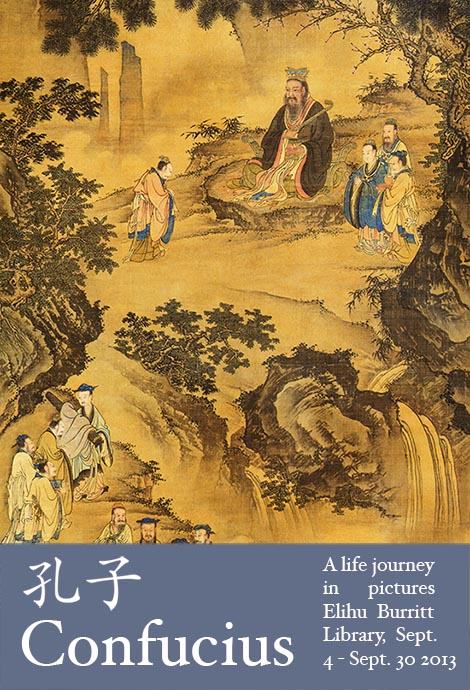 The Confucius Institute and the U.S.-China Center at CCSU, in collaboration with Elihu Burritt Library, proudly present the exhibition:
Confucius – A life journey in pictures
The exhibit displays a series of stunning reproductions of silk paintings and woodcut prints from the Ming and Qing dynasties, depicting the life and travels of the Chinese philosopher Confucius. This exhibit is free, and open to the public. See here for more information.
There will be an Opening Ceremony on Tuesday September 10 @ 6:30pm. Mathew Foust (Assistant Professor of Philosophy at Central Connecticut State University) will deliver a keynote address, “Portraits of Confucius.” Light refreshments will be served. RSVP: confuciusinstitute@ccsu.edu
The exhibit will run through September 30, during regular hours at the Elihu Burritt Library, 2nd floor.
