
Elena Ziliotti has organized an online book symposium on Sungmoon Kim’s recent book Confucian Constitutionalism (OUP, 2023) by inviting several philosophers and political theorists. Please see
https://philevents.org/event/show/121478 for details and to RSVP. The event is Thursday, April 18 beginning at 2:30pm Amsterdam time.
Category Archives: Chinese philosophy – 中國哲學 – 中国哲学
In-Person Workshop: SFU Asian Philosophy
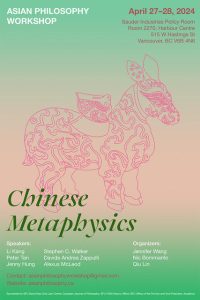
The Simon Fraser University Department of Philosophy is pleased to announce the SFU Asian Philosophy Workshop on April 27-28, 2024.
This year’s theme is Chinese Metaphysics and features talks by six scholars from around the world. For more information including updates about the schedule, please refer to the website.
Registration is not required but can be done by emailing here.
1st Carolina Conference on Chinese Thought
The 1st Carolina Conference on Chinese Thought will take place tomorrow, on April 6, at Appalachian State University. Please see here for all the details, and enjoy!
CFP: Proposed Journal of Social and Political Philosophy issue on Common Sense
In Eclipse of Reason (1947), Max Horkheimer provides a fundamental analysis of the ambivalences of the (Western) concept of reason and showcases what a dialectical understanding of reason could look like. The special issue of JSPP “Eclipse of Common Sense” proposes an analogous treatment of the concept of common sense. The issue will revisit the conceptual foundations and premises of common sense (analytical function); explore its ambivalent normative character (evaluative function); and suggest ways out of this impasse that are inherent (critical function). In a first step, authors will address from a conceptual and a historical perspective a series of parameters or intellectual constants at the core of the term’s conceptual content. Second, other papers will scrutinize the concept’s foundation for democratic societies and test the term’s political applicability by examining its emancipatory promises in regard to promoting core democratic values, e.g., inclusivity, plurality, and visibility. Third, some will draw attention to the dangers underlying every attempt to universalize the supposed qualities of a particular and contextually dependent, Western, type of common sense and extrapolate different ways to reconceptualize the term as well as different practices that help overcome it’s political-social shortcomings.
Anyone interested in submitting a paper dealing with an East Asian approach or approaches to common sense should contact Paul Patton prp@unsw.edu.au
Deadline for Submissions: December 31, 2024.
SDCF 2024 Summer Program
The Sinological Development Charitable Foundation Limited (SCDF) is happy to announce that they will be hosting the 9th Greater China Region Summer Program in Chinese Studies for 2024. This program is intended to happen both online and in person with participation from scholars and key opinion leaders. Scholar applications are due Sunday 28th of April, 2024. Additionally, there are scholarships available for accommodation at the university, meals, and a trip to Mainland China. Please click here for more information or the application forms.
Adamson & Lai Podcast on Classical Chinese Philosophy
Online Lecture: Confucianism and Kant
Professor Heisook Kim, of Ehwa Womans University (Seoul, Korea), is happy to announce that she will be giving an online lecture this Monday, March 19th at 9:00 pm (Standard Korean Time). The title of this lecture is “Knowledge without Transcendental Justification: An Examination of Confucianism through a Kantian Lens”. It should last for around an hour which will then be followed by a Q and A. Please click here to register to join the Zoom room!
New Book: Xiong Shili’s Treatise on Reality and Function
This is the fourth translation in the Oxford Chinese Thought book series, which is devoted to providing high-quality translations of important philosophical and religious texts, for scholars and for classroom use. A free sample chapter is available here (free until April 1, 2024). A short description follows below the fold.
Episode 4 of “This Is the Way”: Daoist Persuasion
In the fourth episode of This Is the Way, we return to the familiar format of doing a close reading of a classical passage and connecting it to a theme. Our theme is “persuasion” and the passage is the dialogue between Confucius and Yan Hui in the Zhuangzi (ch. 4). It’s a great passage — somehow, not so widely discussed as others! But it should be of interest to anyone interested in rhetoric, the power of reasons (or lack thereof), arguments (in at least two senses of “arguments”), and the delicate games we play with our egos and the egos of others when we attempt to persuade.
Somehow, we just immensely enjoyed talking about this passage.
How much historical context when teaching topically?
A colleague recently wrote to me saying that he was:
…inspired by the topical discussion in the Neo-Confucianism book you co-authored and so I decided to structure my course on Neo-Confucianism according to a thematic/topical discussion instead of the usual historical or thinker structure. However, how does one mitigate the pitfalls of sacrificing historicity? Specifically, how much context or historicity should I provide?
I would love to hear any thoughts that folks out there have, either as it relates to teaching Neo-Confucianism or any other relevant subject. Justin Tiwald and I share some thoughts here about why we prefer to teach in a thematic way, and have collected a few teaching ideas here, but I am sure there are some great ideas out there. Please share!
