
Rowman & Littlefield has published Edward Chung, The Great Synthesis of Wang Yangming Neo-Confucianism in Korea. The author adds that for those colleagues who would like to purchase it at the author’s discount (30%), its special promotion code is LEX30AUTH20. The table of contents follows.
Category Archives: Chinese philosophy – 中國哲學 – 中国哲学
Article of Interest: Batsch, “The Rationality Wars”
Readers may be interested in: Shadi Bartsch, “The Rationality Wars: The Ancient Greeks and the Counter-Enlightenment in Contemporary China,” History & Theory 59:4 (2020). Here’s the abstract:
Amid contemporary discussions about the relationship of logic to knowing, an entirely different conversation about the moral status of rationality is taking place between Chinese and Western thinkers. Although most would agree that deductive thought has been a highly privileged feature of the Western philosophical tradition since Plato (for good or bad), the question of its role in Confucian thought is less clear—and considerations of this topic tend to be highly charged. In turn, the question of whether the West has been tarred by a Weberian descent into a merely instrumental form of rationality has emerged as a hot topic in Chinese scholarship. However, the question merely supplies a way of engaging in cross‐cultural comparisons that are political rather than genuinely philosophical in nature. This article explores the sparring over terminology and concepts that characterizes this recent trend in scholarship. Ultimately, it suggests that instead of Chinese scholars appropriating the ideas of Western authors in order to raise anti‐Western specters of spiritual derangement, both traditions would be better off discarding this outdated and essentializing terminology in the first place.
English-based MA and Visiting Program in Chinese philosophy at Fudan
Dear friends,
Thanks to your support, since it was launched in 2011, the MA and Visiting programs in Chinese philosophy (with courses taught in English) at Fudan have been extremely successful. 105 students have been enrolled in either the M.A. program (87 students) and the visiting student program (18 students). They are from 35 countries and from respected institutions of higher education, and many of them are top students in their classes, majoring in (Western) philosophy, classics, East Asian or Chinese studies, international relations, political science, and etc. Therefore, either in terms of the quantity or the quality of the students, the Fudan programs simply are the most successful of their kind (English-based post-graduate programs in Chinese philosophy) in mainland China.
The program boasts perhaps the largest community of English-speaking postgraduate students interested in Chinese philosophy in the world, a community our students have enjoyed greatly. The comprehensiveness and specialization of our curriculum in Chinese philosophy are unmatched by other programs. We have also assigned tutors to our students, helping them read classical Chinese texts, in addition to the normal language classes. Because of the number and the quality of our students, our programs are a “favorite” of the university administration. As a result, we have been EXTREMELY successful at securing fellowships for students applying for the MA program. (For the visiting student program, only partial fellowships are available through Fudan, but students can apply through some external channels, like the Chinese Scholarship Council, the EU, Chinese consulates, Confucius Institutes, etc..)
To continue its success, I ask you to help us to distribute the information about the programs and encourage your students to apply. If they are already in a doctoral program and wish to spend a year in China, they are also welcome. You can go to the following website for more detailed information: https://iso.fudan.edu.cn/_upload/article/files/b8/c0/cc82835d42f79cb393ae0822292b/847b99d0-bc54-4bc7-9040-bab8d5976a52.pdf
Thank you, and be safe and well!
Happy Holidays!
Tongdong
ToC: Asian Philosophy 30:3
Asian Philosophy 30:3 has been published, with articles on Zhuangzi, Li Zehou, gender in Korean Neo-Confucianism, and more. Details are here.
Angle Reviews Bell and Wang, Just Hierarchy
My review of Daniel Bell and Wang Pei’s book Just Hierarchy: Why Social Hierarchies Matter in China and the Rest of the World (Princeton, 2020) has been published in Ethics; see here. The review ends as follows:
…Perhaps a different approach is in order, one more rooted in China’s dynamic traditions than in the modernism that colors some of Bell and Wang’s thinking. Recalling Zhang Zai’s Western Inscription, we could think about the relationality inherent in the entire, ever-changing cosmos and conceptualize these relations through various degrees of kinship. Care, attention, reciprocity, mutuality, learn- ing, and growth would be the watchwords of such a perspective. There is an important place for just—or maybe more accurately, humane or harmonious—hierarchy in such a vision, and Bell and Wang can be important conversation partners in working out what is and what is not valuable among both traditional and more recent forms of social differentiation. Much of this differentiation (such as sexism and racism) needs strong critique, but at the same time, there is reason to agree with Aaron Stalnaker’s concern that modernity in many societies has been characterized by a “systematic pathologization of dependence” (Mastery, Dependence, and the Ethics of Authority [Oxford: Oxford University Press, 2020], 24). Drawing on Wang and Bell’s book and also on more thoroughgoing efforts to engage with traditional philosophical resources from around the world, it should be possible to identify and defend unequal but healthy forms of social cooperation.
ISCP panels at on-line APA
interview with the New Books Network
At the risk of shameless self-promotion, I’m posting to a link to a recent podcast interview about my new book, The Art of Chinese Philosophy, hosted by the New Books Network. Thanks to Alexus McLeod for some very thoughtful questions!
New Books Network | Paul Goldin, “The Art of Chinese Philosophy:…
David Chai was recently interviewed on the same network:
New Books Network | David Chai, “Zhuangzi and the Becoming of…
End-of-term report on “Living a Good Life”
My colleagues Tushar Iriani, Steven Horst, and I have a post at the Daily Nous site about our experience teaching a new “Philosophy as a Way of Life” course that centrally features students doing structured philosophical exercises associated with each of the four main schools we covered (Confucianism, Aristotelianism, Daoism, and Stoicism). The course website itself is here; each of the “Live Like a ______” weeks are linked from here. Comments or questions either here or at Daily Nous most welcome!
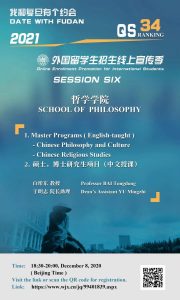
Information session on Fudan’s English-based MA program in Chinese Philosophy
18:30-20:00, Dec. 8 (Tuesday) 2020, Beijing Time. Open to all. See poster below for details.
CFP: Teaching East Asia in the Humanities
Call for Proposals: Teaching East Asia in the Humanities
April 24-25, 2021 (via Zoom)
The past decade has produced a great corpus of literature which defends and reimagines the value of the humanities—its potential to cultivate critical reasoning and cultural literacy necessary for a healthy civil society (Helen Small, 2013), ethically meaningful reading practices (Peter Brooks, 2014), and the character and judgement required to become “more human” (James Hankins, 2017). For teachers of the humanities, maintaining the sort of engaged pedagogy necessary to deliver on these promises means frequent trial and error. This conference is designed to serve as a forum to discuss both our challenges and successes in achieving our goals as humanities teachers in East Asian fields.
We invite proposals that reflect on your own stories of challenging and rewarding moments in your teaching, as well as common pedagogical strategies within your fields. How do we grapple with tensions between global and local perspectives? How do we account for particularities (philosophical concepts, literary forms, and social institutions) in East Asia while avoiding essentialisms, or introduce students to Western theory without perpetuating discursive hegemony? How should we navigate or challenge the boundaries imposed by the premodern/modern divide, or disciplines such as history, literature, philosophy, and religion? What pedagogical hurdles and advantages accompany teaching translated sources? Ultimately, how should we tailor our pedagogy to foster humanistic thinking?
