2016 Term SJSU Center for Comparative Philosophy Workshop (Conference Series Co-Sponsor: SJSU Philosophy Department Symposium)
How Constructive Engagement of Comparative Philosophy Is Possible: Challenges and Prospect
Conference flyer here.

2016 Term SJSU Center for Comparative Philosophy Workshop (Conference Series Co-Sponsor: SJSU Philosophy Department Symposium)
How Constructive Engagement of Comparative Philosophy Is Possible: Challenges and Prospect
Conference flyer here.
Eddy Keming Chen, an advanced graduate student in philosophy at Rutgers, served as rapporteur for the recent Rutgers Workshop on Chinese Philosophy, and compiled this very through report on the day’s presentations and discussion. Many thanks, Eddy! (For those who would prefer a nicely formatted PDF version, it is available here.)
Report on The 3rd Rutgers Workshop on Chinese Philosophy (RWCP): CONVERSATIONS WITH WESTERN PHILOSOPHERS (Friday, April 15, 2016)
Eddy Keming Chen , Rutgers Philosophy Department
The 3rd Rutgers Workshop on Chinese Philosophy (RWCP), organized by Tao Jiang (Rutgers), Ruth Chang (Rutgers), and Stephen Angle (Wesleyan), continued the success of the RWCP conferences of the past two years. This year, the workshop included four sessions. Each presenter had been asked to find a Western philosopher to conduct a dialogue on a common theme in Chinese philosophy and Western philosophy. That resulted in four highly suggestive and fruitful conversations: the importance of studying non-Western philosophy, theories of truth, yuan and the “bourgeois predicament,” and the foundations for moral relativism.
The 2-week Visiting Programs organized by the Research Centre for Chinese Philosophy and Culture at the Department of Philosophy of The Chinese University of Hong Kong are now open for application.
Overview:
In order to promote exchanges with scholars from around the world, the Research Centre for Chinese Philosophy and Culture has established several exchange programs to provide financial assistance for visiting scholars to conduct research and participate in academic activities organized by the Centre.
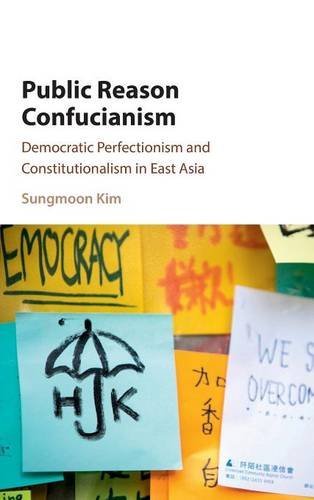 Sungmoon Kim’s new book, Public Reason Confucianism: Democratic Perfectionism and Constitutionalism in East Asia (Cambridge, 2016) has just been published. Congratulations, Sungmoon! Here are links to the CUP website and Amazon. Cambridge has also made available a form that anyone can use to get a 25% discount; click here. Here is the book’s description:
Recent proposals concerning Confucian meritocratic perfectionism have justified Confucian perfectionism in terms of political meritocracy. In contrast, ‘Confucian democratic perfectionism’ is a form of comprehensive Confucian perfectionism that can accommodate a plurality of values in civil society. It is also fully compatible with core values of democracy such as popular sovereignty, political equality, and the right to political participation. Sungmoon Kim presents ‘public reason Confucianism’ as the most attractive option for contemporary East Asian societies that are historically and culturally Confucian. Public reason Confucianism is a particular style of Confucian democratic perfectionism in which comprehensive Confucianism is connected with perfectionism via a distinctive form of public reason. It calls for an active role for the democratic state in promoting a Confucian conception of the good life, at the heart of which are such core Confucian values as filial piety and ritual propriety.
Eiho Baba of Furman University has a nice contribution to “TEDxFurmanU” on “Chinese Philosophical Texts with a Sensitivity to Underlying Assumptions”; see here.
Leigh Jenco (LSE) will be speaking at Harvard on May 2 at 4:00pm. Her title is “How Should We Use the Chinese Past?: Non-Western Histories of Thought in a Global Age.” More information here.
A New York Times piece on Nicholas Berggruen; the Berggruen Institute’s Philosophy and Culture Center has emerged as an important new source of funding and programming in our area. (Disclosure: I am on the Academic Board.)
In response to my posting about archiving my papers, Brian Bruya and I had a bit of correspondence about the differences among home-grown archive sites (like the “WesScholar” site I am using) and others, such as Academia.edu, ResearchGate, PhilPapers, and perhaps others. Brian also pointed me toward this very interesting discussion of the pros- and cons- of various options. Just a couple days ago, a colleague in anthropology told me that in her field, it was very common to post everything — including PDFs of published articles, which I think violates the policies of most journals — on Academia.edu. The advantages in terms of ease of access are pretty obvious, although see the discussion referenced above for some downsides of just using Academia (or, perhaps, any single approach).
Brian himself uses a homegrown arching mechanism, as does Hagop Sarkissian:
I’d be interested in: (1) links to any other on-line sources of work in Chinese and/or comparative philosophy, and (2) any further thoughts about these topics.
At my invitation, my former student Dylan Awalt-Conley has agreed to make the following short essay public as a Guest Post. Please address any questions or comments to Dylan.
Neo-Confucianism and Physicalism
© 2016, Dylan Awalt-Conley
Despite general enthusiasm for engaging with the Neo-Confucian imaginary in a serious philosophical way, there seem to be some widely held reservations against its use in scientific contexts. Yet I believe that much of the intuitive incompatibility between the Cheng-Zhu metaphysic and a scientific framework comes from a sense of ‘science’ that is constrained by an implicit ontological reductionism. If we are willing to take Neo-Confucianism seriously, then the ontology invoked by concepts like li and qi can provide an experimentally sound alternative to physicalism, complete with new ways of thinking and working scientifically.
