
When you hear sad music and feel some sadness in response, is that because the music has successfully carried the sadness of the musician to you as the listener? Or is it better to say that the sadness is in you, released by the music but not “carried” by it? In this show (our second with a live audience), we discuss the music theory of the third-century philosopher Ji Kang 嵆康 (223–262 CE), who argued against the “carrier” view of music and for a more complicated and pluralistic account of the emotional contents of music. We also discuss Ji Kang’s interpretation of a famously evocative and mysterious passage in the Zhuangzi, regarding the “piping of Heaven.” To guide us in discussing these issues, we lean heavily on our guest, Meilin Chinn of Santa Clara University, a leading expert on the philosophy of music in China. Continue reading →
Category Archives: Xuanxue
Live audience recording of “This Is the Way” in Santa Clara: February 12, 2026
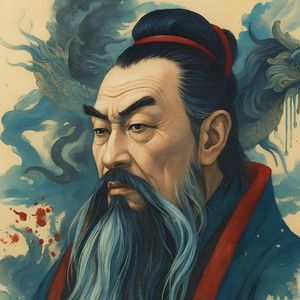 Richard Kim and Justin Tiwald will be recording another podcast episode with a live audience on the evening of February 12, 2026, on the campus of Santa Clara University (SCU) in California, USA. Their guest will be SCU’s Meilin Chinn, and the topic will be the philosophy of music in the thought of Ji Kang 嵇康 (a.k.a. Xi Kang, 224-263 CE).
Here are the event details: Continue reading →
2018 Dao Best Essay Award Announcement
2018 Dao Annual Best Essay Award
Dao has established “The Annual Best Essay Award” since 2007. In addition to a certificate of achievement, the award comes along with a prize of US$1,000. The award winners are noted in the website of the journal as well as the website of Springer, the publisher of the journal. The award ceremony is held each year at the American Philosophical Association Annual Meeting (Eastern Division) in January, where a special panel on the theme of the award winning essay is held. The critical comments and the author’s responses to them presented at the panel, after revision, will be published in the last issue of Dao each year.
The selection process consists of two stages. At the beginning of each year, a nominating committee of at least three editorial members, who have not published in Dao in the given year, is established. This committee is charged with the task of nominating three best essays published in the previous year. These three essays are then sent to the whole editorial board for deliberation. The final winner is decided by a vote by all editorial board members who are not authors of the nominated essays.
The editorial board has just finished its deliberation on the best essay published in 2018, and the award is given to:
Paul J. D’Ambrosio, Hans-Rudolf Kantor, Hans-Georg Moeller, “Incongruent Names: A Theme in the History of Chinese Philosophy,” Volume 17, Issue 3, March 2018, pp. 305-330. (The paper is set for free access by clicking the title here.)
Ziporyn’s Beyond Oneness and Difference Published
The second volume of Brook Ziporyn’s new work on li and coherence in pre-Neo-Confucian Chinese thought has been published. See below for summary and Table of Contents for both volumes.
Review of Book on Early Medieval Chinese Philosophy
A very favorable and informative review of Chan and Lo, eds., Philosophy and Religion in Early Medieval China (SUNY, 2010) has appeared on H-Net; take a look!
