Karyn Lai and Sor-hoon Tan have recently joined the Stanford Encyclopedia of Philosophy as new editors in the Chinese philosophy area, and are undertaking an ambitious program to increase the number of articles on Chinese philosophy from the current dozen up to nearly 40. The SEP’s lack of content in Chinese philosophy has been a topic of discussion here in the past, so this is exciting news. Articles anticipated to come out over the next year include: Chinese Philosophy: Social and Political Thought, Chinese Epistemology, Chinese Metaphysics, Chinese Logic, Chinese Philosophy of War and Peace, Legalism in Ancient China, Tiantai Buddhism, Chan Buddhism, Han Dynasty Syncretism, Song-Ming Confucianism, Qing dynasty philosophy, Contemporary Chinese Philosophy.
Category Archives: Chinese philosophy – 中國哲學 – 中国哲学
New Book Series
Sor-hoon Tan has asked me to share information about the new Bloomsbury Research Handbooks in Asian Philosophy.
Bringing together established academics and rising stars, Bloomsbury Research Handbooks in Asian Philosophy survey philosophical topics across all the main schools of Asian thought. Each volume focuses on the history and development of a core subject in a single tradition, asking how the field has changed, highlighting current disputes, anticipating new directions of study, illustrating the Western philosophical significance of a subject and demonstrating why a topic is important for understanding Asian thought.
The first set of titles includes:
- The Bloomsbury Research Handbook to Chinese Philosophy and Gender, Edited by Ann A. Pang-White, University of Scranton, USA
- The Bloomsbury Research Handbook to Indian Aesthetics and the Philosophy of Art, Edited by Arindam Chakrabarti, University of Hawaii, Manoa, USA
- The Bloomsbury Research Handbook to Indian Epistemology and Metaphysics, Edited by Joerg Tuske, Salisbury University, USA
Forthcoming volumes include: Chinese Aesthetics; Chinese Moral Psychology; Chinese Philosophy and Methodology; Indian Ethics; Indian Philosophy and Gender
More information is available here.
Ancient Philosophy Conference – Call for Papers
Conference on Ancient philosophy that explicitly invites papers from all traditions. Looks like a great opportunity, in a great setting.
THE UNIVERSITY OF BRITISH COLUMBIA
Hosts
The Second Canadian Colloquium
for Ancient Philosophy
May 2–4, 2014
The University of British Columbia warmly invites the submission of proposals in either French or English for individual papers and poster presentations for the Second Canadian Colloquium for Ancient Philosophy. We invite submissions in all areas of Ancient Philosophy (including Graeco-Roman, Indian, and Chinese traditions), and we welcome submissions from graduate and postgraduate students.
The list of confirmed speakers and roundtable presenters includes:
- Hugh Benson (University of Oklahoma)
- Margaret Cameron (University of Victoria)
- Christopher Framarin (University of Calgary)
- Doug Hutchinson (University of Toronto)
- Lloyd P. Gerson (University of Toronto)
- Annie Larivée (Carleton University)
- Monte Ransome Johnson (University of California, San Diego)
- Jean-Marc Narbonne (Laval University)
Walter Mignolo on non-European thinkers and philosophers
Here is an interesting piece (though dating back to February 2013) by Walter D. Mignolo on the role of Slavoj Žižek in the global market of ideas and an exchange between the philosophers Santiago Zabala and Hambid Dabashi. All pieces have been published on the website of Aljazeera and can be easily retrieved.
I have always been thinking that the discussion on Chinese philosophy needs to take into account the larger debates about Eurocentrism, colonialism, and the very nature of philosophy which have been going on for decades (with thinkers like Edward Said, Homi Bhabha, Enrique Dussel, Kwame Appiah, and others). However, quite often, this is at least my impression, scholars working on Chinese philosophy (both in China and in the West) are not willing enough to engage in these debates. In fact, Western scholars working on Chinese philosophy seem to be quite reticent to address these issues which are fiercely debated not in philosophy departments, but rather in departments of comparative literature or sociology. Or is such an impression one-sided? And might this reticency be due to the controversial legacy of Marxism? What do you think?
Reminder: Columbia Society for Comparative Philosophy lecture on Truth and Argument in Ancient Chinese Philosophy Dec 6 @5:30pm
(A reminder about this upcoming lecture this Friday, December 6.)
THE COLUMBIA SOCIETY FOR COMPARATIVE PHILOSOPHY
Welcomes:
BRYAN VAN NORDEN (Vassar College)
With responses from:
TIMOTHY CONNOLLY (East Stroudsburg University)
Please join us at Columbia University’s Religion department on Friday, December 6, 2013 at 5:30 for his lecture called:
“Truth and Argument in Ancient Chinese Philosophy”
ABSTRACT:
Most informed students of comparative Chinese-Western philosophy would agree with the following four claims: 
- Chinese philosophy is almost always concerned with truths that have ethical and social implications, whereas Western philosophy is sometimes concerned with purely theoretical puzzle-solving.
- Nonetheless, historically speaking, most Western philosophers have in fact been motivated to philosophize by ethical and social concerns. The trend toward theoretical puzzle-solving is largely characteristic of some 20th century philosophy, particularly in the English-speaking world.
- Aristotle invented the first form of formal, deductive logic in the West, whereas Chinese philosophers were much more interested in the complexities of ordinary language arguments.
- Nonetheless, philosophers in both China and the West give philosophical arguments – and sometimes structurally similar philosophical arguments – without needing to use formal logic.
Controversy remains, though, over the proper way to understand the role of “truth” in Chinese philosophy. Continue reading →
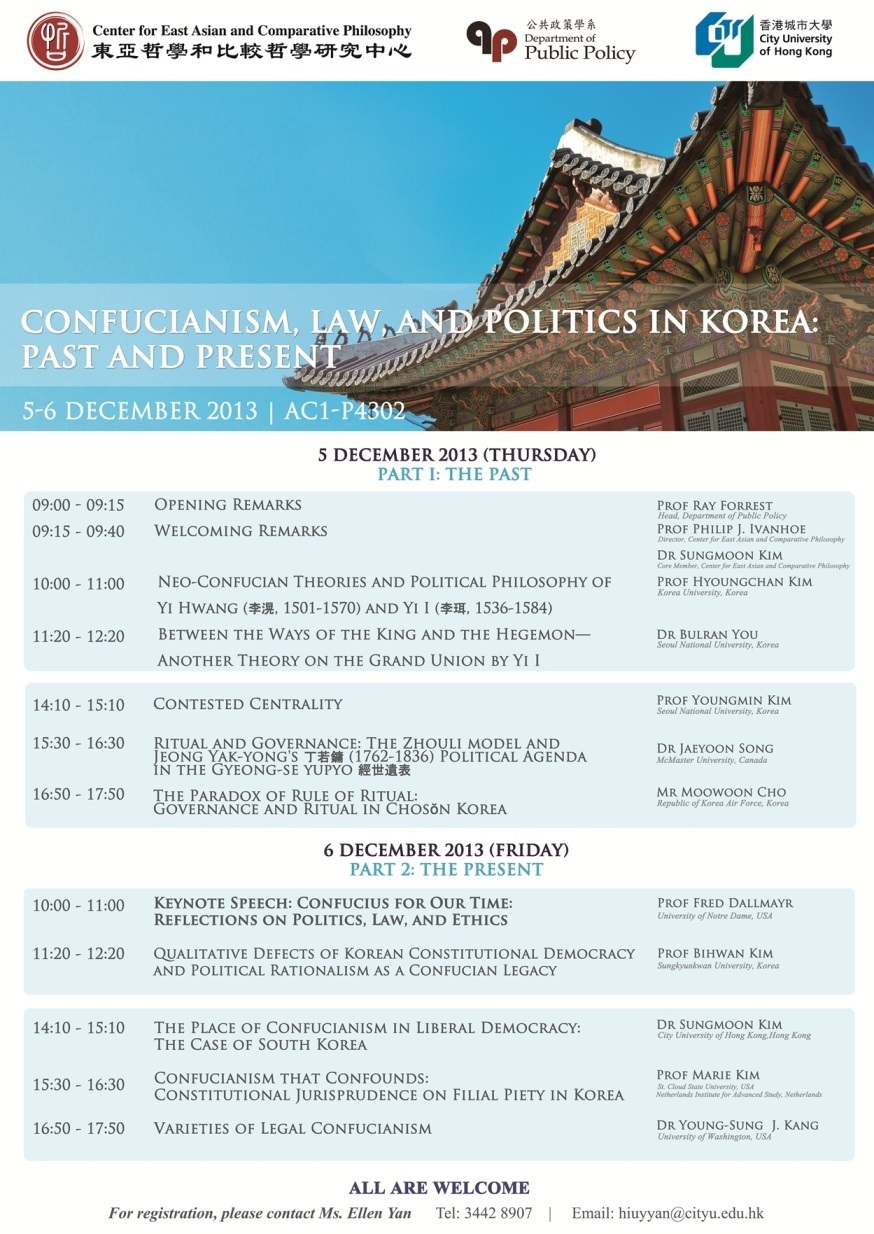
Conference 5-6 December in HK on Confucianism, Law, and Politics in Korea
Eirik Harris reports: We’re hosting a conference on “Confucianism, Law, and Politics in Korea: Past and Present” here at CityU that might interest some of the Warp, Weft and Way readers. The Conference poster with list of speakers and topics is here: http://www6.cityu.edu.hk/ceacop/kpcp/conference_poster.jpg
Neo-Confucianism Seminar this Friday
The next session of the Columbia University Seminar on Neo-Confucian Studies will convene Friday, December 6, 2013 from 3:30 to 5:30pm in the Komoda Room of the Heyman Center for the Humanities at Columbia University.
Our presenter is Ellen Neskar of Sarah Lawrence College. Her paper is titled “Dreams, Court Cases, and Confucians.” Please contact the organizers for a copy.
Classical Daoism – Is there Really Such a Thing? 4.3
Friend of the blog, Scott Barnwell, shares part 4.3 of his extensive study of classical Daoism.
You will find a lengthy PREVIEW below — footnote links send you to the article posted on his own blog. Comments are welcome here; please address comments to Scott.
___________________________________________________
Mysticism, Self-Cultivation and Longevity
Recent statistics for the journal Dao
Courtesy of Yong Huang, editor of Dao: A Journal of Comparative Philosophy, here are some statistics about access to Dao and citation of its articles. (We would be happy to post information on any other journals as well.)
Immediate Job Opportunity
The Leiden University Institute of Philosophy is seeking to fill, on short notice, the position of Assistant Professor in Comparative Philosophy and History of Philosophy. They are particularly interested in a specialist of CHINESE PHILOSOPHY AND/OR BUDDHISM.
The appointment is for 19 hours per week (i.e., half-time) for a period of two years, but opportunities for an extension of the position in time and duration may arise. Note that the deadline for applications is next week, December 2, and the position is to begin in January or February 2014.
For further details please see below.