
The Department of Philosophy at the National Chengchi University is happy to announce that they will be hosting a lecture both in person and virtually titled “The Unfished Project of Miki Kiyoshi”. The speaker for this lecture will be Professor Noe Keiichi alongside discussant Professor Lin Chen-kuo. The lecture will take place at Room 106, BaiNian Building, National Chengchi University on October, 5th, 2023 (1500-1700 Taiwan time) or you can join online by clicking the link here. Read on for more.
Category Archives: Lecture
Online Lecture: How to Produce Learning: Some Preliminary Thoughts on Neo-Confucian Knowledge Culture
How to Produce Learning: Some Preliminary Thoughts on Neo-Confucian Knowledge Culture (1200-1700)
Speaker: Dr. Lianbin Dai, Department of Pacific and Asian Studies, University of Victoria
Moderator: Prof. Nathan Vedal, Department of East Asian Studies, University of Toronto
Time: 2:00-3:30 P.M. EST, Wednesday, February 1, 2023
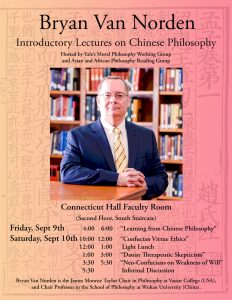
Introductory Lectures on Chinese philosophy
Yale’s Moral Philosophy Working Group and Asian and African Philosophy Reading Group welcomes Professor Bryan Van Norden of Vassar College and Wuhan University for a series of introductory lectures on Chinese philosophy. No previous knowledge of the topic is necessary. Van Norden will speak on four different topics; each is an hour of presentation followed by an hour of Q and A. The University is happy to provide lunch on Saturday so please email harry.lloyd@yale.edu if you plan on joining for lunch. More information is on the poster and below.
Online Lecture: Luo, Understanding the Alienated Self
An online lecture titled Understanding the Alienated Self: The Interest in and Problemtization of the Village in the Post-May-Forth Period is being hosted by the Centre for Modern East Asian Studies & Department of East Asian Studies, University of Göttingen. The lecture will be given by Luo Zhitian, a distinguished professor at Sichuan University, and is co-organized by Dr. Axel Schneider and Dr. Thomas Fröhlich. Participants are required to register for the event, and it will be held in Chinese.
May 27, 2022, 10:00 AM Amsterdam time; Registration form HERE.
For more information about the conference click HERE.
Two remaining lectures in “New Perspectives on Modernity in China”
The University of Göttingen Centre for Modern East Asian Studies is hosting two more lectures on New Perspectives on Modernity in China. The lectures look at Chinese history, philosophy, religion, politics etc. presenting current research that is addressing unsettling questions triggered by these developments. Individuals must register for each event that they want to attend.
Justin Ritzinger — Push and Pull: Toward a Taylorian Theory of Alternative Modernities
May 6, 2022 4:00 pm – 6:00 pm (CET time); for more information and registration click HERE.
Viren Murthy — Conservative Radicalism: Watsuji Tetsuro’s Critique of Civil Society and Its Implications for Chinese Intellectual History
May 20, 2022 12:00 pm – 2:00 pm (CET time); for more information and registration click HERE.
Lecture: Xu Jilin on Maruyama Masao
Announcing the next lecture of the University of Göttingen’s Centre for Modern East Asian Studies’s 2021/2022 lecture series New Perspectives on Modernity in China.
Xu Jilin (Professor at East China Normal University) will speak about Maruyama Masao’s Research on Intellectual History as seen by Chinese scholars (lecture and discussion in Chinese)
Time: Feb 11, 2022 12:00 PM Amsterdam, Berlin, Rome, Stockholm, Vienna
Registration (required) is at: Zoom link.
Time: Feb 11, 2022 12:00 PM Amsterdam, Berlin, Rome, Stockholm, Vienna
Registration (required) is at: Zoom link.
Abstract
Maruyama Masao is the most influential post-war Japanese intellectual historian. He transcends the dichotomy between Eastern and Western thought, uncovering the “insistent bass” in the “ancient layers” of Japanese thought and examining how it has recreated the universality of modern Japanese thought. He views the study of the history of thought as an “art of representation” similar to the performance of music, in which re-creation is achieved within the confines of a text. He relativizes universal thought in a specific historical context, presenting the richness and diversity of thought itself.
Maruyama Masao is the most influential post-war Japanese intellectual historian. He transcends the dichotomy between Eastern and Western thought, uncovering the “insistent bass” in the “ancient layers” of Japanese thought and examining how it has recreated the universality of modern Japanese thought. He views the study of the history of thought as an “art of representation” similar to the performance of music, in which re-creation is achieved within the confines of a text. He relativizes universal thought in a specific historical context, presenting the richness and diversity of thought itself.
On-Lecture on Filial Piety in Contemporary China
Piety without Obedience? Popular Discourse on Filial Piety as a Resource for Morality in Contemporary China Lecture (online), December 17, 16:00–18:00
Registration at: https://us02web.zoom.us/meeting/register/tZMvcemgqD4pHtwbv3Xm1wsOHWP42K7I_RkN
ABOUT THE SPEAKER
Marius Meinhof received his PhD degree in 2017 at Bielefeld University. From 2013 to 2016 he held a doctoral research Position at Bielefeld Graduate School in History and Sociology. In 2016, he joined the faculty of sociology at Bielefeld University as a research associate. He is currently the project leader in the DFG-funded project »Zivilisierte Familien. Diskurse der ›kindlichen Treue‹ in China im Zeitalter des ›chinesischen Traums‹«. His fields of research are China, Post-colonialism in China and Consumption, placing an accent on Governmentality in consumption.
Lecture: Li, The relationship between Neo-Confucianism and Buddhism
The Glorisun Global Network for Buddhist Studies is pleased to present:
The relationship between Neo-Confucianism and Buddhism in Song Dynasty taking Zhu Xi as an example
By Professor Li Chunying 李春穎, International Confucian Academy at China University of Political Science and Law
Date: Monday, December 6, 2021, 10:00 AM PST
Webpage: https://glorisunglobalnetwork
Registration: https://ubc.zoom.us/meeting/r
Shogimen lecture: Metaphor Analysis and Comparative History of Political Thought
Jun-Hyeok KWAK writes:
The 20th Comparative Philosophy Workshop sponsored by Sun Yat-sen University will be held virtually at 10:00 AM to 12:00 PM (Beijing Time), 3rd December (Friday), 2021.
Topic: “Metaphor Analysis and Comprative History of Political Thought”
Speaker: Takashi SHOGIMEN (Professor of History, University of Otago)
Moderator: Jun-Hyeok KWAK (Professor of Philosophy (Zhuhai), Sun Yat-sen University)
On-line Lecture: Jenco: The Ming-Qing Transition as a Philosophical Problem
Leigh Jenco: The Ming-Qing Transition as a Philosophical Problem
Time: Dec 3, 2021 04:00 PM (German time); register here.
Description: The transition from the Ming dynasty to the Qing dynasty was not experienced as a sharp break for those who lived through it, but it has come to stand in the minds of later Chinese literati as nothing less than an existential crisis for Chinese identity—both driving and driven by a shift in intellectual perspective that emerged in the early years of Qing consolidation. Many educated literati retrospectively blamed the fall of the Ming on the abstruse philosophizing that preoccupied followers of Wang Yangming, a sixteenth-century statesman, frontier general and philosopher whose rejection of state-sponsored Confucian orthodoxy rode a wave of interest in metaphysical speculation about the sources of moral knowledge. In its place—just as the government policy adapted from an inward-looking, Han-dominated state to a cosmopolitan, expansionist inner Asian empire—seventeenth- and eighteenth-century literati turned their attention to the historical and philological verification of classic texts, inaugurating the “evidential learning” (kaozheng) that twentieth-century Chinese reformers would see as proof of an indigenous, modern “scientific spirit.” In this paper I argue that such divisions obscure from view the extent to which the Manchu victory and the territorial consolidation that followed continued the strong parallels that marked both Chinese and European societies in early modernity. There are thus important philosophical consequences for periodizing the Chinese early modern period as an abrupt transition from “Ming to Qing” or “philosophy to philology”. I use my current research to offer examples of these consequences. Specifically, I argue that characterizing this time period in terms of a rupture between dynasties, rather than as a more general epoch of early modernity, leaves us unable to assess philosophically the ways in which ideas and practices thematized by scholars of Yangming learning enabled particular kinds of discourse about human difference to take shape.
