
A major new book is about to be released: the 704-page Luxuriant Gems of the Spring and Autumn (春秋繁露), attributed to Dong Zhongshu; edited and translated by Sarah A. Queen and John S. Major (Columbia University Press). This is a tremendous accomplishment, and should help to further open up post-classical philosophy to broader attention and analysis.
Category Archives: Translation
Translation of Xiong Shili
I am very pleased to announce the publication of John Makeham’s outstanding translation of Xiong Shili’s huge influential New Treatise on the Uniqueness of Consciousness 新唯識論. This is the first East Asia-related volume in Yale University Press’s World Thought in Translation series. Congratulations, John!
Noticed any typos in Hutton’s Xunzi?
Eric Hutton has informed me that Princeton University Press intends to release a paperback edition of his translation of the Xunzi, and there is an opportunity for him to make minor changes to the translation. Readers of this blog who have noticed typos in the current edition or who have other small corrections to suggest are invited to email them directly to Eric at: eric.hutton@utah.edu.
Sung in NDPR on Hutton’s Xunzi
Notre Dame Philosophical Reviews
2015.03.16 View this Review Online View Other NDPR Reviews
Xunzi, Xunzi: The Complete Text, Eric L. Hutton (tr.), Princeton University Press, 2014, xxxi+ 397pp., $39.95 (hbk), ISBN 9780691161044.
Reviewed by Winnie Sung, Nanyang Technological University
New Analects Translation
Penguin has recently brought out a new translation of, and commentary on, the Analects, by Annping Chin. The Amazon page is here, at which one can get a good sense of the format and goals of this new translation. Considerable comentary is appended after each passage, with a combination of Chin’s own thoughts and comments from mostly post-Song (primarily Qing to the present) scholars. Chinese text is provided in an appendix. Anyone have any thoughts on this new translation?
Mair on Xin
Victor Mair has published an essay about the meaning of <i>xin</i> 心, about which we had some considerable discussion here a little while ago.
Hutton’s Xunzi Translaton Published
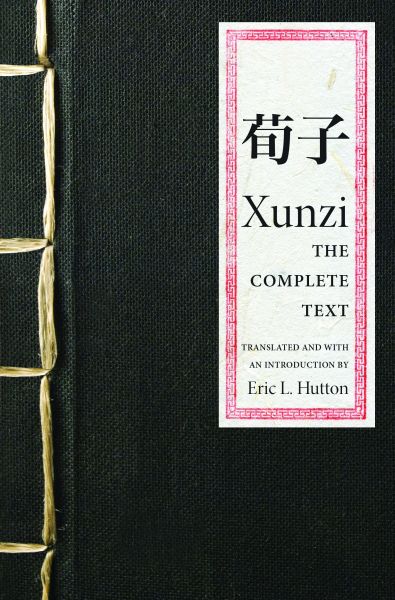
Xunzi: The Complete Text
Princeton University Press would like to announce the publication of Eric Hutton’s new translation of Xunzi.
“This is the first complete, one-volume English translation of the ancient Chinese text Xunzi, one of the most extensive, sophisticated, and elegant works in the tradition of Confucian thought. Through essays, poetry, dialogues, and anecdotes, the Xunzi articulates a Confucian perspective on ethics, politics, warfare, language, psychology, human nature, ritual, and music, among other topics. Aimed at general readers and students of Chinese thought, Eric Hutton’s translation makes the full text of this important work more accessible in English than ever before.
New Book: Readings in Later Chinese Philosophy
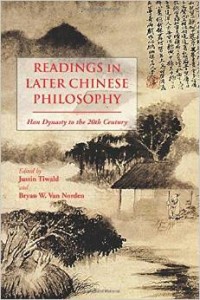 I’m pleased to announce the publication of our reader in post-classical Chinese philosophy.
I’ll put the details below the fold, but it might help to have a quick summary of some the book’s most noteworthy (or at least distinctive) advantages.
- Better selections than Chan’s Sourcebook, including several overlooked gems and works on and by women
- Consistent translations of key terms and oft-quoted passages
- Begone Wade-Giles!
Norton Critical Edition of Analects
The Norton Critical Edition of the Analects has just been published. Edited by Michael Nylan, it joins together Nylan’s Introduction, Simon Leys’s translation of the text, and a series of interpretive essays:
- Nicolas Zufferey • On the Ru and Confucius
- Robert Eno • In Search of the Origins of Confucian Traditions in Lu
- Mark Csikszentmihalyi and Tae Hyun Kim • The Formation of the Analects
- Eric L. Hutton • Mencius, Xunzi, and the Legacy of Confucius
- Luke Habberstad • The Sage and His Associates: Kongzi and Disciples across Early Texts
- Julia K. Murray • Visualizing Confucius and His Disciples from the Analects
- Thomas Wilson • Reading the Analects in the Sage’s Courtyard: A Modern Diner’s Guide to an Ancient Feast
- Sébastien Billioud and Vincent Goossaert • Confucius and his Texts: A Century of Crisis and Reinventions
- Yuming He • Talking Back to the Master: Play and Subversion in Entertainment Uses of theAnalects
- Henry Rosemont Jr. • On “New Confucianism”
- Sam Ho • Confucius on Film: Toward a Confucian Aesthetic
The choice of Leys’s translation — which consciously renders the text in modern, accessible language — may make sense in light of the Nylan’s objective in assembling this range of interpretive essays, which collectively “suggest that the Confucius we thought we knew is not the Kongzi of record and that this Kongzi is a protean figure given to rapid change and continual reevaluation.”
Why can’t we all agree on how to translate “xin”?
Translation of Chinese philosophical terminology is often one of the more vexed problems that we face. This is both because the interpretation and understanding of some of these terms is complicated (and controversial), and because it is rarely easy to choose a single word, or a short phrase, that readily expresses the meaning of a given term. Many potential translations carry inapt baggage with them; others can be misleading in other ways. Often we are urged to give up and leave a term romanized. I would agree that, depending on one’s specific goals, this can sometimes be the best choice, but of course to resort to it too often is to abandon the project of interpretation and translation.
