
City U’s Centre for East Asian and Comparative Philosophy is advertising a postdoc that will be of interest to readers of this blog. I’ll post some highlights below the fold and then link to the complete listing.
Author Archives: Justin Tiwald
In Memoriam: David S. Nivison (1923-2014)
American sinologist and philosopher David Nivison passed away on the 16th of this month. Nivison was a true polymath and made tremendous contributions to a variety of fields that overlapped with Chinese thought and history. For most readers of this blog, he will perhaps be best remembered for his contributions to Chinese philosophy, which was greatly enriched by his work on Daoists and Confucian philosophers across history, including the classical period as well as the Song, Ming and Qing dynasties. For much of his adult life, he also served as one of a small handful of scholars working on Chinese thought under the aegis of a Western philosophy department, and played a major role in integrating Chinese philosophy with contemporary philosophy as practiced in the English-speaking world. Among his best-known books are The Life and Thought of Chang Hsueh-ch’eng, The Ways of Confucianism, and The Riddle of the Bamboo Annals.
There are two substantial obituaries available on-line. One in English and the other in Chinese. The latter includes a nice collection of photographs.
New Book: Readings in Later Chinese Philosophy
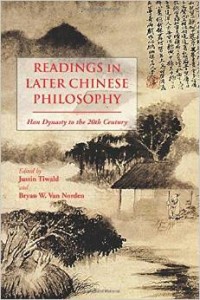 I’m pleased to announce the publication of our reader in post-classical Chinese philosophy.
I’ll put the details below the fold, but it might help to have a quick summary of some the book’s most noteworthy (or at least distinctive) advantages.
- Better selections than Chan’s Sourcebook, including several overlooked gems and works on and by women
- Consistent translations of key terms and oft-quoted passages
- Begone Wade-Giles!
New Book: Ritual & Religion in the Xunzi
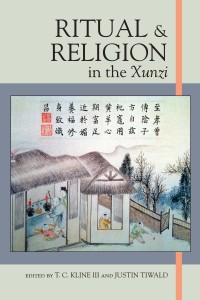 Not without shame, I’d like to mention (and thereby promote) a book that I co-edited with Jack Kline, Ritual & Religion in the Xunzi, devoted to interpretations of Xunzi as a religious philosopher. I’ll include a brief description below the fold.
New Book Series
Rowman and Littlefield has a new book series that will be of interest of many readers here, and they are now taking proposals. Note that they intend to publish works on Japan and Korea as well as China.
We are pleased to announce the establishment of the CEACOP Series in East Asian Comparative Ethics, Politics, and Philosophy of Law, a new monograph series organized and overseen as a cooperative venture by Rowman and Littlefield International and the Center for East Asian and Comparative Philosophy (CEACOP) at City University of Hong Kong.
We publish path-breaking and field-defining works in East Asian comparative ethics with a special interest in works of normative and applied ethics, political theory, and philosophy of law. We seek works that are more historically grounded as well as those that are more focused on contemporary affairs and problems that meet the standards of clarity and argumentative rigor characteristic of the best philosophy in the Anglo-American tradition. We expect more historically grounded works will demonstrate a sophisticated sensitivity and approach to issues of historical context and interpretation while wholly contemporary works will begin from and respond to issues of relevance to modern East Asian and Western societies.
Conference on Multiculturalism and Comparative Philosophy
Bay Area folks might be interested in attending the following conference at the University of California Santa Cruz, where Bo MOU and I will represent Chinese and comparative philosophy (for better or worse!). The conference is free and open to the public.
“Free to Universalize or Bound by Culture? Philosophy in a Multicultural Context” Conference
University of California Santa Cruz
Saturday, October 20, 2012, Humanities 1, Room 210
This public conference investigates the relation between philosophy and its multicultural context. Are there immutable questions and universal answers regarding knowledge, values, and reality, or is philosophical inquiry bound by history, geography, and culture? Should the philosopher be responsible to the public?
10:00-10:15 Welcome Remarks: UCSC Humanities Dean William A. Ladusaw
10:15-10:45 Keynote: Helen Longino (Stanford)
Peer Review and Rationalization
I tend to do a lot of peer reviewing, but I’m certain that I don’t do it well. Of all of the consequential stuff that I have to write as a professional academic, I get the least feedback on my reviewer reports, and there isn’t much incentive to reflect on my deficiencies as a reviewer. I know that I have many such deficiencies, but I don’t know exactly what they are. If you were to point to any bit of advice and say that it’s poor, I would deny it and have a justification for it ready at hand. But I also recognize that I’m no better than (and probably worse than) the average reviewer, and I know that the average reviewer has significant vices. So while I can’t point to any direct evidence of my vices, I know by other routes that I have them, and that they are significant.
Update on ISCP's APA panel
Please note some changes in the scheduling and organization of ISCP’s panel at the Eastern Division meeting in Boston. The panel, “New Topics: Chinese and Comparative Philosophy” will now take place on Tuesday, December 28 at 7:30-10:30 PM. Click on “Read more” to see the list of talks and speakers, slightly modified since the publication of the APA’s original bulletin.
Chinese Philosophy in the New York Times
New Issue of Comparative Philosophy
http://www.comparativephilosophy.org
COMPARATIVE PHILOSOPHY Vol 1, No 2 (2010)
Table of Contents
Articles
| THE LABYRINTH OF PHILOSOPHY IN ISLAM | |
| Nader El-Bizri |
| THE LOGIC OF THE CATUSKOTI | |
| Graham Priest |
Recent Work
| CONFUCIANISM AND VIRTUE ETHICS: STILL A FLEDGLING IN CHINESE AND COMPARATIVE PHILOSOPHY | |
| Justin Tiwald |
