
The editors of a volume under contract to be entitled Routledge History of Human Rights are very keen to find potential chapters that deal with Chinese and/or East Asian perspectives on human rights. I attach the call here. Please respond directly to the editors.
Category Archives: Comparative Political Theory
Sungmoon Kim, Public Reason Confucianism now available
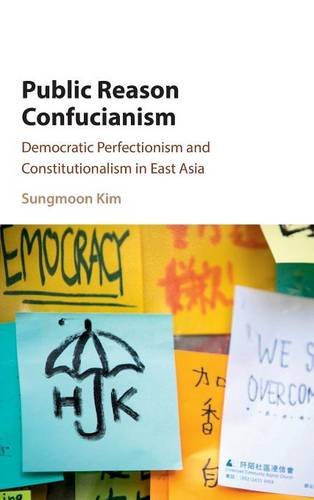 Sungmoon Kim’s new book, Public Reason Confucianism: Democratic Perfectionism and Constitutionalism in East Asia (Cambridge, 2016) has just been published. Congratulations, Sungmoon! Here are links to the CUP website and Amazon. Cambridge has also made available a form that anyone can use to get a 25% discount; click here. Here is the book’s description:
Recent proposals concerning Confucian meritocratic perfectionism have justified Confucian perfectionism in terms of political meritocracy. In contrast, ‘Confucian democratic perfectionism’ is a form of comprehensive Confucian perfectionism that can accommodate a plurality of values in civil society. It is also fully compatible with core values of democracy such as popular sovereignty, political equality, and the right to political participation. Sungmoon Kim presents ‘public reason Confucianism’ as the most attractive option for contemporary East Asian societies that are historically and culturally Confucian. Public reason Confucianism is a particular style of Confucian democratic perfectionism in which comprehensive Confucianism is connected with perfectionism via a distinctive form of public reason. It calls for an active role for the democratic state in promoting a Confucian conception of the good life, at the heart of which are such core Confucian values as filial piety and ritual propriety.
Jenco at Harvard: How Should We Use the Chinese Past?
Leigh Jenco (LSE) will be speaking at Harvard on May 2 at 4:00pm. Her title is “How Should We Use the Chinese Past?: Non-Western Histories of Thought in a Global Age.” More information here.
Angle papers archive site
Thanks to the enormous help of my research assistant Max Fong, I now have a site at which many of my publications are archived and can be downloaded. We will try to add anything currently missing over the next few weeks. Because of copyright policies, in most cases these are the final, edited versions but not the actual published versions. I am sure that many folks out there are way ahead of me in putting a site like this together; please feel free to share that info!
El Amine in WaPo on HR and Democracy
Loubna El Amine discusses Confucianism, human rights, and related topics–and even mentions this blog–in her recent Washington Post piece, “Are ‘democracy’ and ‘human rights’ Western colonial exports? No. Here’s why.”
Book Review: Jenco, Changing Referents
Xinyu Li reviews Leigh Jenco, Changing Referents: Learning Across Space and Time in China and the West (OUP, 2015) here.
El Amine and Symposium on Bell in Perspectives on Politics
The new issue of Perspectives on Politics (14:1, March 2016), available here, contains several articles of interest:
- Loubna El Amine, “Beyond East and West: Reorienting Political Theory through the Prism of Modernity”
- An extended discussion of Daniel Bell’s The China Model, with articles by Baogang He, Victoria Tin-bor Hui, Leigh Jenco, Andrew Nathan, Lynette Ong, Thomas Pangle, and Joseph Wang.
El Amine to Northwestern
Loubna El Amine, who earned her PhD from the Department of Politics at Princeton and has been teaching (comparative) political theory at Georgretown, has recently accepted an offer to move to Northwestern University, starting in Fall 2016. Congratulations, Loubna!
Hutton Reviews El Amine, Classical Confucian Political Thought
Notre Dame Philosophical Reviews
2016.01.17 View this Review Online View Other NDPR Reviews
Loubna El Amine, Classical Confucian Political Thought: A New Interpretation, Princeton University Press, 2015, 218pp., $39.95 (hbk), ISBN 9780691163048.
Reviewed by Eric L. Hutton, University of Utah
This book’s subtitle, A New Interpretation, provides a convenient starting point for discussing its aims, methods, strengths and weaknesses. The interpretation offered aims to be new not merely in the sense that it argues for a view that previously has not (or not much) been defended by other scholars, but moreover and especially in that it aims to challenge claims made by other scholars. So described, the book might sound like it is primarily for specialists in ancient Chinese thought, and while Loubna El Amine never identifies her target audience very clearly, at points she also provides basic background information that would allow non-specialists to follow along. The book is thus potentially of interest to non-specialists as well, such as Western political philosophers and theorists who know little about Confucian political thought and want a compact and accessible discussion of Confucianism that speaks to their interests. This review will focus on those aspects in which the book addresses a specialist audience, but my discussion is equally for the benefit of non-specialists. As will become apparent from the reservations I express below, the value of the book for non-specialists needs to be carefully qualified, in a way to be explained at the end.
Bai Review Bell, The China Model
Bai Tongdong of Fudan University has review Daniel Bell’s The China Model: Political Meritocracy and the Limits of Democracy (Princeton University Press, 2015) at NDPR. Read on for the link and for the full review.
