SACP Submission Deadline Extended for 2012 Eastern APA

DEADLINE EXTENDED

2012 Eastern Division Conference of the American Philosophical Association

December 27-30, Atlanta, GA

Please submit individual paper abstracts or complete panel proposals for this year’s SACP Panels at the American Philosophical Association Eastern Division Meeting in Atlanta, GA. Paper abstracts should be 150-200 words in length, and complete panel abstracts should include a 150 word introduction to the theme of the panel, complete with panel title, along with 150 word abstracts for each of the papers.  Please include each presenter’s name, e-mail address, and institution.  Please submit these materials no later than May 21, 2012 to Brian Bruya at bbruya@emich.edu.

Do China’s Traditions Make Chinese People Illogical?

Apparently there is a current meme in China alledging that Chinese people are too often illogical (and, instead, swayed by rhetoric, emotions, and politics) and that the cause of this may be the lack of concern for logical reasoning in China’s philsoophical traditions. Recently a journalist from the magazine Window on the Southern Wind 南风窗 interviewed well-known CASS philosopher Zhao Tingyang concerning these ideas.  The conversation is pretty interesting: Zhao suggests that too much attention to “dialectic” and too little training in logic–and, more generally, in critical reasoning–is the main culprit. He grants that early Chinese classics mainly were concerned with “thought 思想” rather than “theory 理论,” and adds that in this context:

…有些观念之间不一致也不足为奇,而且还必须考虑到,生活本身充满矛盾,因此,表达生活的思想有些互相矛盾,反而是如实反映了生活。这不是不讲逻辑。

…to have some inconsistencies between a few concepts would not be odd; and we should also consider, life itself is full of contraditions, therefore “thought” that seeks to express life and thus has some self-contradictions is actually in this way reflecting life. This is not to be illogical.

In light of all this, Joachim Kurz’s recent Discovery of Chinese Logic takes on added significance. (My review of Kurz’s excellent book can be found here.)

The Shortcomings of the Sages

I’d like to use this as an opportunity to think about depictions of sages in early Confucian texts (Mengzi in particular). I’ve thought, for better or worse, that the authors of these texts used the figures of the sages as representations of fully cultivated people. Yet I’ve noticed that these sages are sometimes described as falling short of perfection, and this gives rise to a question–in what ways can one be deficient, and yet still be considered a sage? Continue reading →

Postdoc in Asian Philosophy at Melbourne

Laura Schroeter of the philosophy department at Melbourne (and fellow Univ. of Michigan doctoral program alum!) writes that their one-year postdoc position is still open for applications (deadline is June 17) and they encourage qualified specialists in Asian Philosophy to apply. According to Laura, “The position involves teaching an Asian phil survey course (probably around 40 students) and a small 4th year undergrad seminar (5-15 students), and runs from July 2012-July 2013. It’s funded through some research money of Graham Priest’s, and Graham may want some minor admin help. But basically it’s a low-teaching postdoc position.  We’re mainly interested in getting someone who’s good to talk philosophy with.” So, if you’re within something like a 5-year period since you’ve finished your doctoral degree, consider applying to spend a year in Australia with some good philosophers. Below are the particulars for application, as they appeared in the Jobs for Philosophers ad.

Continue reading →

New Scholarship on 20th Century Chinese Philosophy

As the semester winds toward its end, and with it, my class on Modern Chinese Philosophy,I find myself reflecting on how much new scholarship has become available on 20th- and 21st-century Chinese philosophy in just the last 18 months. Most of these books are, alas, quite expensive, but the quality is very high. This slew of excellent books makes me feel that the field of modern Chinese philosophy has suddenly come of age — and, at the same time, become eminently teachable. Reflect with me on this list:

Continue reading →

Eichmann, Arendt, Milgram and Mencius

A cross-posting of Eric Schwitzgebel’s post on his Splintered Mind blog. Please address all comments directly to Eric; he’ll be checking in here periodically to reply.

********************************************************

Adolf Eichmann, Hannah Arendt, Stanley Milgram, and King Xuan of Qi

Perhaps my favorite Mencius passage is 1A7.  At its core is a story of a king’s mercy on an ox.

While the king was sitting up in his hall, an ox was led past below. The king saw it and said, “Where is the ox going?” Hu He replied, “We are about to ritually anoint a bell with its blood.” The king said, “Spare it. I cannot bear its frightened appearance, like an innocent going to the execution ground.” Hu He replied, “So should we dispense with the anointing of the bell?” The king said, “How can that be dispensed with? Exchange it for a sheep.” (Van Norden, trans.)

Mencius asks the king (King Xuan of Qi):

If Your Majesty was pained at its being innocent and going to the execution ground, then was is there to choose between an ox and a sheep?… You saw the ox but had not seen the sheep.  Gentlemen cannot bear to see animals die if they have seen them living. If they hear the cries of their suffering, they cannot bear to eat their flesh. Hence, gentlemen keep their distance from the kitchen.

(Note that Mencius does not conclude that gentlemen should become vegetarians.  Interesting possibilities for reflection arise regarding butchers, executioners, soldiers, etc., but let’s not dally.) Continue reading →

Neo-Confucianism Seminar Next Friday

The next session of the Columbia University Seminar on Neo-Confucian Studies will convene on Friday, May 4, from 3:30 to 5:30pm in the Heyman Center for the Humanities at Columbia University.

We will have two presenters (listed here in alphabetical order):

  • Agnes Chalier will present the paper “Many Voices of Earlier Chinese Texts and their Relationship to China, Today.”
  • Wen-Sheng Wang of National Chengchi University, Taiwan will present the paper “How Can we Express What is Implied in Our Life?   A Comparative Examination of Husserl, Heidegger, Arendt, and Tang Chun-I.”

Continue reading →

Columbia Comp. Phil. Seminar: Introducing Asian Philosophy: A Discussion of Texts and Strategies

May 4, 2012: “Introducing Asian Philosophy: A Discussion of Texts and Strategies”

5:45-7:45 pm, Rm. 101 in the Department of Religion 80 Claremont Avenue

Several members of the seminar will circulate and present (for around 10 minutes) a short, philosophically interesting passage from a classical Asian text that he has found an effective way of teaching to undergraduates.

Continue reading →

Ritual Revival in China

Not sure how we missed this story (c/o China Daily). I’d be interested in your comments, or if anyone has/had involvement with the event or organization, please chime in with your perspective on the revival project.

************************************************************************

Scholars call for revival of Chinese ritual

(China.org.cn)

Scholars call for revival of Chinese ritual

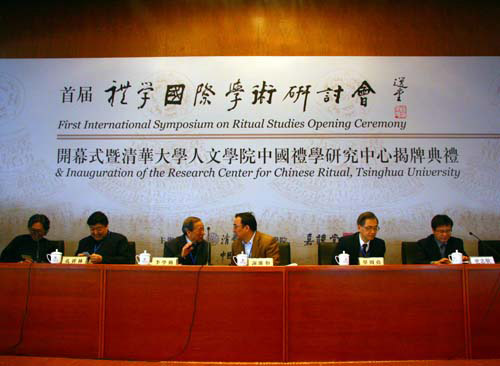
The opening ceremony of the First International Symposium on Ritual Studies at Tsinghua University, Apr. 9, 2012. [Photo/China.org.cn] Continue reading →