
Journalist Evan Osnos has a new article, “Confucius Comes Home,” in The New Yorker. Only subscribers will have access to more than the first few paragraphs, I fear. It’s a terrific and provocative piece!
Category Archives: Confucius
Confucius Exhibition at Central Connecticut State University; Foust Keynote
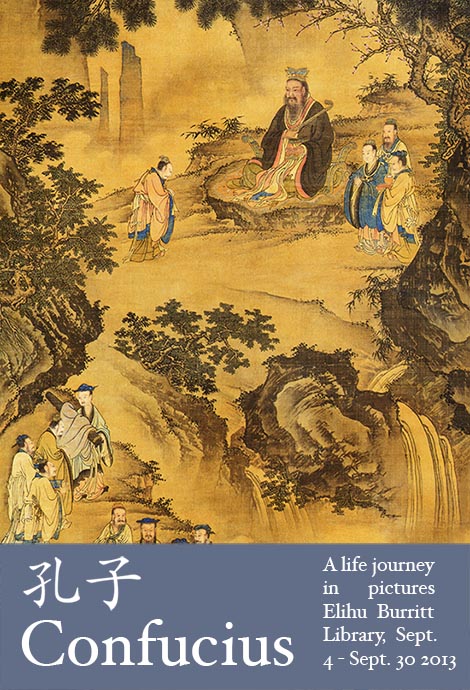 The Confucius Institute and the U.S.-China Center at CCSU, in collaboration with Elihu Burritt Library, proudly present the exhibition:
Confucius – A life journey in pictures
The exhibit displays a series of stunning reproductions of silk paintings and woodcut prints from the Ming and Qing dynasties, depicting the life and travels of the Chinese philosopher Confucius. This exhibit is free, and open to the public. See here for more information.
There will be an Opening Ceremony on Tuesday September 10 @ 6:30pm. Mathew Foust (Assistant Professor of Philosophy at Central Connecticut State University) will deliver a keynote address, “Portraits of Confucius.” Light refreshments will be served. RSVP: confuciusinstitute@ccsu.edu
The exhibit will run through September 30, during regular hours at the Elihu Burritt Library, 2nd floor.
Van Norden Reviews Cline on NDPR
Notre Dame Philosophical Reviews
2013.07.38 View this Review Online View Other NDPR Reviews
Erin M. Cline, Confucius, Rawls, and the Sense of Justice, Fordham University Press, 2013, 354pp., $65.00 (hbk), ISBN 9780823245086.
Reviewed by Bryan W. Van Norden, Vassar College
ToC: Asian Philosophy 23.3
A new issue of Asian Philosophy 23.3 (2013) has been published. Five out of the six papers are on Chinese Philosophy:
Moral Emotions, Awareness, and Spiritual Freedom in the Thought of Zhu Xi (1130–1200)
Kai Marchal
Dōgen and Wittgenstein: Transcending Language through Ethical Practice
Laura Specker Sullivan
Han Fei’s Enlightened Ruler
Alejandro Bárcenas
Han Fei, De, Welfare
Henrique Schneider
Clearing Up Obstructions: An Image Schema Approach to the Concept of ‘Datong’ in Chapter 6 of the Zhuangzi
C. Lynne Hong
Next Columbia Neo-Confucianism Seminar
The next session of the Columbia University Seminar on Neo-Confucian Studies will convene on Friday, April 12 (the second Friday of the month, a departure from our usual first-Friday format), from 3:30 to 5:30pm. We will meet in the Komoda Room in the Heyman Center for the Humanities at Columbia University.
We will have two presenters for this session (listed here in alphabetical order).
- Theresa Kelleher of Manhattanville College will present the paper “Looking at the Quotidian Dimensions of Neo-Confucianism: Excerpts from the Journal of Wu Yubi (1392-1469).”
- Zhou Zehao of York College will present the paper “Confucius and the Cultural Revolution: A Brief Comparison of the Two Anti-Confucian Campaigns during the Cultural Revolution.”
Copies of their papers will be distributed soon. All are welcome to attend. Please feel free to forward this message to interested colleagues. Please join us after the seminar for dinner at the Columbia Cottage restaurant, which is located on the corner of Amsterdam and 111th Streets.
Review of Rosemont, Reader’s Companion to the Analects
Guest poster Andrew Komasinski offers us a review of Henry Rosemont Jr., A Reader’s Companion to the Confucian Analects (Palgrave Macmillan, 2012). Please direct any comments to Andrew.
Henry Rosemont Jr.’s A Reader’s Companion to the Confucian Analects is a novel approach in the English-language world. Building on Rosemont’s forty years of professional knowledge and personal experience with the Analects, this text will be of great use for the right type of reader. Containing no footnotes and not structured as an argument, this is not a scholarly monograph and bypasses many issues primarily of interest to scholars. The text differs from the similarly titled Cambridge Companion series which provides a set of scholarly essays highlighting the contemporary debate or Routledge Philosophy Guidebooks that guide undergraduate students through complex arguments.
New Book: Yong Huang, Confucius
It has just come to my attention that Yong HUANG’s book Confucius: A Guide for the Perplexed (Bloomsbury 2013) has recently been published [publisher’s site] [Amazon link]. I have only had a chance to take a quick look at it, but it looks to be philosophically sophisticated and yet engaging and accessible. Rather than a systematic overview of Confucius’s teachings, Huang tackles a series of questions that arise “in our everyday life or moral reflection,” and argues that Confucius’s answers are the best — or at least, better than available alternative answers in the Western tradition. Enjoy!
New Book on the Analects / Review Opportunity
Palgrave Macmillan has recently published A Reader’s Companion to the Confucian Analects by Henry Rosemont Jr. Further details can be found here.
Macmillan is interested in offering a free electronic version of this title to a scholar interested in posting a review of the book here on Warp, Weft, and Way. If you would like to pursue this, please contact Katie Gordon (Palgrave Macmillan Marketing Executive; katie.gordon@palgrave.com) and also let one of the blog administrators know. (If you’re not an official contributor, we can arrange to post the review as a guest post.)
Friday’s Neo-Confucianism Seminar at Columbia
The next session of the Columbia University Seminar on Neo-Confucian Studies will convene on Friday, March 1, 2013, from 3:30 to 5:30pm. We will meet in the Board Room on the first floor of the Heyman Center for the Humanities at Columbia University. Please note the earlier starting time.
Our presenter for this session is Deborah Sommer of the Department of Religious Studies at Gettysburg College. Her paper is titled “The Body of Confucius in Han Apocrypha.” The paper was originally scheduled for November 2012 but was postponed due to Hurricane Sandy. Please contact one of the organizers if you would like a copy.
When Confucius criticizes Zhu Xi and more stories…
When Confucius criticizes Zhu Xi and more stories…
I have had the chance to come across fascinating interpretations of the Great Learning in a book titled Daxue zhengshi 大學證釋 (Evidential Interpretation of the Great Learning). To be more accurate, the striking part of the story lies less in the philosophical originality of the interpretations than in the identity of the commentators.
In this volume, the original Daxue text is commented upon by a series of sages (liesheng qishu 列聖齊述) including Confucius, Yan Hui, Zengzi and Mencius… Zhu Xi was also a contributor to this volume and wrote a nice self-criticism piece about his problematic Song-dynasty interpretations of the text. He finally admitted that he got it completely wrong with his former discussions on the “extension of knowledge lying in the investigation of things” (zhizhi zai gewu 致知在格物), etc… Among the other contributions, the one of Confucius was interesting but I doubt that Zhu Xi enjoyed it much because it happens that he was wrong again ! Kongzi’s line of argument was the following: basing himself on Zhu Xi’s edited introductory sentence of the Daxue (大學之道,在明明德 , 在親民,在止於至善) he criticized Zhu’s replacement of the original 在親親 , 在新民 by 在親民 (understood as: 在新民). He posited that these changes did not reflect “the entirety of Confucian doctrine” (fei rujiao jiaoyi zhi quan yi 非儒教教義之全矣) and highlighted the fact that ideas such as “ruling the country primarily requires to regulate the family” (zhi guo bi xian qi jia 治國必先齊家) or “the foundations of the country lie in the family” (guo zhi ben zai jia 國之本在家) all originated from the “affection to the kindred” (親親), that is, from characters cut off by Zhu Xi….
I will skip my comments on these comments and concentrate on some background information that might be more interesting. Continue reading →
