
The North American Korean Philosophy Association will hold its fourth annual conference at SKK (Sungkyunkwan) University in Seoul, Korea, Oct. 25-27, 2017 on the theme “Why Korean Philosophy Today?: Its Relevance to the Twenty-first century.” Please read on for more information about submissions and other details. Also, the latest NAKPA newsletter is available here.
Category Archives: Korea
New Book on Political Legitimacy
Cambridge University Press has published East Asian Perspectives on Political Legitimacy: Bridging the Empirical-Normative Divide, edited by Joseph Chan, Doh Chuli Shin, and Melissa S. Williams. More details and table of contents here.
Latest NAKPA E-newsletter
The NAKPA (Korean Philosophy Association) E-newsletter No. 3, 2016 is now available.
New Book on Korean Philosophy
Traditional Korean Philosophy: Problems and Debates, Edited by Youngsun Back and Philip J. Ivanhoe, has been published by Rowman & Littlefield International, in their CEACOP East Asian Comparative Ethics, Politics and Philosophy of Law series. It looks great — congratulations to the editors and contributors!
New Book: P.J. Ivanhoe, Three Streams
Lecture in Berlin: Nelson on Neo-Confucianism and Buddhism
Prof. Dr. Eric NELSON (Division of Humanities, The Hong Kong University of Science and Technology):
The Debate between Neo-Confucianism and Buddhism in Jeong Dojeon and Gihwa
Nov. 30, 2016; 18:00-20:00. More information here.
New Book: Chung, Trans., Yi Hwang (Toegye), A Korean Confucian Way of Life and Thought
Yi Hwang (Toegye), A Korean Confucian Way of Life and Thought: The Chasongnok (Record of Self-Reflection).
Translated by Edward Y. J. Chung. Honolulu: University of Hawaii Press, 2016.
New Korean Philosophy Newsletter
The latest North American Korean Philosophy Association Courier (2016, issue 2) is available here.
Sungmoon Kim, Public Reason Confucianism now available
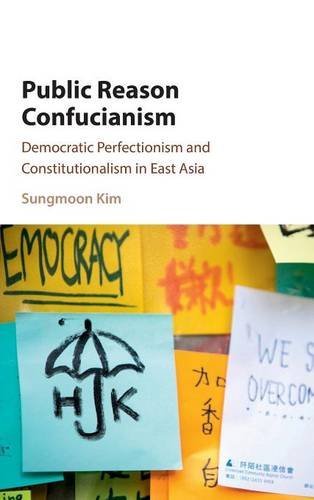 Sungmoon Kim’s new book, Public Reason Confucianism: Democratic Perfectionism and Constitutionalism in East Asia (Cambridge, 2016) has just been published. Congratulations, Sungmoon! Here are links to the CUP website and Amazon. Cambridge has also made available a form that anyone can use to get a 25% discount; click here. Here is the book’s description:
Recent proposals concerning Confucian meritocratic perfectionism have justified Confucian perfectionism in terms of political meritocracy. In contrast, ‘Confucian democratic perfectionism’ is a form of comprehensive Confucian perfectionism that can accommodate a plurality of values in civil society. It is also fully compatible with core values of democracy such as popular sovereignty, political equality, and the right to political participation. Sungmoon Kim presents ‘public reason Confucianism’ as the most attractive option for contemporary East Asian societies that are historically and culturally Confucian. Public reason Confucianism is a particular style of Confucian democratic perfectionism in which comprehensive Confucianism is connected with perfectionism via a distinctive form of public reason. It calls for an active role for the democratic state in promoting a Confucian conception of the good life, at the heart of which are such core Confucian values as filial piety and ritual propriety.
CFP: NAKPA Annual Conference
From Halla Kim:
The North American Korean Philosophy Association (NAKPA) holds its annual conference at Univ of San Francisco, NOV 28-30, 2016 on the theme “From Interactions to Creations: Currents and Counter-currents in Korean Philosophy.” We are pleased to accept proposals for presentations and panels related to the conference theme. For example, the concept of emotion in (a phases of) Korean neo-Confucian movement or the “desire” in the Korean Zen tradition or the body and mind in a comparative framework. Papers on other topics will also be considered, esp. philosophical works related to Korean and comparative philosophy, for example, work that brings non-Korean philosophy into a comparative framework with Korean philosophy. Paper abstracts should be 150-200 words in length. Complete panel proposals should include: panel title, a 150-word introduction to the theme of the panel, and a 150-word abstract for each of the papers. Include each presenter’s name, e-mail address, and institutional affiliation. Graduate students and post-docs are welcome to apply. The winner of the graduate student/post-doc award will be given $500.00 to defray the expenses for travel. The review will begin on June 15, 2016 and primarily close on August 1. The language of the conference is English. Thank you. Please send your submission and inquires to: hallakim@unomaha.edu
