
|
APA Newsletter on Asian and Asian-American Philosophers and Philosophies From the Guest Editor “Buddhist Philosophy Today: Theories and Forms,” Rafal Stepien Submission Guidelines and Information Articles “Philosophy, Quo Vadis? Buddhism and the Academic Study of Philosophy,” Brook Ziporyn “What/Who Determines the Value of Buddhist Philosophy in Modern Academia?,” Hans-Rudolf Kantor “Buddhist Philosophy? Arguments from Somewhere,” Rafal Stepien “Doing Buddhist Philosophy,” C. W. Huntington, Jr. “Decolonizing the Buddhist Mind,” Mattia Salvini “Reflecting on Buddhist Philosophy with Pierre Hadot,” Matthew T. Kapstein “Some Suggestions for Future Directions of the Study of Buddhist Philosophy,” Jan Westerhoff “Practicing Buddhist Philosophy as Philosophy,” Pierre-Julien Harter “Emptiness, Multiverses, and the Conception of a Multi-Entry Philosophy,” Gereon Kopf “Buddhist Philosophy and the Neuroscientific Study of Meditation: Critical Reflections,” Birgit Kellner |
New Book: Marshall, ed., Comparative Metaethics
Comparative Metaethics: Neglected Perspectives on the Foundations of Morality, edited by Colin Marshall, has been published by Routledge. Several of the chapters are devoted to classical Chinese philosophy; more information is available at the publisher’s website, here.
Job at York
York University is advertising a senior (tenured) position in “Non-Canonical Philosophy,” which includes Asian Philosophy. See here for more details. The deadline for full consideration is Nov. 1, 2019.
Job at CSU
The Department of Philosophy at Colorado State University invites applications for the position of Assistant Professor of Philosophy with a specialization in East Asian Philosophy. The successful candidate will be appointed untenured and at the rank of Assistant Professor. This is a full-time, nine-month, entry-level, tenure-track appointment to begin August 17, 2020.
Area of Specialization (AOS): East Asian Philosophy. Area of Competence (AOC): Open, but the Department currently has coverage in Ethics (including Applied Ethics), Japanese Philosophy, and Indian Philosophy. The Department prefers to hire a candidate who can complement these existing strengths. PhD in hand by August 17, 2020, publications or evidence of strong research and scholarly promise, relevant language competence in AOS, and evidence of excellence in teaching is required. Teaching load currently is 4 courses per academic year (2 courses per semester) and includes teaching introductory and upper-division courses in East Asian philosophy and religion. Graduate-level teaching and advising are required, as are the usual undergraduate advising and committee work.
New Book: New Life for Old Ideas
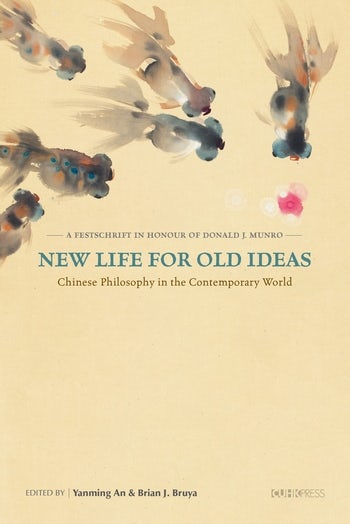
As a student of Don Munro and one of the contributors to the book, I am very happy to announce that CUHK Press has published Yanming An and Brian J. Bruya, eds., New Life for Old Ideas: Chinese Philosophy in the Contemporary World: A Festschrift in Honour of Donald J. Munro.
The publisher’s blurb: “Over five decades, Donald J. Munro has been one of the most important voices in sinological philosophy. Among other accomplishments, his seminal book The Concept of Man in Early China influenced a generation of scholars. His rapprochement with contemporary cognitive and evolutionary science helped bolster the insights of Chinese philosophers, and set the standard for similar explorations today. In this festschrift volume, students of Munro and scholars influenced by him celebrate Munro’s body of work in essays that extend his legacy, exploring their topics as varied as the ethics of Zhuangzi’s autotelicity, the teleology of nature in Zhu Xi, and family love in Confucianism and Christianity. Essays also reflect on Munro’s mentorship and his direct intellectual influence. Through their breadth, analytical excellence, and philosophical insight, the essays in this volume exemplify the spirit of intellectual inquiry that marked Donald Munro’s career as scholar and teacher.”
New Book: Treatise on Awakening Mahāyāna Faith

Oxford University Press has published a second translation in the Oxford Chinese Thought series, which is the Treatise on Awakening Mahāyāna Faith, a translation of the Dasheng qixin lun 大乘起信論. We are very pleased to make widely available this scholarly translation of one of the most influential texts in East Asian Buddhism. This is the product of years of careful work by John Jorgensen, Dan Lusthaus, John Makeham, and Mark Strange. A short description follows below the fold.
ToC: Early China, Volume 42, September 2019
Volume 42 of Early China is now available on Cambridge Core. For the table of content, please see the publisher’s website or below.
Suggestions for 2nd Edition of Doing Philosophy Comparatively?
An editor at Bloomsbury contacted me about putting together a 2nd edition of my book Doing Philosophy Comparatively. In the next couple of months we’ll be gathering suggestions about what to add the new edition, which will include about 30% new material, and we’re trying to get as much feedback about the current edition as possible. If you have looked at the book and thought certain topics were missing or that parts of it could be expanded or have other suggestions for improvement, please send me an email at tconnolly@esu.edu. Many thanks!
Vedal at Columbia Neo-Confucianism Seminar
The next session of the Columbia Seminar on Neo-Confucian Studies (University Seminar #567) will convene on November 1st, from 3:30 to 5:30pm in the main board room of the Heyman Center for the Humanities at Columbia University.
The speaker will be Nathan Vedal, who will be sharing his book chapter titled “Script, Antiquity, and Mental Training: Metaphysical Inquiry into the History of Writing.” This will be part of his new book The Culture of Language in Ming China. If you plan on attending and would like a copy of the paper, please contact Chuyu Tian, Rapporteur for the Seminar on Neo-Confucian Studies, at ct2823@columbia.edu.
Richard Kim – Columbia Society for Comparative Philosophy Lecture: “THE ROLE OF NEGATIVE EMOTIONS IN THE GOOD LIFE: REFLECTIONS FROM THE ZHUANGZI” Friday October 11 at 5:30pm
THE COLUMBIA SOCIETY FOR COMPARATIVE PHILOSOPHY
Welcomes: RICHARD KIM (Loyola University Chicago)
With responses from: CHRISTOPHER GOWANS (Fordham University)
Please join on October 11, 2019 at 5:30 for his lecture entitled,
THE ROLE OF NEGATIVE EMOTIONS IN THE GOOD LIFE: REFLECTIONS FROM THE ZHUANGZI
ABSTRACT: The philosophical and psychological literature on well-being tend to focus on the prudential value of positive emotions such as pleasure, joy, or gratitude. But how do the negative emotions such as grief fit into our understanding of well-being? It is often assumed that negative emotions are intrinsically bad far us and that we should work toward eliminating them, especially from the perspective of our own well-being. Continue reading →
