
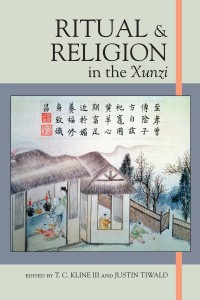
 Not without shame, I’d like to mention (and thereby promote) a book that I co-edited with Jack Kline, Ritual & Religion in the Xunzi, devoted to interpretations of Xunzi as a religious philosopher. I’ll include a brief description below the fold.
Category Archives: Books of Interest
New Book: Democracy in Contemporary Chinese Thought
Excuse the lack of modesty, but I’d like to announce the publication of my new book, Democracy in Contemporary Confucian Philosophy.
Interesting resource: Reviews of Asian-language books
I’ve just become aware of New Frontiers of Asian Scholarship, a resource hosted by the Harvard-Yenching Institute, posting reviews of Asian-language scholarly books. There are a few philosophy books, and a variety of other interesting materials.
New Book: India in the Chinese Imagination
India in the Chinese Imagination: Myth, Religion, and Thought
John Kieschnick and Meir Shahar, Editors
Norton Critical Edition of Analects
The Norton Critical Edition of the Analects has just been published. Edited by Michael Nylan, it joins together Nylan’s Introduction, Simon Leys’s translation of the text, and a series of interpretive essays:
- Nicolas Zufferey • On the Ru and Confucius
- Robert Eno • In Search of the Origins of Confucian Traditions in Lu
- Mark Csikszentmihalyi and Tae Hyun Kim • The Formation of the Analects
- Eric L. Hutton • Mencius, Xunzi, and the Legacy of Confucius
- Luke Habberstad • The Sage and His Associates: Kongzi and Disciples across Early Texts
- Julia K. Murray • Visualizing Confucius and His Disciples from the Analects
- Thomas Wilson • Reading the Analects in the Sage’s Courtyard: A Modern Diner’s Guide to an Ancient Feast
- Sébastien Billioud and Vincent Goossaert • Confucius and his Texts: A Century of Crisis and Reinventions
- Yuming He • Talking Back to the Master: Play and Subversion in Entertainment Uses of theAnalects
- Henry Rosemont Jr. • On “New Confucianism”
- Sam Ho • Confucius on Film: Toward a Confucian Aesthetic
The choice of Leys’s translation — which consciously renders the text in modern, accessible language — may make sense in light of the Nylan’s objective in assembling this range of interpretive essays, which collectively “suggest that the Confucius we thought we knew is not the Kongzi of record and that this Kongzi is a protean figure given to rapid change and continual reevaluation.”
New Book: Perkins on Problem of Evil
An important new book is now available from Indiana University Press:
Heaven and Earth Are Not Humane: The Problem of Evil in Classical Chinese Philosophy
Franklin Perkins
New overview of Daoism
Komjathy, Louis. 2014. Daoism: A Guide for the Perplexed. New York: Bloomsbury Academic. 250 pages.
According to Lydia Kohn: A different, yet very successful approach to Daoism by topic rather than chronology or lineage, this consists of nine chapters: Tradition, Community, Identity, View, Personhood, Practice, Experience, Place, and Modernity. Highly insightful, meticulously researched, the book is extremely well written and combines a strong historical understanding with a deep involvement in contemporary practice. It opens Daoism in a new and amazing way.
New book on Early 20th Century Thought
Xiaoqun Xu, Cosmopolitanism, Nationalism, and Individualism in Modern China: The Chenbao Fukan and the New Culture Era, 1918-1928. Lanham, MD: Lexington Books, 2014. Pp.255. ISBN 978-0-7391-8914-6.
The book analyzes aspects of intellectual life and cultural practices in the New Culture era of modern China by examining an influcential newspaper supplement published in Beijing during 1918-1928, along with other contemporary sources. It highlights a key intellectual-moral paradox in Chinese disourses between cosmopolitanism as an idealistic aspiration and nationalism as a practical imparative, both in complext relationship to indivudialism, and in constant negotiations between Chinese tradition and Western culture in the making of Chinese modernity. It argues for a re-consideration and re-appreciation of the New Culture era in modern Chinese history, as the issues treated in the book remain relevant to China and the world today.
New Book – Nothingness in Asian Philosophy
Nothingness in Asian Philosophy – Routledge 2014
by Douglas Berger (editor) & Jeeloo Liu (editor)
From the Description at Amazon:
“A variety of crucial and still most relevant ideas about nothingness or emptiness have gained profound philosophical prominence in the history and development of a number of South and East Asian traditions—including in Buddhism, Daoism, Neo-Confucianism, Hinduism, Korean philosophy, and the Japanese Kyoto School. These traditions share the insight that in order to explain both the great mysteries and mundane facts about our experience, ideas of “nothingness” must play a primary role.”
New Book on Yi Jing
Unearthing the Changes: Recently Discovered Manuscripts of the Yi Jing (I Ching) and Related Texts, Edward L. Shaughnessy
April, 2014; Cloth, 400 pages, ISBN: 978-0-231-16184-8, $40.00
