
Loubna El Amine has published a review (available here) of Fred Dallmayr’s Being in the World: Dialogue and Cosmopolis (Lexington: University of Kentucky Press, 2013). In light of El Amine’s remarks at the end of the review about the central place still occupied in Dallmayr’s theorizing by Western theory, it may be fruitful to compare with Leigh Jenco’s new book.
Category Archives: Comparative philosophy
New Book: Jenco, Changing Referents
I am happy to announce the publication of Leigh Jenco’s new book; congratulations!
L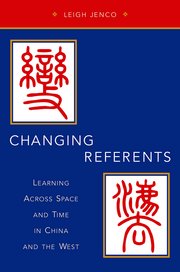 eigh Jenco, Changing Referents: Learning Across Space and Time in China and the West (Oxford University Press, 2015): 304 Pages; ISBN: 9780190263812
Globalization has brought together otherwise disparate communities with distinctive and often conflicting ways of viewing the world. Yet even as these phenomena have exposed the culturally specific character of the academic theories used to understand them, most responses to this ethnocentricity fall back on the same parochial vocabulary they critique. Against those who insist our thinking must return always to the dominant terms of Euro-American modernity, I argue and demonstrate that methods for understanding cultural others can take theoretical guidance from those very bodies of thought typically excluded by political and social theory.
New Issue of Asian Philosophy
Asian Philosophy 25(4) has been published; see here.
Wong Reviews Cline, Families of Virtue
Notre Dame Philosophical Reviews
2015.11.28 View this Review Online View Other NDPR Reviews
Erin M. Cline, Families of Virtue: Confucian and Western Views on Childhood Development, Columbia University Press, 2015, 342pp., $30.00 (pbk), ISBN 9780231171557 .
Reviewed by David B. Wong, Duke University
This book attributes to early Confucianism the view that the parent-child relationship has a “unique and irreplaceable” role in early moral development (xi) and goes on to argue that this view is right. In the course of making this argument Erin M. Cline provides careful and perceptive comparative readings of early Confucian texts and a very wide range of texts in the Western tradition, from Plato, Aristotle, Locke, and Rousseau to contemporary feminists, to show how unusual and in-depth the insights of Confucian thinkers were. She draws from a wide range of empirical studies to support the Confucian view. There is much in this book that will be of value to anyone with interests in the fields of the philosophy and psychology of moral development, feminist care ethics, and comparative ethics. Cline’s comparison of Confucian and feminist views, which have the most to say about parent-child relationships, is informative and balanced. It is not clear that she has fully established the unique and irreplaceable role of the parent-child relationship, but Cline surely has given enough argument to establish that the relationship is one of the most important factors, perhaps the most important single factor, in moral development, and she raises good questions as to why U.S. society largely neglects its importance in its public policies.
Recent Book on Daodejing, Han Feizi, and Machiavelli
A new book of interest: Jason P. Blahuta, Fortune and the Dao: A Comparative Study of Machiavelli, the Daodejing, and the Han Feizi (Lexington, 2015). The publisher’s description:
Karsten Struhl & Graham Priest, Columbia Seminar for Comparative Philosophy: “Buddhism and Marxism: Points of Intersection” — December 11 @ 5:30pm
THE COLUMBIA SOCIETY FOR COMPARATIVE PHILOSOPHY
Welcomes:
KARSTEN STRUHL (John Jay College) and GRAHAM PRIEST (CUNY Graduate Center)
Please join us at Columbia University’s Religion Department on FRIDAY, DECEMBER 11th at 5:30PM for their lecture entitled:
“Buddhism and Marxism: Points of Intersection”
Although Marxism and Buddhism might seem like unlikely bedfellows, they have a number of things in common. Continue reading →
Chinese Translation of Contemporary Confucian Political Philosophy
I am very ha ppy to pass on the news that the Chinese translation of my book Contemporary Confucian Political Philosophy: Toward Progressive Confucianism (Polity, 2013) has been published by Jiangxi People’s Press, as 《当代儒家政治哲学:进步儒学发凡》. More information, including the Preface to the Chinese Edition, can be found here. In case anyone is interested in an English-language version of this new Preface, I will post it below.
El Amine’s Reflections on Cross-Cultural Life and Scholarship
Political theorist Loubna El Amine, author of a recent book on Confucian political thinking, has written a provocative reflection on “What is it Like to be Lebanese and to Work on China.”
Confucianism in Modern America?
Earlier in the fall, Sam Crane posted a conference paper of his called “Confucianism in Modern American Life” at his blog. There was a bit of discussion there, as well as a longer response here. This is a subject in which I am very interested, and would certainly welcome any further thoughts anyone wants to share.
Two Books on Korean Confucianism
Over the past year, Edward Chung has published two significant books on Korean Confucianism, one a translation and one an overview. Please read on for details.
