
The latest issue of Asian Philosophy (Volume 29, Number 1, 2 January 2019) has been published. See here or below for the Table of Contents.
Category Archives: Comparative philosophy
Song Reviews Liu, Neo-Confucianism
Notre Dame Philosophical Reviews
2019.03.33 View this Review Online View Other NDPR Reviews
JeeLoo Liu, Neo-Confucianism: Metaphysics, Mind, and Morality, Wiley-Blackwell, 2018, 316pp., $34.95 (pbk), ISBN 9781118619414.
Reviewed by Bin Song, Washington College
This book is clearly one of the greatest accomplishments among English Neo-Confucian philosophical studies in recent decades. JeeLoo Liu uses clear language and rigorous philosophical reasoning to analyze eight pivotal Neo-Confucian figures regarding three major areas: metaphysics, moral theory and moral practice. The book can be aptly used as both an introduction to Neo-Confucianism for beginners and a top reference for researchers, which is itself a rare achievement.
SKKU Conference on Confucianism, Buddhism, and Kantian Moral Theory
The Sungkyun Institute for Confucian Studies and East Asian Philosophy (SKKU) is delighted to announce that it will host an International Conference on the theme Confucianism, Buddhism, and Kantian Moral Theory, 6-7 September 2019 on the campus of Sunkyunkwan University, Seoul, Korea. This event is made possible by a generous grant from The American Council of Learned Societies with support from the Chiang Ching-kuo Foundation for International Scholarly Exchange.
Kang accepts position at Washington and Lee
Li KANG writes to let us know that she has accepted a tenure-track offer from Washington and Lee University, and will be joining the Philosophy Department as an Assistant Professor starting in Fall of 2019. Her bio:
I got my philosophy degrees on three continents: a B.A. from Wuhan University (China), an M.Phil. from University of St Andrews (UK), and a Ph.D. from Syracuse University (US). From 2017 to 2019, I am a Visiting Assistant Professor of Philosophy at Vassar College. My main areas of research are metaphysics and Chinese Buddhism. While half of my work involves developing views within the analytic tradition, the other half involves showing how the analytic tradition and non-Western traditions enrich each other. Currently, I am working on discovering and developing the metaphysics of Chinese Buddhism in relation to analytic philosophy and cognitive science.
Congratulations, Li!
Hongladarom Reviews Epistemology for the Rest of the World
Notre Dame Philosophical Reviews
2019.03.30 View this Review Online View Other NDPR Reviews
Masaharu Mizumoto, Stephen Stich, and Eric McCready (eds.), Epistemology for the Rest of the World, Oxford University Press, 2018, 295pp., $85.00 (hbk), ISBN 9780190865085.
Reviewed by Soraj Hongladarom, Chulalongkorn University
When I was a graduate student at the Department of Philosophy at Indiana University in Bloomington, Indiana back in the 1980s, I took the program’s required epistemology course. What struck me then was that its content was very much tied to the English language. It was not exactly the kind of English that I studied in my English major classes back home, but a simple one focusing on only a few words. The main analysis was of sentences such as “S knows that p”. Naturally, I came across the famous paper by Edmund Gettier, and I remember that I spent a large amount of time figuring out what was going on. Somebody had a true and justified belief that the man who will get the job has ten coins in his pocket, but in the end, he does not know that. I wondered what was going on. So I translated the whole thing into Thai thinking that doing so might help me understand the whole thing better, but to no avail. To a normal Thai-speaking person it was strange to think that such a scenario could ever happen. I remember that I had to impose the strangeness of the situation onto my intuition of English. Since I am not a native speaker, I assumed that English speakers might have some kind of intuitive understanding of how the word ‘know’ was used.
Conference in Taipei: “Phenomenology and Chinese Philosophy” (March 18-20)
Dear colleagues,
this is to inform you about the international conference “Selfhood, Otherness, and Cultivation. Phenomenology and Chinese Philosophy” (March 18-20, at National Chengchi University in Taipei). You can still register on our website which also contains many helpful information (list of speakers, abstracts, etc.). The conference is co-hosted by the philosophy department and the interdisciplinary “Research Center on Chinese Cultural Subjectivity in Taiwan” at National Chengchi University. Our guest of honor is Dan Zahavi (Kopenhagen/Oxford) who, besides participating in our conference, will also give a series of lectures next week (see here).
Cordially,
Kai Marchal
New episodes of The Issue is Not The Issue
The Issue is Not the Issue: A Podcast with Hans-Georg Moeller and Dan Sarafinas
https://www.youtube.com/channel/UCfs0MY7rs8J6jWlCdneoPVQ
Hans-Georg Moeller and Dan Sarafinas discuss contemporary debates on “political correctness” and related moral and social issues. They point to concepts such as virtue speech (“virtue signalling”), civil religion, “profilicity,” and the role of critique to better understand their nature.
Episode 3—Critique: https://www.youtube.com/watch?v=3W1m0Bez8vU
Philosophy today runs the risk of once more becoming the “handmaiden of theology” by being put in the service of civil religion. The Kantian concept of critique is revived to reflect on contemporary dogmatism and associated power structures that lead to phenomena such as “competitive wokeness” in entertainment (Taylor Swift) or the need to write “diversity statements” in academia. The idea of a therapeutic rather than a normative philosophy is suggested and it is explained how society, along with critique, evolves rather than progresses.
Episode 4—Profilicity: https://www.youtube.com/watch?v=3Yz1C0-mtWI
Why do we need to produce “virtue speech”? We need it to be competitive in society and to bolster our public profiles. A new profile-based identity paradigm, called “profilicity,” is on the rise. It is replacing other identity paradigms such as sincerity and authenticity and provides not only individuals but also institutions (political parties, companies, universities, etc.) with identity value.
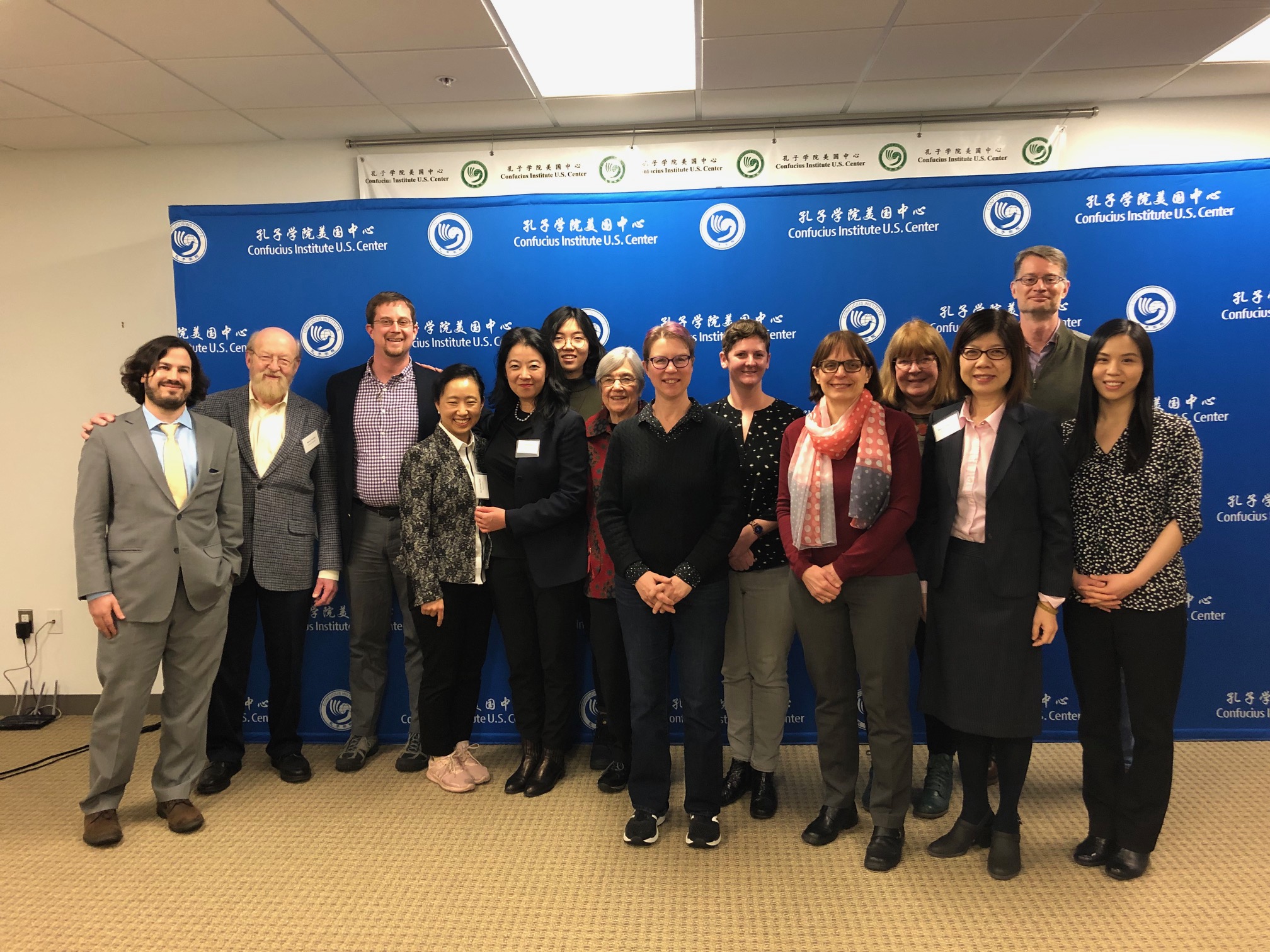
Successful Conference on Women in the Ru Tradition
The first conference on Confucianism that I have attended in which men were in the minority: last weekend’s “Women as Exemplary Persons in The Ru (Confucian) Tradition”; program here.
Article of Interest: “Indeterminate self: Subjectivity, body and politics in Zhuangzi” by Peng Yu
Yu, Peng. “Indeterminate Self: Subjectivity, Body and Politics in Zhuangzi.” Philosophy & Social Criticism, (January 2019). doi:10.1177/0191453718820900.
To see the full article please click here.
Article of Interest: “Discovering Wang Yangming” by George L. Israel
George L. Israel. “Discovering Wang Yangming: Scholarship in Europe and North America, 1600-1950, “Monumenta Serica 66, no. 2 (2018)
To read the full article please click here.
