
CRITICAL THEORY FROM AND BEYOND THE MARGINS
24 OCTOBER 2020, SATURDAY | 10:00 AM TO 6:00 PM (UTC +8)
ZOOM MEETING- ID: 976 4344 1616 | PASSCODE: 241
HTTPS://UMAC.ZOOM.US/J/97643441616?PWD=BTJYBLH5NMTNSDFFA2NML285WDJLUT0924
Critical theory is a Western, and distinctly European, intellectual tradition that drew its normative resources from the social and political events that transpired in Europe over the course of the 20th century. It is relevant to ask the question whether, as a critical-practical
tradition, critical theory has anything to contribute outside the Western-European context, given the emergence of globalization and the issues that arose with it. For some, the Eurocentrism of critical theory is symptomatic of its very own crisis, one which challenges the universality of its normative claims, e.g., the abolition of social injustice. Is it possible for critical theory to overcome its Eurocentrism and, therefore, its own crisis? The irony is that critical theory is only able to defend the universality of its normative claims when it is able to
renew itself. If it is at all possible to renew critical theory, what does this renewal entail? The workshop will pursue these questions by expanding the scope of traditional critical theory, especially, but not exclusively, by drawing on critical perspectives on modern societies and
emancipation movements that have originated in Asia.
Category Archives: Comparative Political Theory
Bai On-Line Lecture on Confucian Meritocracy
Of the People, for the People, but not by the People ― Confucian Meritocracy as a Correction of Democracy (BAI Tongdong, Fudan University, China)
Thursday, October 08, 2020, 07:00pm – 08:30pm
This talk is co-sponsored by Rutgers Global-China Office. It is open to the public, but registration is required; please see below for information.
New Book: Deparochializing Political Theory
Cambridge University Press has published Melissa Williams, ed.,
Deparochializing Political Theory — a terrific collection of essays. Here’s the editorial description:
In a world no longer centered on the West, what should political theory become? Although Western intellectual traditions continue to dominate academic journals and course syllabi in political theory, up-and-coming contributions of ‘comparative political theory’ are rapidly transforming the field. Deparochializing Political Theory creates a space for conversation amongst leading scholars who differ widely in their approaches to political theory. These scholars converge on the belief that we bear a collective responsibility to engage and support the transformation of political theory. In these exchanges, ‘deparochializing’ political theory emerges as an intellectual, educational and political practice that cuts across methodological approaches. Because it is also an intergenerational project, this book presses us to re-imagine our teaching and curriculum design. Bearing the marks of its beginnings in East Asia, Deparochializing Political Theory seeks to de-center Western thought and explore the evolving tasks of political theory in an age of global modernity.
More info is here, and the Table of Contents follows.
CFP: Association for Political Theory
The organizers tell me “We welcome papers in Chinese and comparative political philosophy and hope that we will receive many submissions from philosophers and theorists who work in these fields.”
2020 Association for Political Theory Call for Papers
Proposal Deadline: Monday, February 10, 2020
The Association for Political Theory Annual Conference (University of Massachusetts Amherst, November 12th-14th, 2020)
Program Committee Co-Chairs: Jennie Ikuta (University of Tulsa) andK ennan Ferguson (University of Wisconsin, Milwaukee)
The Association for Political Theory (APT) invites paper proposals for its annual conference to be held November 12th-14th, 2020, at the campus of the University of Massachusetts, Amherst. We will consider papers on all topics in political theory, political philosophy and their cognate disciplines, from scholars working in any field at any institution. Any scholars who are ABD or who hold a terminal degree in their fields may apply; we also encourage faculty members to volunteer to serve as chairs and/or discussants.
New Book: Bai, Against Political Equality—The Confucian Case
Bai Tongdong writes with information about his new book — congratulations!
My new book, Against Political Equality—The Confucian Case was just published by Princeton University Press. In this book, I offer a viable political alternative to liberal democracy that is inspired by Confucian ideas. In domestic governance, I argue that Confucianism can embrace the liberal aspects of democracy along with the democratic ideas of equal opportunities and governmental accountability to the people. But Confucianism would give more political decision-making power to those with the moral, practical, and intellectual capacities of caring for the people. While most democratic thinkers still focus on strengthening equality to cure the ills of democracy, the proposed hybrid regime—made up of Confucian-inspired meritocratic elements with democratic elements and a quasiliberal system of laws and rights—recognizes that egalitarian elements are sometimes in conflict with good governance and the protection of liberties, and defends liberal aspects by restricting democratic ones. I apply these views to the international realm by supporting a hierarchical order, the “Confucian New Tian Xia Order,” based on how humane each state is toward its own and other peoples, and the principle of international interventions under this order whereby humane responsibilities override sovereignty.
PUP’s official link: https://press.princeton.edu/books/hardcover/9780691195995/against-political-equality
(Enter discount code BAI1 on the PUP website to get 30% off, through June 30, 2020. *Shipping charges and local import fees apply*)
Amazon’s page:
https://www.amazon.com/Against-Political-Equality-Confucian-Princeton-China/dp/0691195994/
Some newish journal articles
As I have mentioned before, I am happy to post information about articles relevant to Chinese and/or comparative philosophy that are published in journals other than those whose Tables of Contents we try to routinely post. Please just send the information to me! In that spirit:
In the summer 2019 issue of The Review of Politics, three relevant items:
- Zhuoyao Li, “Political Confucianism and Multivariate Democracy in East Asia” (see here)
- Sungmoon Kim, “Reasonable Pluralism and Pragmatic Confucian Democracy: Reply to Li” (see here)
- Zhuoyao Li, “Between Confucianism and Democracy: A Response to Sungmoon Kim” (see here)
And in New German Critique:
New Book: Kim, Theorizing Confucian Virtue Politics
New book: Mastery, Dependence, and the Ethics of Authority, by Aaron Stalnaker
Oxford University Press has just published my new book on early Confucian social thought, and what contemporary people might learn from it: Mastery, Dependence, and the Ethics of Authority. The publisher’s page is here. At present the cheapest way to purchase it is directly from Oxford, with a discount code for 30% off (AAFLYG6).

This comes with hearty thanks to Steve Angle and Bryan Van Norden, who were belatedly revealed as the press’s referees.
New Journal / Roundtable on Kim, Confucian Public Reason
Thanks to Kyung Rok Kwon for sharing the following information and the linked PDF of the the journal’s roundtable!
The Hong Kong Journal of Law and Public Affairs (HKJLPA) is the first student-edited
law and political science journal in all of Asia, established by the Government and Laws
Committee, Politics and Public Administration Association, with full support
from the Bachelor of Social Sciences (Government and Laws) and Bachelor of Laws
Programme (BSocSc (Govt&Laws) & LLB / Government and Laws / GLaws) at The University
of Hong Kong in 2018.
The theme of the inaugural volume is “Confucian Democracy and Constitutionalism”. In this volume, not only four articles on the theme but also book symposium for Prof. Kim’s Public Reason Confucianism will be published. The full text of the issue is available for download here.
New Book: O’Dwyer, Confucianism’s Prospects
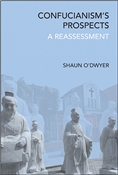
SUNY Press has published Shaun O’Dwyer, Confucianism’s Prospects: A Reassessment. SUNY’s website is here.
The publisher’s blurb: In Confucianism’s Prospects, Shaun O’Dwyer offers a rare critical engagement with English-language scholarship on Confucianism. Against the background of historical and sociological research into the rapid modernization of East Asian societies, O’Dwyer reviews several key Confucian ethical ideas and proposals for East Asian alternatives to liberal democracy that have emerged from this scholarship. He also puts the following question to Confucian scholars: what prospects do those ideas and proposals have in East Asian societies in which liberal democracy and pluralism are well established, and individualization and declining fertility are impacting deeply upon family life? In making his case, O’Dwyer draws upon the neglected work of Japanese philosophers and intellectuals who were witnesses to Japan’s pioneering East Asian modernization and protagonists in the rise and disastrous wartime fall of its own modernized Confucianism. He contests a sometimes Sinocentric and ahistorical conception of East Asian societies as “Confucian societies,” while also recognizing that Confucian traditions can contribute importantly to global philosophical dialogue and to civic and religious life.
