
The excellent journal devoted to pedagogy about Asia (from K-12 through university education), Education About Asia, is now available open-access. Over the years it has had articles about teaching Chinese philosophy, among many other subjects.
Category Archives: Pedagogy
New Cooperation Between CityU and Duke
Duke University’s Center for Comparative Philosophy and the Center for East Asian and Comparative Philosophy (CEACOP) at City University of Hong Kong are happy to announce an exciting new partnership . These two centers will initiate regular student and faculty exchanges, co-sponsor international conferences and workshops, and jointly teach courses, beginning with a new course this spring that can be taken for credit at either campus, Eastern and Western Conceptions of Human Nature, Ethics, and Politics. Additional cooperative programs will follow in the coming years. Read on for information about the new joint course.
The Limits of Academic Philosophy?
I have lately been reading Frank Perkins’s marvelous book Heaven and Earth are Not Humane: The Problem of Evil in Classical Chinese Philosophy (Indiana, 2014). There’s lots of rich and provocative content in the book worth talking about, but at least for right now I want to focus on a different kind of question that Frank raises right at the beginning, on p. 5. Discussing the question of whether Warring States thought is appropriately labelled “philosophy,” he writes that “in practice, [this] is a question about institutions and the power of inclusion and exclusion… Certain boundaries are accepted in practice by almost all academic philosophers.”
New Book: Readings in Later Chinese Philosophy
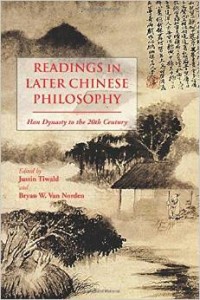 I’m pleased to announce the publication of our reader in post-classical Chinese philosophy.
I’ll put the details below the fold, but it might help to have a quick summary of some the book’s most noteworthy (or at least distinctive) advantages.
- Better selections than Chan’s Sourcebook, including several overlooked gems and works on and by women
- Consistent translations of key terms and oft-quoted passages
- Begone Wade-Giles!
Deparochializing Political Theory “Short Course” at APSA
You are warmly invited to participate in the upcoming short course, ‘Deparochializing Political Theory’, running the day before APSA begins. Details and link below!
To find short course info online: https://www.apsanet.org/mtgs/program_2014/program.cfm?event=1523901
To register: once logged in to myAPSA, click ‘Register for a short course’ in the 2014 APSA Annual Meeting window (SC5)
“Short Course” at APSA on Teaching Chinese and Islamic/Arab Political Thought
This should be of interest both to anyone attending the American Political Science Association meetings this coming fall, and also those of us in other fields who might want to try something similar at our own disciplinary meetings. Does the APA ever have such “short courses”? If you have any questions about the course, please contact Professor Browers.
Deparochializing Political Theory: How to Teach Chinese and Islamic/Arab Political Thought
Wednesday August 27, 1:30-5:30pm
APSA Annual Conference, Washington, DC (exact location TBA)
Michaelle L. Browers, Wake Forest University; Loubna El-Amine, Georgetown University
New Group: Society for Teaching Comparative Philosophy
The new Society for Teaching Comparative Philosophy has a website and is seeking teaching materials (among other things) to share. Check it out!
Add Syllabi to AAS Repository
The APA Committee on Inclusiveness in the Profession is collecting syllabi related to underrepresented areas of our profession. One such area is “Asian and Asian American Philosophy.” Read on to see how you can contribute to making the philosophy profession–or at least our teaching–more diverse.
Bard College Admissions and the Analects
An article in today’s New York Times discusses Bard College’s decsion to allow students to apply to Bard via submission of four 2,500 word essays, in lieu of the standard list of test scores and high school grades. My eye was drawn to the first of the questions listed in the article:
In “The Analects,” Confucius identifies the cardinal virtue of ren (variously translated as goodness, humanity, benevolence) with many different attitudes and behaviors. Yet Confucius also says, “There is one thread that runs through my doctrines.” Commentators differ about what that one thread is. What, in your opinion, could that one thread be? How does that one thread tie together the wide range of moral values that Confucius celebrates in “The Analects”? Support your answer by interpreting specific passages from the text.
This is perhaps less surprising, in light of the fact that Bard for several years used the Analects as a key reading in its First-Year Seminar program, and continues to include readings from classical Chinese thought.
2012 Dao Best Essay Winner
The editorial board of Dao: A Journal of Comparative Philosophy has completed its annual selection of the best essay. The winner of 2012 Dao Annual Best Essay Award is given to
“Instruction Dialogues in the Zhuangzi: An `Anthropological’ Reading” by Carine Defoort (Dao: A Journal of Comparative Philosophy 11:459-478)
Congratulations to Carine!
Below is the official citation:
This essay provides a fresh reading of the ancient Chinese Daoist classic Zhuangzi. While the author claims that it is a non-philosophical reading, it turns out to be a philosophical reading that is most appropriate to the Zhuangzi and perhaps many if not all other ancient Chinese classics. The Zhuangzi authors, just like many other classical Chinese philosophers, were not so much interested, if at all, in theory building as in transformation of the person. Through a focus on the formal characteristics of the dialogues, careful textual analyses, perceptive interpretations, and coherent arguments, Dr. Defoort convincingly shows that the instruction of the Zhuangzi’s masters hint at the importance of non-teaching in various senses; it also focuses on attitudes and skills (knowing how) rather than knowledge (knowing that). The essay thus breaks ground not only in our interpretation of the Zhuangzi but also in our understanding of philosophy per se. It is the type of work that Dao promotes.
