Modern China
Special Issue: The Basis for the Legitimacy of the Chinese Political
System: Whence and Whither? Dialogues among Western and Chinese
Scholars, VII
March 2014; Vol. 40, No. 2
http://mcx.sagepub.com/content/40/2?etoc

Modern China
Special Issue: The Basis for the Legitimacy of the Chinese Political
System: Whence and Whither? Dialogues among Western and Chinese
Scholars, VII
March 2014; Vol. 40, No. 2
http://mcx.sagepub.com/content/40/2?etoc
Perhaps these events are a little distant from Chinese philosophy, but I wish I could attend!
“Conceptions of Democracy on Taiwan and the Chinese Mainland”
Professor David Lorenzo, College of International Affairs, Chengchi National University, Taiwan and author of Concepts of Chinese Democracy (Johns Hopkins University Press, 2013).
Tuesday, February 4, 4:00 – 6:00 p.m.
Eilts Room, Department of International Relations | 154 Bay State Road, 2nd Floor
Boston University Center for the Study of Asia (BUCSA)
China Policy is an impressive commercial website that has been sending me teasers…and the most recent one contains a bit I thought I’d share: a fascinating essay by a contemporary Chinese political theorist critiquing the idea that China ought to pursue a form of “new authoritarianism” that will lead ultimately to democracy. Instead, says Rong Jian, it may well lead to fascism. I think this link will take you to the page with the essay.
As Steve and Manyul announced last month, with each new issue of Dao the blog will host a discussion of one of the issue’s articles, and the journal will make that article freely available online. Here I’m kicking off the series with a discussion of Loy Hui-chieh’s “On the Argument for Jian’ai” (Dao 12.4, available here).
Loy’s article treats the Mohists’ main argument for inclusive care (jiān ài 兼愛), focusing on the role played in it by appeals to virtues such as filial piety that are inevitably partial. Fundamental to his treatment is the view (which I share) that inclusive care did not require absolute impartiality—it did not imply that we have equal obligations to all people, or that we should treat them the same, or feel the same about them. Loy thus undermines one common sort or argument against the Mohists, that inclusive care is incompatible with the partial virtues and is therefore morally dubious. However, this does not mean that the Mohists’ own appeals to the partial virtues succeed, and Loy goes on to argue that they do not. I’ll sketch Loy’s argument, and then make critical comments on two points.
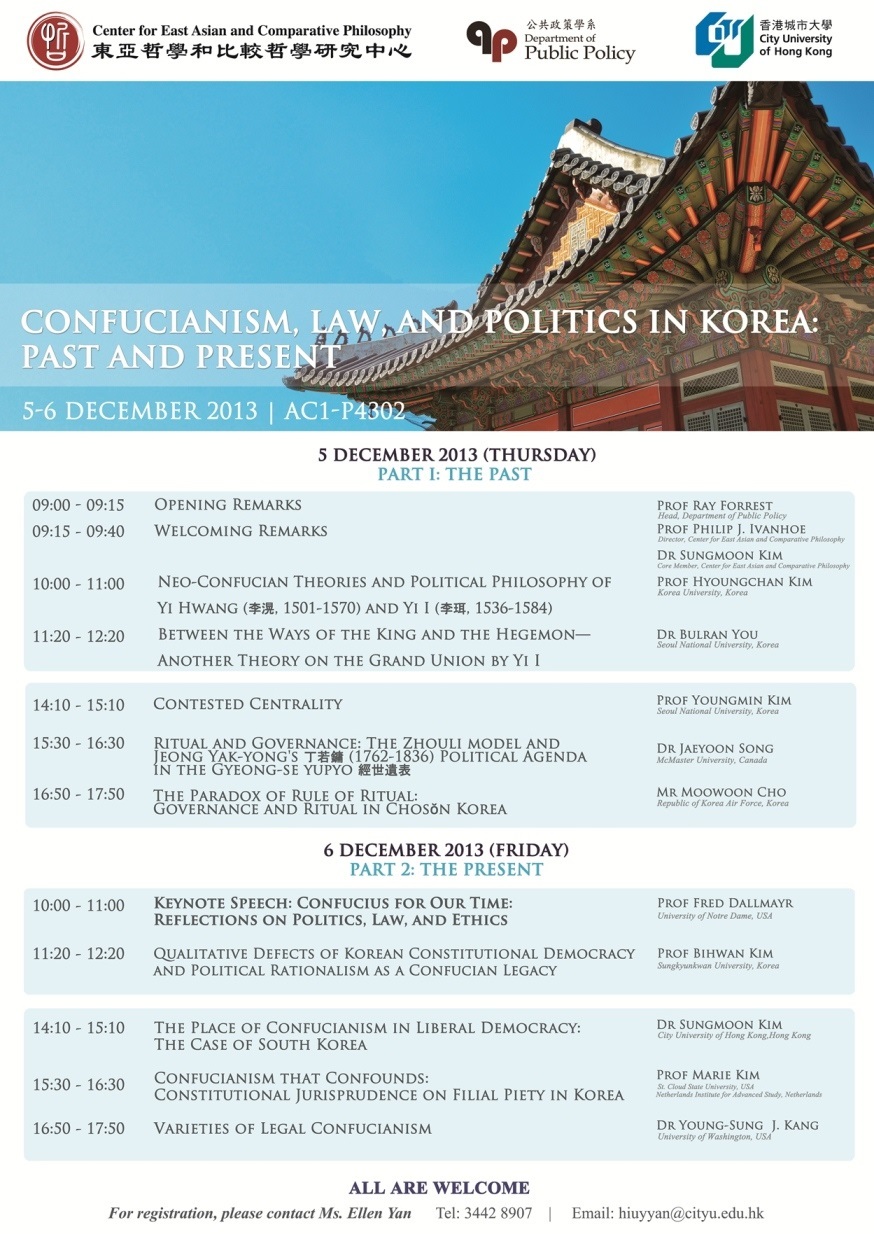
Eirik Harris reports: We’re hosting a conference on “Confucianism, Law, and Politics in Korea: Past and Present” here at CityU that might interest some of the Warp, Weft and Way readers. The Conference poster with list of speakers and topics is here: http://www6.cityu.edu.hk/ceacop/kpcp/conference_poster.jpg
A new book titled The East Asian Challenge for Democracy: Political Meritocracy in Comparative Perspective, coedited by Daniel Bell and Chenyang Li, has just been published by Cambridge University Press. It is an interdisciplinary work with contributions by leading historians, social scientists, and philosophers. It is the first book in decades to examine the rise (or revival) of political meritocracy and what it will mean for political developments in China and the rest of the world. It also reminds us that there are political alternatives to electoral democracy and military dictatorship. Here is the link on amazon, where you’ll see a brief endorsement from me (among other people).
‘Tis the season for reviews of works in Chinese philosophy to be published, apparently! The latest issue of The China Journal has reviews of three recent works in our field, along with much else of interest:
Tze-ki Hon’s review of my latest book, Contemporary Confucian Political Philosophy: Toward Progressive Confucianism (Polity, 2012) has been published “on-line first” in Dao. (If your library subscribes to Dao, you should be able to get to the article, though quite possibly not through the link I just gave.) The review’s final paragraph reads:
While Angle may not be completely faithful to MOU Zongsan, he succeeds in drastically changing the image of New Confucianism. Instead of an abstract philosophy in the ivory tower, he transforms New Confucianism into a political theory for promoting tolerance, diversity, and equality. While it is still early to tell whether New Confucianism will have a strong impact on twenty-first century Chinese politics, it is clear that the three parts of a healthy society that Angle describes—the ethic subjectivity, the rights of the public, and the communicative acts based on rituals—are essential to building a fair and open political system in China. They directly address the new political condition of contemporary China where individuals aggressively demand recognition of their unique personality, inalienable rights, and full participation in the communicative lifeworld.
Many thanks to Tze-ki for his generous and probing review!