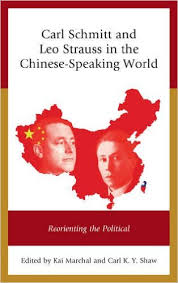
New Book: Carl Schmitt and Leo Strauss in the Chinese-Speaking World

This is to announce that the volume Carl Schmitt and Leo Strauss in the Chinese-Speaking World: Reorienting the Political, edited by Carl K. Y. Shaw (蕭高彥)and me, has just been published by Lexington and is now available on the internet and elsewhere. Here is the link to the publisher’s website, here on Amazon. And here is the description on our cover:

“Reorienting the Political examines the reception of Carl Schmitt and Leo Strauss in the Chinese-speaking world. The legacies of both Schmitt, the German legal theorist and thinker who joined the Nazi party, and Strauss, the German-Jewish classicist and political philosopher who became famous after his emigration to the United States, are highly controversial. Since the 1990s, however, these thinkers have had a powerful resonance for Chinese scholars.

Continue reading →

Central APA Panel on Chinese Philosophy

The APA committee on International Cooperation is sponsoring a panel on “Ancient Chinese and Contemporary Philosophy” at the upcoming Central APA. I imagine there are other Chinese/Comparative panels as well; if anyone could list those in the Comments, that would be great!

This session happens Friday, March 3 from 1:15 to 4:15pm and the speakers and titles of their presentations are:

  • Julianne Chung (University of Louisville) “Why Chinese Philosophy Is Indispensable”
  • Amy Olberding (University of Oklahoma) “Early Chinese Ethics and What Matters Morally”
  • Hagop Sarkissian (Baruch College, CUNY) “Metaethical Relativism and Natural Daos”

CFA: Comparative Humanities Conference in Hyderabad

Department of Comparative Literature and India Studies, English and Foreign Languages University Hyderabad is pleased to organize a Three-day National Conference on:

COMPARATIVE HUMANITIES: RE-CONFIGURING HUMANITIES ACROSS CULTURES

April 5-7, 2017

[Last date for sending in the abstract: 3rd March, 2017]

Continue reading →

JHI Blog Entry on Heidegger and Zhuangzi

Dag Herbjørnsrud has written a fascinating entry at the Journal of the History of Idea blog, which begins as follows…

A remarkable example of how ideas migrate across so-called cultural borders and change minds in unknown ways happened in the German city of Bremen on October 8, 1930. There, Martin Heidegger gave a speech based upon his masterwork Being and Time (1927). Afterwards, he and several of Bremen’s citizens gathered at the home of a wholesaler. During the evening, Heidegger suddenly turned to his host and asked, “Mister Kellner, would you please bring me the Parables of Zhuangzi? I would like to read some passages from it.”

New Book and Website: Angle & Tiwald, Neo-Confucianism

Justin Tiwald and I are very happy to announce the publication of our jointly-authored book, Neo-Confucianism: A Philosophical Introduction (Polity, 2017). Advance copies of the book have begun to appear, it will be generally available in the UK soon, and available in the US in another six weeks or so.

Justin and I have also prepared a website, Neo-Confucianism.Com, to support the book and to promote the study of Neo-Confucianism more generally. That site has its own blog (plus lots of other stuff, including sample syllabi and the Chinese texts corresponding to all the translated material in the book), though I expect that when we post things there, we will also announce it here. If anyone has ideas about what other material we can include at Neo-Confucianism.Com, please just let one of us know!

New Book: Ni translation of the Analects

Peimin Ni’s new translation-and-commentary on the Analects, Understanding the Analects of Confucius: A New Translation of Lunyu with Annotations, is due out soon:  (SUNY, 2017). I have read the book in manuscript, and wrote the following blurb:

Peimin Ni’s translation of the Analects has many virtues that make it stand out as an exemplary version of this most important Chinese text. Ni has chosen to present the text as a living document, embedded in two thousand years of commentarial conversation over its meaning, with today’s readers very much part of that ongoing conversation.

Among other things, Peimin skillfully translates the text so that its potential ambiguity comes through, making sense of commentarial debates in ways that previous translations have not captured. Congratulations!

Wang Hui et al on Contemporary China (Harvard)

Thursday, February 23, 4:00 p.m. to 6:00 p.m.
Liberalism, Globalization, Populism and Nationalism in the World Today
Wang Hui, Professor of literature and history at Tsinghua University
David Armitage, Lloyd C. Blankfein Professor of History, Harvard University
Malika Zeghal, Prince Alwaleed Bin Talal Professor in Contemporary Islamic Thought and Life, Harvard University
Mahdav Khosla, B. R. Ambedkar Academic Fellow, Columbia Law School and Ph.D. candidate in political theory, Harvard University.
James Kloppenberg, Charles Warren Professor of American History, Harvard University
Moderator: Peter Bol, Vice Provost for Advances in Learning and the Charles H. Carswell Professor of East Asian Languages and Civilizations, Harvard University
Sponsored by the Fairbank Center for Chinese Studies, Harvard University
S010, Tsai Auditorium, 1730 Cambridge Street, Cambridge

Lecture on Islamic Thought in China (Harvard)

Wednesday, March 1, 1:00 p.m. to 2:00 p.m.  
Free Thinkers: Islamic Reform and Ahmadi thought in China during the Republican period
Inner Asian and Altaic Studies Lecture Series
Dr. Z. Hale Eroglu Sager, IAAS ’16 – Fairbank Center for Chinese Studies
Sponsored by the Inner Asian and Altaic Studies, Harvard University
S153, CGIS South, 1730 Cambridge Street, Cambridge