Category Archives: Books of Interest

New Book: Lambert, trans., Li Zehou, A History of Classical Chinese Thought

Andrew Lambert’s translation of Li Zehou’s A History of Classical Chinese Thought (中国古代思想史论) has just come out with Routledge. More information is here.

The publisher’s description:

Li Zehou is widely regarded as one of China’s most influential contemporary thinkers. He has produced influential theories of the development of Chinese thought and the place of aesthetics in Chinese ethics and value theory. This book is the first English-language translation of Li Zehou’s work on classical Chinese thought. It includes chapters on the classical Chinese thinkers, including Confucius, Mozi, Laozi, Sunzi, Xunzi and Zhuangzi, and also on later eras and thinkers such as Dong Zhongshu in the Han Dynasty and the Song-Ming Neo-Confucians.

The essays in this book not only discuss these historical figures and their ideas, but also consider their historical significance, and how key themes from these early schools reappeared in and shaped later periods and thinkers. Taken together, they highlight the breadth of Li Zehou’s scholarship and his syncretic approach—his explanations of prominent thinkers and key periods in Chinese intellectual history blend ideas from both the Chinese and Western canons, while also drawing on contemporary thinkers in both traditions. The book also includes an introduction written by the translator that helpfully explains the significance of Li Zehou’s work and its prospects for fostering cross-cultural dialogue with Western philosophy.

A History of Chinese Classical Thought will be of interest to advanced students and scholars interested in Chinese philosophy, comparative philosophy, and Chinese intellectual and social history.
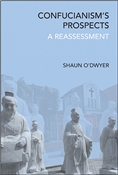
New Book: O’Dwyer, Confucianism’s Prospects


SUNY Press has published Shaun O’Dwyer, Confucianism’s Prospects: A Reassessment. SUNY’s website is here.

The publisher’s blurb: In Confucianism’s Prospects, Shaun O’Dwyer offers a rare critical engagement with English-language scholarship on Confucianism. Against the background of historical and sociological research into the rapid modernization of East Asian societies, O’Dwyer reviews several key Confucian ethical ideas and proposals for East Asian alternatives to liberal democracy that have emerged from this scholarship. He also puts the following question to Confucian scholars: what prospects do those ideas and proposals have in East Asian societies in which liberal democracy and pluralism are well established, and individualization and declining fertility are impacting deeply upon family life? In making his case, O’Dwyer draws upon the neglected work of Japanese philosophers and intellectuals who were witnesses to Japan’s pioneering East Asian modernization and protagonists in the rise and disastrous wartime fall of its own modernized Confucianism. He contests a sometimes Sinocentric and ahistorical conception of East Asian societies as “Confucian societies,” while also recognizing that Confucian traditions can contribute importantly to global philosophical dialogue and to civic and religious life.

New translation of Xinyu 新語

Just a quick announcement that Elisa Levi Sabattini and I are about to publish a new translation of Xinyu:

https://brill.com/view/title/56294?rskey=msXfbz&result=1

Also watch out for my new book on classical Chinese philosophy, forthcoming from Princeton University Press.  Since I’m not ashamed of self-promotion, I’ll be posting with details in due course.

New Books: Behuniak, Experiments in Intra-cultural Philosophy

SUNY has brought out a major work by Jim Behuniak: John Dewey and Daoist Thought: Experiments in Intra-cultural Philosophy, Volume One and John Dewey and Confucian Thought Experiments in Intra-cultural Philosophy, Volume Two.

There is also a significant savings in buying the two volume set; see here. Congratulations, Jim! Summaries follow.

Volume One:

In this timely and original work, Dewey’s late-period “cultural turn” is recovered and “intra-cultural philosophy” proposed as its next logical step—a step beyond what is commonly known as comparative philosophy. The first of two volumes, John Dewey and Daoist Thought argues that early Chinese thought is poised to join forces with Dewey in meeting our most urgent cultural needs: namely, helping us to correct our outdated Greek-medieval assumptions, especially where these result in pre-Darwinian inferences about the world.

Continue reading →

New Book: The Wrong of Rudeness

Oxford University Press has now published Amy Olberding’s The Wrong of Rudeness: Learning Modern Civility from Ancient Chinese Philosophy.

A short description follows. I also recommend that people look at the brief blog entry that introduces some major themes and the remarkable first-person approach of the book to these issues. Anyone familiar with the look-to-oneself-first methodology and tenor of so much Confucian reflection will particularly appreciate this approach, and it makes the book all the more compelling reading as well.

Description:

In a time of fractious politics, being rude can feel wickedly gratifying, while being polite can feel simple-minded or willfully naïve. Do manners and civility even matter now? Is it worthwhile to make the effort to be polite? When rudeness has become routine and commonplace, why bother? When so much of public and social life with others is painful and bitterly acrimonious, why should anyone be polite? Continue reading →

Book: The Global Encyclopedia of Informality


While scouring the web for freebies this morning, I came across something that may be of interest to many readers here: The Global Encyclopedia of Informality, University College London, 2018, in two volumes.

http://oapen.org/search?identifier=642570;keyword=informality


Here’s the table of contents for Volume 1:

Continue reading →

New Book: Handbook on Human Rights in China

Just published: Handbook on Human Rights in China (Edward Elgar Publishing), edited by Sarah Biddulph (Melbourne Law School, University of Melbourne, Australia) and Joshua Rosenzweig (East Asia Research Director, Amnesty International). More info here; Table of Contents below.

Continue reading →

New Book: Zhu Xi

Zhu Xi: Selected Writings has been published. This is the first volume in the new translation series, Oxford Chinese Thought.

This is the first book-length translation to give a comprehensive look at Zhu Xi’s thought and his place in history, literature, philosophy, and religion. It includes Zhu’s writings or lessons on a wide variety of topics, including his ethics, metaphysics, political thought, views on ghosts and spirits, objections to Daoism and Buddhism, selected commentaries, and his thoughts on literature, poetry, and current social conditions. The volume is edited by Philip J. Ivanhoe with contributions from experts in various areas and aspects of Zhu Xi’s writings.

The book has been released directly into paperback and there is a companion website that includes the Chinese text for all translated materials, both of which we hope will appeal to instructors looking to adopt the volume for their courses. The paperback edition is quite affordable, and the easy reference to the Chinese text gives language instructors a way to teach Song dynasty Chinese as applied to a variety of topics and genres.

The table of contents is below the fold.

Continue reading →