
On 15 October, Peter D. Hershock will deliver a talk on Buddhism and AI. The public talk will be followed by a roundtable discussion extending the conversation beyond Buddhism.
Category Archives: Chinese philosophy – 中國哲學 – 中国哲学
Philosophy Podcast: Beyond Democracy, Toward Meritocracy (OUP, 2026)
The Ethical Frontier is a podcast hosted by Jason Chen, where he primarily interviews philosophers on ethics. Notable past guests include Julian Savalescu, Walter Sinnott-Armstrong, Roger Crisp, and Jess Flanigan.
Today’s podcast is with John J. Park, associate professor of philosophy at California State University-Sacramento, on his new book Beyond Democracy, Toward Meritocracy (Oxford University Press, 2026).
Listen to the podcast: https://youtu.be/3e2IF6iXXrQ
CFP: 2027 APA Pacific Meeting
The ISCWP (International Society for Comparative Studies of Chinese and Western Philosophy) plans to host one or two group panels for the 2027 APA Pacific Meeting, which will be held March 24-27, in Portland.
ToC: Asian Studies 14:3
The latest issue of Asian Studies has been published. Please see here and below for the Table of Contents.
ToC: JCPC Volume 46
Vol. 46 of the Journal of Confucian Philosophy and Culture (JCPC) has been recently published. Please see here and below for the Table of Contents.
CFP: 2027 EACP Conference
The European Association for Chinese Philosophy (EACP) announces its 2027 conference in Poznan, Poland (July 1-4, 2027):
CFP: ISCP at APA-Pacific, March 2027
The International Society for Chinese Philosophy invites submissions to be considered for inclusion in panels at the upcoming APA Pacific Division Meeting, March 24–27, 2027, to be held in Portland, Oregon. Submissions focusing on any area of Chinese philosophy will be considered. Both individual papers and completed panel proposals are welcomed.
New Book: Explaining and Illustrating the Laozi (the Han Feizi Commentary)
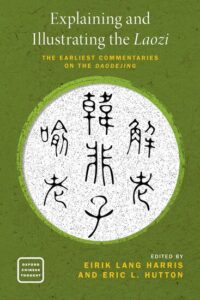 Although the ancient Chinese text Laozi–also known as the Daodejing–is highly popular worldwide, few Anglophone readers are familiar with the history of how the Chinese themselves have interpreted it. This volume aims to introduce students and general readers to the two earliest surviving commentaries on the Laozi, through translations that are approachable for non-specialists and can be read on their own. These two commentaries, the “Jie Lao” (Explaining the Laozi) and “Yu Lao” (Illustrating the Laozi), appear as two chapters in the book Han Feizi, traditionally dated to the 3rd century BCE. They are interesting not only for showing how at least one very early reader understood the Laozi, but also for what they may reveal about the state of the Laozi itself at that time, before it achieved the form of the text that is so famous nowadays. The book also includes original essays that explore the commentaries’ relation to the rest of the Han Feizi, compare and contrast them with other Laozi commentaries, and analyze their place in the larger history of Chinese commentarial writing. The table of contents is below the fold.
Ivanhoe Reviews Tsui, Affective Betrayal
P.J. Ivanhoe has published a review of Jean Tsui’s book, Affective Betrayal: Mind, Music, and Embodied Action in Late Qing China (SUNY, 2024). The review opens:
This book displays vast erudition, moves nimbly across a number of disciplines, and presents complex, interlocking arguments aimed at showing how Liang Qichao (1873-1929) presented modern political knowledge in musical and visual terms that were designed to stimulate his readers’ bodily senses and motivate them to become committed to and act on behalf of the views he advocated.
Two Articles on Wang Yangming
I am pleased to share that the following two articles have recently been published:
Stephen C. Angle (2026). “A Halfhearted Defense of the Perceptual Model of Wang Yangming’s ‘Genuine Knowing’.” Ergo: an Open Access Journal of Philosophy 13: 43. https://doi.org/10.3998/ergo.11001
Stephen C. Angle and Chi-keung Chan (2026). “Affective Knowing in Wang Yangming.” European Journal of Philosophy. Early View. https://doi.org/10.1111/ejop.70122
